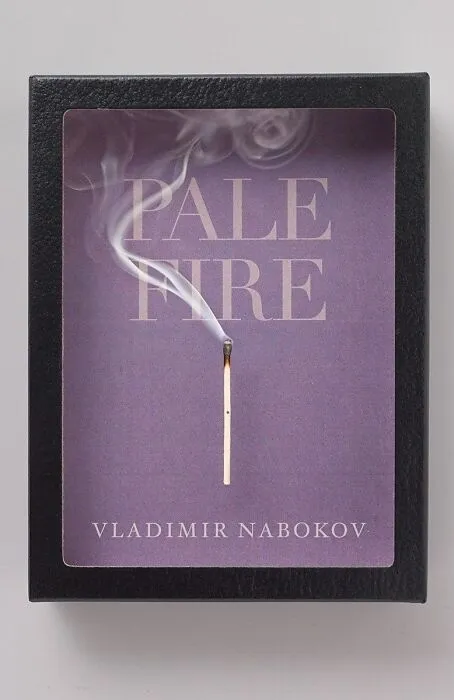
Pale Fire
Beschreibung
Zusatztext "This centaur work! half-poem! half-prose . . . is a creation of perfect beauty! symmetry! strangeness! originality and moral truth. Pretending to be a curio! it cannot disguise the fact that it is one of the great works of art of this century." --M...Format auswählen
- Kartonierter EinbandCHF 19.50
Wird oft zusammen gekauft
Andere Kunden kauften auch
Beschreibung
Zusatztext "This centaur work! half-poem! half-prose . . . is a creation of perfect beauty! symmetry! strangeness! originality and moral truth. Pretending to be a curio! it cannot disguise the fact that it is one of the great works of art of this century." --Mary McCarthy Informationen zum Autor Vladimir Nabokov Klappentext In Pale Fire Nabokov offers a cornucopia of deceptive pleasures: a 999-line poem by the reclusive genius John Shade; an adoring foreword and commentary by Shade's self-styled Boswell, Dr. Charles Kinbote; a darkly comic novel of suspense, literary idolatry and one-upmanship, and political intrigue.INTRODUCUTION by Richard Rorty [WARNING: this Introduction not only gives away the plot of Pale Fire , but presumes to describe the reader's reactions in the course of a first reading of the book reactions which will not occur if the Introduction is read first. The first-time reader may wish to postpone the Introduction until he or she has finished the Index.] The imagination, Wallace Stevens said, is the mind pressing back against reality. But it is in the interest of reality that is to say, of the imagination of the dead to insist that no further pressure is needed: that the imagination of the living can do nothing save reiterate lessons previously learned, instantiate previously known truths. Judicious reviewers must presuppose that nothing genuinely new can be written, for only on that assumption are they in a position to judge, and in no danger of being judged by, the book they are reviewing. Like the judicious reviewer, the common reader is made nervous by books that are insufficiently like the books he or she has read in the past. Vladimir Nabokov (18991977) wrote books which were not much like anybody else's, and they rarely got good reviews. Most reviewers echoed Dr Johnson's dictum that nothing odd can last, and proceeded to diagnose Nabokov's oddities as signs of his egoistical disdain for reality, a disdain which cloaked his inability to imitate reality convincingly. Simon Raven, reviewing Pale Fire on its publication in 1962, said that it was 'not a novel, but a blueprint'. Saul Maloff's review explained that 'the novelist's immemorial purpose and justification' was 'to create a world', and that Nabokov had created only 'a constellation of elegant and marvelous bibelots , an art which is minor by definition'. Reviewer after reviewer conceded Nabokov's skill while deploring his self-indulgence, his delight in his own tricks tricks which made clear his lack of respect for both reality and the common reader. Dwight Macdonald called Pale Fire 'unreadable', emphasized that Nabokov, even at his best, was 'minor', and urged that 'the technical exertions he [Nabokov] expends on the project are so obtrusive as to destroy any aesthetic pleasure on the reader's part'. Perturbed by the fact that Mary McCarthy had called Pale Fire 'a creation of perfect beauty, symmetry, strangeness, originality and moral truth', Macdonald explained that both the novel and McCarthy's review were 'exercises in misplaced ingenuity'. Nabokov had no interest whatever in creating a world like the one to which Raven, Maloff and Macdonald were accustomed. 'We speak,' he once said, 'of one thing being like another thing, when what we are really craving to do is to describe something that is like nothing on earth.' It was just that craving which annoyed so many of the reviewers. To those who wish reality to be given the respect it takes as its due, such a craving is a sign of egotistic self-indulgence. 'Egotism' is reality's name for whatever calls attention to itself whatever is odd, hard to understand, hard to follow. Those who respect reality, who are sure that it needs no further pressure, insist that what is worthwhile is already a part of reality, and merely needs to be accurately represented. Wha...
"This centaur work, half-poem, half-prose . . . is a creation of perfect beauty, symmetry, strangeness, originality and moral truth. Pretending to be a curio, it cannot disguise the fact that it is one of the great works of art of this century." --Mary McCarthy
Autorentext
Vladimir Nabokov
Klappentext
In Pale Fire Nabokov offers a cornucopia of deceptive pleasures: a 999-line poem by the reclusive genius John Shade; an adoring foreword and commentary by Shade's self-styled Boswell, Dr. Charles Kinbote; a darkly comic novel of suspense, literary idolatry and one-upmanship, and political intrigue.
Zusammenfassung
**A darkly comic novel of suspense, literary idolatry and one-upmanship, and political intrigue from one of the leading writers of the twentieth century, the acclaimed author of Lolita.
"Half-poem, half-prose...a creation of perfect beauty, symmetry, strangeness, originality and moral truth. One of the great works of art of this century." —Mary McCarthy, New York Times bestselling author of The Group**
An ingeniously constructed parody of detective fiction and learned commentary, Pale Fire offers a cornucopia of deceptive pleasures, at the center of which is a 999-line poem written by the literary genius John Shade just before his death. Surrounding the poem is a foreword and commentary by the demented scholar Charles Kinbote, who interweaves adoring literary analysis with the fantastical tale of an assassin from the land of Zembla in pursuit of a deposed king. Brilliantly constructed and wildly inventive, Vladimir Nabokov's witty novel achieves that rarest of things in literature—perfect tragicomic balance.
Leseprobe
INTRODUCUTION by Richard Rorty
[WARNING: this Introduction not only gives away the plot of Pale Fire, but presumes to describe the reader’s reactions in the course of a first reading of the book – reactions which will not occur if the Introduction is read first. The first-time reader may wish to postpone the Introduction until he or she has finished the Index.]
The imagination, Wallace Stevens said, is the mind pressing back against reality. But it is in the interest of reality – that is to say, of the imagination of the dead – to insist that no further pressure is needed: that the imagination of the living can do nothing save reiterate lessons previously learned, instantiate previously known truths. Judicious reviewers must presuppose that nothing genuinely new can be written, for only on that assumption are they in a position to judge, and in no danger of being judged by, the book they are reviewing. Like the judicious reviewer, the common reader is made nervous by books that are insufficiently like the books he or she has read in the past.
Vladimir Nabokov (1899–1977) wrote books which were not much like anybody else’s, and they rarely got good reviews. Most reviewers echoed Dr Johnson’s dictum that nothing odd can last, and proceeded to diagnose Nabokov’s oddities as signs of his egoistical disdain for reality, a disdain which cloaked his inability to imitate reality convincingly. Simon Raven, reviewing Pale Fire on its publication in 1962, said that it was ‘not a novel, but a blueprint’. Saul Maloff’s review explained that ‘the novelist’s immemorial purpose and justification’ was ‘to create a world’, and that Nabokov had created only ‘a constellation of elegant and marvelous bibelots, an art which is minor by definition’. Reviewer after reviewer conceded Nabokov’s skill while deploring his self-indulgence, his delight in his own tricks – tricks which made clear his lack of respect for both reality and the common reader. Dwight Macdonald called Pale Fire ‘unreadable’, emphasized that Nabokov, even at his best, was ‘minor’, and urged that ‘the technical exertions he [Nabokov] expends on the project are so obtrusi…