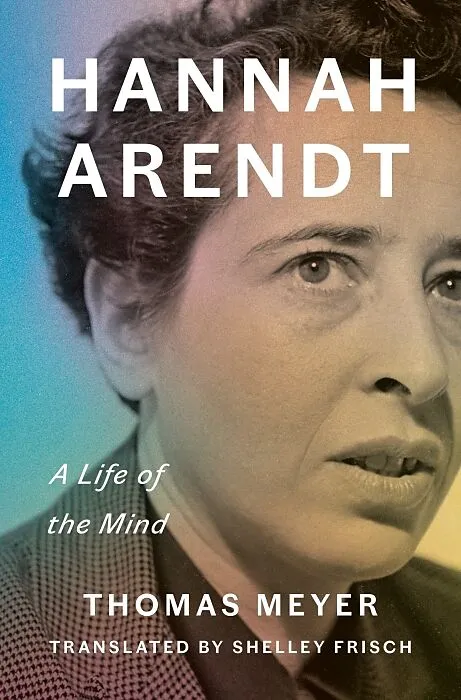

Hannah Arendt
Beschreibung
A revelatory, long-awaited, and definitive intellectual biography of Hannah Arendt, one of the greatest philosophers of the twentieth century Drawing on newly discovered archival materials and previously overlooked documents--from both Germany where Arendt was...Format auswählen
- Fester EinbandCHF 37.20
Wird oft zusammen gekauft
Andere Kunden kauften auch
Beschreibung
A revelatory, long-awaited, and definitive intellectual biography of Hannah Arendt, one of the greatest philosophers of the twentieth century Drawing on newly discovered archival materials and previously overlooked documents--from both Germany where Arendt was born to a Jewish family in 1906, to the United States where she was a citizen from 1950--Thomas Meyer tells the story of;an intellectual icon whose character and ideas continue to captivate and challenge us to this day. Tracing anew Arendt’s journey from Königsberg to Paris, where she fled to after being imprisoned by the Gestapo in 1933, and finally to New York, Meyer illuminates her formative years and the development of her radical and brilliant books, as well as her long love affair with Martin Heidegger, whose Nazism posed a deadly threat to Arendt’s life and family. His account centers on two pivotal phases--Arendt’s years in Paris after fleeing Nazi Germany and her years in the U.S. leading up to the landmark publication of At a time of acute political polarization, with liberalism in crisis and urgent debates about freedom, responsibility, and truth unfolding all around, Arendt’s writings and ideas echo more powerfully than ever. Meyer’s account of her extraordinary life is groundbreaking and sensational, not just for his illuminating and peerless research, but his incisive account of Arendt’s work has meant over the decades--and continues to mean for us today.
Autorentext
Thomas Meyer, born 1966 in Bernkastel-Kues, specializes in modern German philosophy and the history of ideas. He earned his doctorate in 2003 and completed his habilitation in 2009. Meyer is currently a professor of philosophy at Ludwig Maximilian University of Munich. He has held teaching positions at the universities of Chicago, Vanderbilt, Wake Forest, Zurich, and Graz. His writing has appeared in leading publications such as Die Zeit, Süddeutsche Zeitung, and Jüdische Allgemeine. He has published extensively on Ernst Cassirer, as well as on Jewish philosophy and theology. His 2006 biography of Cassirer was nominated for the Leipzig Book Fair Prize. His most recent works include Über Palästina, which he edited. He is the editor of the twelve volumes studienausgabe (2020–2025) of Arendt’s German writings.
Shelley Frisch’s translations from German, which include biographies of Friedrich Nietzsche, Albert Einstein, Leonardo da Vinci, Franz Kafka, and a dual biography of Marlene Dietrich and Leni Riefenstahl, along with many other works of fiction and nonfiction, have been awarded numerous translation prizes. Frisch has chaired the Helen & Kurt Wolff Translator’s Prize jury since 2015. She lives in Princeton, New Jersey.
Klappentext
The definitive, long-awaited, and revelatory intellectual biography of Hannah Arendt, one of the greatest philosophers of the twentieth century
Drawing on newly discovered archival materials and previously overlooked documents—from both Germany, where Hannah Arendt was born to a Jewish family in 1906, and the United States, where she was a citizen from 1950—Thomas Meyer tells the story of an intellectual icon whose character and ideas continue to captivate and challenge us to this day. Tracing anew Arendt’s journey from Königsberg to Paris, where she fled after being imprisoned in 1933, and finally to New York in 1941, Meyer illuminates her formative years and the development of her radical and brilliant books, as well as her lifelong philosophical debate with Martin Heidegger, whose Nazism was a permanent challenge for her. Meyer’s account centers on two pivotal phases—Arendt’s years in Paris after fleeing Nazi Germany and her time in the United States leading up to the landmark publication of The Origins of Totalitarianism in 1951—providing not only a meticulous reconstruction of her life but also a compelling invitation to rethink her legacy for our times.
At a time of acute political polarization, with liberalism in crisis and urgent debates about freedom, responsibility, and truth unfolding all around, Arendt’s writings and ideas resonate more powerfully than ever. Meyer’s account of her extraordinary life is groundbreaking and sensational, not just for his illuminating and peerless research, but also for his incisive exploration of what Arendt’s work has meant over the decades—and continues to mean for us today.