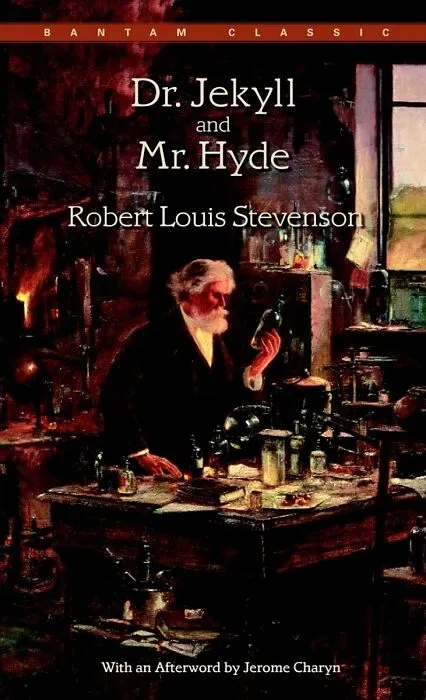
Dr. Jekyll and Mr. Hyde
Beschreibung
Informationen zum Autor Robert Louis Stevenson with an Afterword by Jerome Charyn Klappentext Robert Louis Stevenson originally wrote Dr. Jekyll And Mr Hyde as a "chilling shocker." He then burned the draft and, upon his wife's advice, rewrote it as the darkly...Format auswählen
- TaschenbuchCHF 8.90

Wird oft zusammen gekauft
Andere Kunden kauften auch
Beschreibung
Informationen zum Autor Robert Louis Stevenson with an Afterword by Jerome Charyn Klappentext Robert Louis Stevenson originally wrote Dr. Jekyll And Mr Hyde as a "chilling shocker." He then burned the draft and, upon his wife's advice, rewrote it as the darkly complex tale it is today. Stark, skillfully woven, this fascinating novel explores the curious turnings of human character through the strange case of Dr. Jekyll, a kindly scientist who by night takes on his stunted evil self, Mr. Hyde. Anticipating modern psychology, Jekyll And Hyde is a brilliantly original study of man's dual natureas well as an immortal tale of suspense and terror. Published in 1866, Jekyll And Hyde was an instant success and brought Stevenson his first taste of fame. Though sometimes dismissed as a mere mystery story, the book has evoked much literary admirations. Vladimir Nabokov likened it to Madame Bovary and Dead Souls as "a fable that lies nearer to poetry than to ordinary prose fiction." Leseprobe Story of the Door MR. UTTERSON the lawyer was a man of a rugged countenance that was never lighted by a smile; cold, scanty and embarrassed in discourse; backward in sentiment; lean, long, dusty, dreary and yet somehow lovable. At friendly meetings, and when the wine was to his taste, something eminently human beaconed from his eye; something indeed which never found its way into his talk, but which spoke not only in these silent symbols of the after-dinner face, but more often and loudly in the acts of his life. He was austere with himself; drank gin when he was alone, to mortify a taste for vintages; and though he enjoyed the theater, had not crossed the doors of one for twenty years. But he had an approved tolerance for others; sometimes wondering, almost with envy, at the high pressure of spirits involved in their misdeeds; and in any extremity inclined to help rather than to reprove. "I incline to Cain's heresy," he used to say quaintly: "I let my brother go to the devil in his own way." In this character, it was frequently his fortune to be the last reputable acquaintance and the last good influence in the lives of downgoing men. And to such as these, so long as they came about his chambers, he never marked a shade of change in his demeanour. No doubt the feat was easy to Mr. Utterson; for he was undemonstrative at the best, and even his friendship seemed to be founded in a similar catholicity of good-nature. It is the mark of a modest man to accept his friendly circle ready-made from the hands of opportunity; and that was the lawyer's way. His friends were those of his own blood or those whom he had known the longest; his affections, like ivy, were the growth of time, they implied no aptness in the object. Hence, no doubt, the bond that united him to Mr. Richard Enfield, his distant kinsman, the well-known man about town. It was a nut to crack for many, what these two could see in each other, or what subject they could find in common. It was reported by those who encountered them in their Sunday walks, that they said nothing, looked singularly dull, and would hail with obvious relief the appearance of a friend. For all that, the two men put the greatest store by these excursions, counted them the chief jewel of each week, and not only set aside occasions of pleasure, but even resisted the calls of business, that they might enjoy them uninterrupted. It chanced on one of these rambles that their way led them down a by-street in a busy quarter of London. The street was small and what is called quiet, but it drove a thriving trade on the weekdays. The inhabitants were all doing well, it seemed, and all emulously hoping to do better still, and laying out the surplus of their grains in coquetry; so that the shop fronts stood along that thoroughfare with an air of invitation, like rows of smiling saleswomen. Even on Sunday, when it veiled its more florid charms and lay comparati...
Autorentext
Throughout his life, Robert Louis Balfour Stevenson was tormented by poor health. Yet despite frequent physical collapses–mainly due to constant respiratory illness–he was an indefatigable writer of novels, poems, essays, letters, travel books, and children’s books. He was born on November 13, 1850, in Edinburgh, of a prosperous family of lighthouse engineers. Though he was expected to enter the family profession, he studied instead for the Scottish bar. By the time he was called to the bar, however, he had already begun writing seriously, and he never actually practiced law. In 1880, against his family’s wishes, he married an American divorcée, Fanny Vandegrift Osbourne, who was ten years his senior; but the family was soon reconciled to the match, and the marriage proved a happy one.
All his life Stevenson traveled–often in a desperate quest for health. He and Fanny, having married in California and spent their honeymoon by an abandoned silver mine, traveled back to Scotland, then to Switzerland, to the South of France, to the American Adirondacks, and finally to the south of France, to the South Seas. As a novelist he was intrigued with the genius of place: **Treasure Island **(1883) began as a map to amuse a boy. Indeed, all his works reveal a profound sense of landscape and atmosphere: Kidnapped (1886); The Strange Case of Dr. Jekyll and Mr. Hyde (1886); The Master of Ballantrae (1889).
In 1889 Stevenson’s deteriorating health exiled him to the tropics, and he settled in Samoa, where he was given patriarchal status by the natives. His health improved, yet he remained homesick for Scotland, and it was to the “cold old huddle of grey hills” of the Lowlands that he returned in his last, unfinished masterpiece, Weir of Hermiston (1896).
Stevenson dies suddenly on December 3, 1894, not of the long-feared tuberculosis, but of a cerebral hemorrhage. The kindly author of Jekyll and Hyde went down to the cellar to fetch a bottle of his favorite burgundy, uncorked it in the kitchen, abruptly cried out to his wife, “What’s the matter with me, what is this strangeness, has my face changed?”–and fell to the floor. The brilliant storyteller and master of transformations had been struck down at forty-four, at the height of his creative powers.
Klappentext
Robert Louis Stevenson originally wrote Dr. Jekyll And Mr Hyde as a "chilling shocker." He then burned the draft and, upon his wife's advice, rewrote it as the darkly complex tale it is today. Stark, skillfully woven, this fascinating novel explores the curious turnings of human character through the strange case of Dr. Jekyll, a kindly scientist who by night takes on his stunted evil self, Mr. Hyde. Anticipating modern psychology, Jekyll And Hyde is a brilliantly original study of man's dual nature—as well as an immortal tale of suspense and terror. Published in 1866, Jekyll And Hyde was an instant success and brought Stevenson his first taste of fame. Though sometimes dismissed as a mere mystery story, the book has evoked much literary admirations. Vladimir Nabokov likened it to Madame Bovary and Dead Souls as "a fable that lies nearer to poetry than to ordinary prose fiction."
Zusammenfassung
Robert Louis Stevenson originally wrote Dr. Jekyll And Mr Hyde as a "chilling shocker." He then burned the draft and, upon his wife's advice, rewrote it as the darkly complex tale it is today. Stark, skillfully woven, this fascinating novel explores the curious turnings of human character through the strange case of Dr. Jekyll, a kindly scientist who by night takes on his stunted evil self, Mr. Hyde. Anticipating modern psychology, Jekyll And Hyde is a brilliantly original study of man's dual nature—as well as an immortal tale of suspense and terror. Published in 1866, Jekyll And Hyde was an instant success and brought Stevenson his first taste of fame. Though sometimes dismissed…