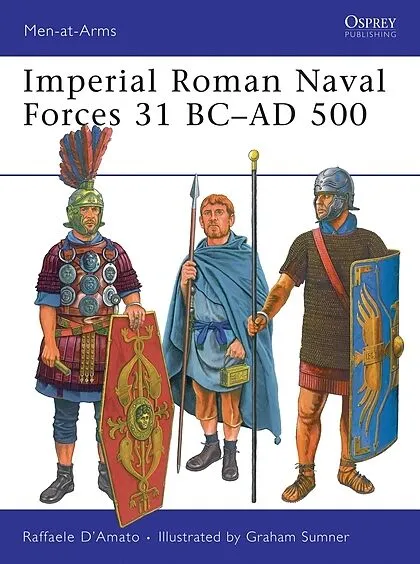
Imperial Roman Naval Forces 31 BCAD 500
Beschreibung
Informationen zum Autor Raffaele D'Amato, PhD , is the author of some 40 books and has written numerous articles on the Roman Empire, Byzantium, medieval Europe and the military of Ancient Greece. He has taught at the University of Ferrara, and was a visiting ...Format auswählen
- Kartonierter EinbandCHF 17.95

Wird oft zusammen gekauft
Andere Kunden kauften auch
Beschreibung
Informationen zum Autor Raffaele D'Amato, PhD , is the author of some 40 books and has written numerous articles on the Roman Empire, Byzantium, medieval Europe and the military of Ancient Greece. He has taught at the University of Ferrara, and was a visiting professor at Fatih University, Istanbul. He currently lives in England, working as an archaeological consultant and lawyer for Timeline Auctions Ltd of Harwich, and also as an external researcher for the Laboratory of the Danubian Provinces at the University of Ferrara. Klappentext The Roman Navy, although somewhat overshadowed by the legions, played an important role for the Roman Empire. For the Army to conquer and rule its vast territories, control of the sea lanes was essential. The navy fleets needed to be structured and powerful in order to dominate the trade routes, transport legions and defend and attack against pirates and other enemies. Under Augustus in 31BC, the navy consisted of 800 warships with many being sent to Ravenna and Misenus in Italy, and smaller squadrons to the external coasts and to the major rivers to support land operations. This book provides a detailed re-evaluation of the vital contribution made by the Roman navy to Roman imperial power, covering the organisation of the fleets and the everyday life of the soldiers. Previously unpublished research is complemented by superb colour reconstructions of the uniforms and equipment, making this a central resource on a neglected piece of ancient history. An illustrated account of the organisation, uniforms, fighting methods and equipment of the warship crews of Imperial Rome, from Augustus to Justinian. Zusammenfassung Offers a re-evaluation of the vital contribution made by the Roman navy to Roman imperial power, covering the organisation of the fleets and the everyday life of the soldiers. Inhaltsverzeichnis Introduction Glossary Chronology of the Roman milites classiarii - 'soldiers of the fleet' The fleets: organization - the Mediterranean fleets - the provincial and river squadrons Command and officers - crews: milites - remiges - nautae Fighting at sea Everyday life - weapons and armour - clothing and equipment The ships: construction - rigging - sterring - armament - decoration ...
Vorwort
An illustrated account of the organisation, uniforms, fighting methods and equipment of the warship crews of Imperial Rome, from Augustus to Justinian.
Autorentext
Raffaele D'Amato, PhD, is the author of some 40 books and has written numerous articles on the Roman Empire, Byzantium, medieval Europe and the military of Ancient Greece. He has taught at the University of Ferrara, and was a visiting professor at Fatih University, Istanbul. He currently lives in England, working as an archaeological consultant and lawyer for Timeline Auctions Ltd of Harwich, and also as an external researcher for the Laboratory of the Danubian Provinces at the University of Ferrara.
Graham Sumner was born in 1958. He studied illustration at Wrexham Art School and has specialised in archaeological reconstruction drawings. Graham has been involved with the Ermine Street Guard for nearly 20 years. He has written a number of articles for 'Military Illustrated' magazine and was the author of the popular 'Roman Army: Wars of the Empire' in Brasseys' 'History of Uniform' series. He lives in Flintshire, UK.
Klappentext
The Roman navy, although somewhat overshadowed by the Legions, played an important role for the Roman Empire. For the army to conquer and rule its vast territories, control of the sea lanes was essential. The navy fleets needed to be structured and powerful in order to dominate the trade routes, transport Legions and defend and attack against pirates and other enemies. Under Augustus in 31BC, the navy consisted of 800 warships with many being sent to Ravenna and Misenus in Italy, and smaller squadrons to the external coasts (e.g. Gaul, Spain, Britain) and to the major rivers, to support land operations (e.g. Rhine, Danube, Seine and others). When Roman coasts came under attack from Teutonic raiders in the 3rd and 4th centuries, the navy played a key part in the defense of the empire. This book provides a detailed re-evaluation of the vital contribution made by the Roman navy to imperial power, covering the organization of the fleets and the everyday life of the soldiers. Previously unpublished research is complemented by superb color reconstructions of the uniforms and equipment, making this a central resource on a neglected piece of ancient history.
Zusammenfassung
Offers a re-evaluation of the vital contribution made by the Roman navy to Roman imperial power, covering the organisation of the fleets and the everyday life of the soldiers.
Inhalt
Introduction
Glossary
Chronology of the Roman milites classiarii - 'soldiers of the fleet'
The fleets: organization - the Mediterranean fleets - the provincial and river squadrons
Command and officers - crews: milites - remiges - nautae
Fighting at sea
Everyday life - weapons and armour - clothing and equipment
The ships: construction - rigging - sterring - armament - decoration