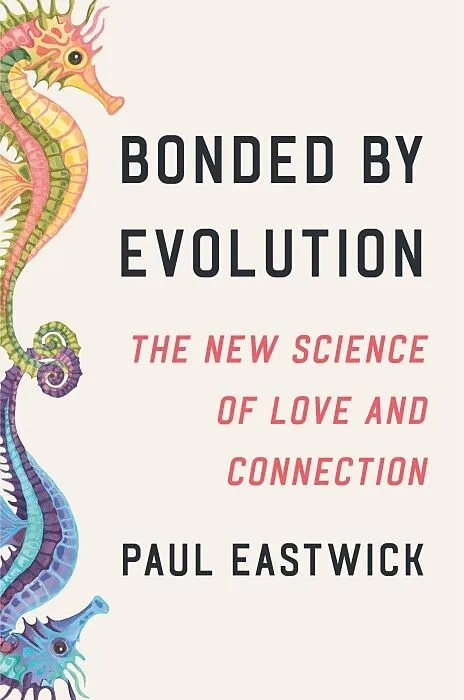
Bonded by Evolution
Beschreibung
A groundbreaking look at the science of attraction and compatibility, challenging our most fundamental assumptions about how human mating evolved--to demonstrate the real keys to romantic attachment. Over the past few decades, a buzzy new branch of science has...Format auswählen
- Fester EinbandCHF 35.90
Wird oft zusammen gekauft
Andere Kunden kauften auch
Beschreibung
A groundbreaking look at the science of attraction and compatibility, challenging our most fundamental assumptions about how human mating evolved--to demonstrate the real keys to romantic attachment. Over the past few decades, a buzzy new branch of science has spread a deeply flawed story about romantic relationships. Cloaking itself in the language of incontrovertible Darwinian fact, evolutionary psychology claims that our minds have been shaped by primal drives that pit the genders against each other, from the myth that men are wired to be promiscuous to the notion that wealth, status, and beauty are the ultimate aphrodisiacs.;; Drawing on pathbreaking research--including original experiments from his own lab--UC Davis psychology professor Paul Eastwick reveals that these stories bear little resemblance to how pair-bonding really works. While beauty and charisma factor into first impressions, their influence fades fast--after a few months, we barely agree on who''s "desirable." From ancestral times through the present, Eastwick shows, lasting attraction has been built through gradual, often mundane moments that forge strong attachment bonds. Ultimately, he offers a liberating new paradigm for finding meaningful, exciting relationships, showing readers: By excavating the hidden history of human mating, Eastwick paints a radical new picture of the roots of enduring chemistry. Distilling evolutionary biology, anthropology, and psychology into accessible insights, <Bonded by Evolution< explains why we so often choose dating strategies that make us miserable and how to use a more; evolved approach....
Autorentext
Paul Eastwick is a Professor of Psychology at UC Davis, where he serves as the head of the Social-Personality Psychology program and the director of the Attraction and Relationships Research Laboratory. Thousands of undergraduate students have taken his course on attraction and close relationships, and he has published over one hundred scientific articles and chapters and won numerous early career awards. His research and writing has been featured in outlets like The New York Times, The Atlantic, NPR, and Scientific American Mind. He hosts the popular podcast Love Factually with his longtime colleague, Eli Finkel, where they analyze rom-coms and romantic dramas from the perspective of relationship science. He earned his bachelor’s degree at Cornell University and his PhD at Northwestern University.
Klappentext
A groundbreaking look at the science of attachment and compatibility, challenging our most fundamental assumptions about love and attraction and revealing the real keys to lasting connection and deeper relationships.
“Riveting insights . . . on the idiosyncratic, contingent ways real relationships develop.”—Science
Modern media and culture have taught you a vast array of inaccurate ideas about dating and relationships. Scroll through Instagram and Tiktok, and you’ll inevitably see the influence of a buzzy new branch of science—evolutionary psychology—at play in videos, touting gender stereotypes and spreading a deeply flawed story about romance and connection. Evolutionary psychology claims that our minds have been shaped by primal drives that pit the genders against each other, from the myth that men are wired to be promiscuous to the notion that wealth, status, and beauty are the ultimate aphrodisiacs.
In Bonded by Evolution UC Davis psychology professor Paul Eastwick reveals that these stories bear little resemblance to how pair-bonding really works. While beauty and charisma factor into first impressions, their influence fades fast—after a few months, we barely agree on who's “desirable.” Drawing on pathbreaking research—including original experiments from his own lab—Eastwick explains that lasting attraction has, from ancestral times through the present, been built through gradual, often mundane moments that forge strong attachment bonds. Ultimately, he offers a liberating new paradigm for finding meaningful, exciting relationships, showing us:
- Why the traits we often look for in a partner—personality, lifestyle, values, and humor—are poor predictors of compatibility, and what behaviors and experiences we should focus on instead
- Why someone's tendency to “date around” or their reputation as a player has little bearing on their long-term relationship potential
- Why the most secure relationships offer a "safe haven" and "secure base" for each partner, and how to cultivate them in new and existing relationships
By excavating the hidden history of human mating, Eastwick paints a radical new picture of the roots of enduring chemistry. Distilling evolutionary biology, anthropology, and psychology into accessible insights, Bonded by Evolution explains why we so often choose dating strategies that make us miserable and how to use a more evolved approach.
Leseprobe
**• 1 •**
Measuring Desirability
Here is a story about how I learned my place.
It is 1999, and I’m at Cornell University in upstate New York. The school is big enough to foster considerable anonymity, and the dazzling cold makes it easy to disappear under the requisite winter hat, scarf, and parka. On one such freezing morning in early November, a woman approaches me in the middle of the sidewalk. This is not a common occurrence. Did I drop something? Will I be asked to make a donation? Surely she has mistaken me for someone else? She exudes a social confidence that feels like a foreign language.
I quickly discover that she knows who I am; we went to the same high school. After fumbling awkwardly through the first few minutes of conversation, it finally occurs to me to blurt out that I have a car, since the easiest way to travel back to our hometown outside of Boston is a six-hour car trip. We exchange email addresses.
Anna is younger than me, but she possesses an uncommon level of sophistication. She is tall and striking; when she enters a room, the center of gravity shifts in her direction. She is fluent in Russian, she is a fan of classic films, and she writes poetry. She is friends with interesting people. On the 1–10 EvoScript scale of mate value, Anna is a 9.
I, on the other hand, would be considered a 6. I’m not bad-looking, but at this particular moment in my life I don’t exercise much, so my physique can charitably be described as “doughy-adjacent.” More problematic is that I have very little social cachet: I wake up early, dutifully attend all my classes, study hard, and spend any remaining free time with a small group of close friends. I’m a little too proud of the fact that I rarely go to parties, and when I do, I’ll glom onto the one or two people I already know. I have not yet learned the fine art of mingling.
A drive home together over the holiday break gives Anna and me a chance to get to know each other. The conversation is easy; I initially award the credit to her charming lack of inhibition, but maybe I’m playing a role, too—I do seem to be making her laugh. We talk about exes and the Beatles and my pet gecko named Ringo. We make plans to hang out in person over the break. Cue butterflies.
And we do hang out. A lot. Whereas most month-long breaks reach a plateau of dreary sameness, this one is jam-packed. I go with her to buy her first guitar, and I teach her how to play. We get high and watch Yellow Submarine. She shares with me some poetry she has written, and I set it to music. Critically, whatever tiny crushes and flings she had mentioned previously all seem to be evaporating. It feels like I can’t lose.
Or can I? On the one hand, we are spending a massive amount of time together. Not many women have ever wanted to spend this much time with m…