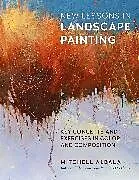
New Lessons in Landscape Painting
Beschreibung
Autorentext Mitchell Albala, whose semi-abstract and atmospheric landscapes have been exhibited nationally, is the author of three books: New Lessons in Landscape Painting, The Landscape Painter’s Workbook: Essential Studies in Shape, Composition, and Co...Format auswählen
- Kartonierter EinbandCHF 30.80

Wird oft zusammen gekauft
Andere Kunden kauften auch
Beschreibung
Autorentext
Mitchell Albala, whose semi-abstract and atmospheric landscapes have been exhibited nationally, is the author of three books: New Lessons in Landscape Painting, The Landscape Painter’s Workbook: Essential Studies in Shape, Composition, and Color (both from Rockport Publishers) and Landscape Painting: Essential Concepts and Techniques for Plein Air and Studio Practice (Watson-Guptill), a leading title on the subject since it was published in 2009. In addition to leading plein air workshops in Italy, Albala is also a popular workshop instructor in the Pacific Northwest and has lectured on Impressionism and landscape painting at the Seattle Art Museum. He has written for International Artist and Artists & Illustrators magazines, and his work was profiled in the French arts magazine Pratique des Arts. His popular painting blog holds a top spot on feedspot.com’s “Top 80 Websites & Blogs for Painters.” His paintings, workshops, and blog can be found on his website mitchalbala.com. He lives in Seattle, Washington.
Klappentext
**Refine and expand your landscape painting skills with this next-level guide by award-winning painter and bestselling author Mitchell Albala.
**New Lessons in Landscape Painting builds on the success of the bestselling The Landscape Painter’s Workbook, with new topics, step-by-step exercises, demonstrations, and in-depth painting analyses. Each is designed to build stronger skills in the core practices of landscape painting: shape interpretation, composition, and color.
Alongside inspiring contemporary artwork from an array of talented artists, this indispensable reference offers intermediate and advanced skill-building lessons that apply to both plein air and studio painting. You'll learn practical strategies to improve your creative decision-making and problem-solving skills, regardless of your chosen style.
Inside, you’ll find:
- Comprehensive lessons on color temperature, color dominance, composition, notan, edge work, abstraction, depth, and the spatial properties of color
- Step-by-step, practical exercises designed to build skills you can directly apply to solving problems in your own paintings
- Key concept primers that explain the theory behind each technique
- Over 100 paintings from more than 50 of today’s most respected landscape artists working in oil, pastel, watercolor, and acrylic
If you're ready to move beyond the basics, New Lessons in Landscape Painting is the ideal technical resource and creative companion for your journey--inspiring you to explore new practices that will help you create more successful landscape paintings.
The For Artists series expertly guides and instructs artists at all skill levels who want to develop their classical drawing and painting skills and create realistic and representational art.
Also available from the series: Drawing the Head for Artists, Essential Human Anatomy for Artists, Facial Expressions for Artists, Figure Drawing for Artists, Life Drawing for Artists, Drawing and Painting Botanicals for Artists, Dynamic Still Life for Artists, The Landscape Painter’s Workbook, Painting Luminous Portraits for Artists, Plein Air Techniques for Artists, Light and Color in the Watercolor Landscape, and Sketching Techniques for Artists.
Inhalt
Contents
Introduction
1 | The Forest and the Trees
The Poetry of Simplification
The Rigorously Shape-Oriented Style
Shapes and Planes
Demonstration: The Art of Implication
Exercise: 10 Shapes or Fewer
Exercise: Combining Shapes
Demonstration: Simplifying with a Three-Value Study
2 | The Power of Variation
Key Concept: Aspects of Variation
Key Concept: Notan
Exercise: Variation through Abstract Notan
Key Concept: The Picture Window
Exercise: Variation in Representational Notan
All Shapes, Great and Small
“Meaningful” Contrast
3 | The Spatial Stage
Volume, Scale, and Overlap
Perspective: An Overview
Atmospheric Perspective
Linear Perspective
Tactile Perspective
The Power of Edges
Edge Variability
The Relativity of Edges
How Value and Color Contrasts Affect the Appearance of Edges
Edges: Creative Translation, Not Direct Transcription
Choose Your Edge—Hard versus Soft
Using Edges to Control Focus
Using Edges to Imply Depth
Using Edges to Step Through the Spatial Stage
Lost and Found Edges
The Spatial Properties of Color
Exercise: Perceiving the Illusion
Exploring Ambiguous Space
Demonstration: Transparency to Opacity
Demonstration: Spatial Repair
4 | The Power of Color Temperature
Understanding Temperature
Temperature: A Relative Affair
Temperature: An Aspect of Color Contrast
Temperature: A Global Form of Contrast
Temperature Differences, Great and Small
Four Temperature Analyses
Exercise: Building Temperature Sensitivity
Key Concept: The Temperature-Driven Palette
Exercise: Temperature-Based Painting
5 | Color Dominance
Key Concept: Color Grouping
The Benefits of Color Dominance
Demonstration: With and Without Color Dominance
Dominance by Proportion
Dominance Through Hue Integration
In Practice: Eleinne Basa’s Snow Moon
Dominance in Action
6 | Day and Night
Value and Color: The Twin Forces of Light
Day
How Value Affects Hue Identity
Leading with Value Contrast
Leading with Color Interaction
Saturated Color as a Substitute for Light
Balancing Value and Color Interaction
Daylight Painting Considerations
Night
Managing Value and Color Contrast in Nocturnal Light
Frederick Remington: Blue and Green Makes Night
Demonstration: Day into Night
Nocturne Color Considerations
Between Day and Night
Twilight
Sunrise/Sunset
7 | Beyond Observational Color
Key Concept: Color Evolution
Direct Observation
Informed Modification
Interpretive Color
Exercise: Color Transposition
Beyond: Plein Air
Beyond: In the Studio
8 | Cultivating an Abstract Aesthetic
What Makes a Painting Abstract?
Inducing Abstraction
Ultra-Simplification
Expressive and/or Textural Mark-Making
Expressive Use of Color
Abstraction and Vision
Demonstration: Representational to Abstract
Abstraction and Flatness
Abstracting in Series
In Practice: Mitchell Albala
In Practice: Vahe Yeremyan
Resources
Contributing Artists
Acknowledgments
About the Author
Index