Beschreibung
Although research into language learning strategies (LLS) has flourished over the last several decades, some areas have remained blatantly neglected. This evaluation surely applies to grammar learning strategies (GLS), defined as actions and thoughts that lea...
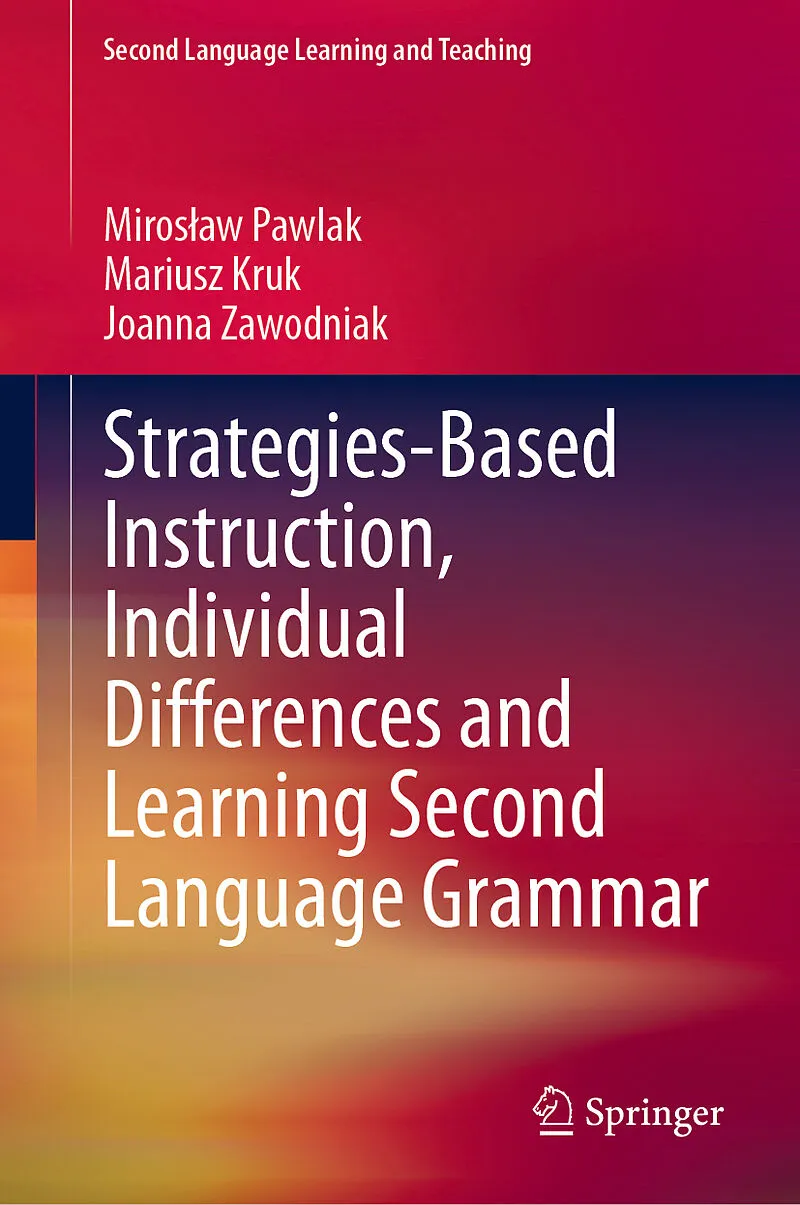
Although research into language learning strategies (LLS) has flourished over the last several decades, some areas have remained blatantly neglected. This evaluation surely applies to grammar learning strategies (GLS), defined as actions and thoughts that learners draw upon to better understand grammar structures and to use them in different contexts. Research in this area is scant and it has for the most part focused on the identification of GLS employed by second language learners in various settings. The present book offers an overview of existing research into GLS against the backdrop of the broader field of LLS. It also reports a study that investigated the effects of strategies-based instruction targeting GLS on the use of these strategies and the explicit and implicit (automatized) knowledge of second language grammar, also taking into account the role of selected individual difference factors. Based on the results, pedagogical implications are provided and future research directions are considered.
Focuses on how strategybased instruction shapes grammar strategies and L2 mastery, mediated by motivation and grit Considers intervention effects on specific L2 grammar core structures, addressing both explicit, and implicit knowledge Provides a key reference for researchers designing pedagogical interventions in specific L2 areas, especially grammar
Autorentext
Prof. Miros aw Pawlak is a leading Polish scholar in the fields of applied linguistics, second language acquisition (SLA), and foreign language pedagogy. He serves as Professor of English in the Department of English Studies, Faculty of Pedagogy and Fine Arts in Kalisz at Adam Mickiewicz University, Poland and also holds an appointment at the Faculty of Humanities and Social Sciences, University of Applied Sciences in Konin, Poland. Dr. Mariusz Kruk is an applied linguist and Associate Professor at the University of Zielona Góra, Poland, working within the Department of English Philology. He is also affiliated with the Faculty of Pedagogy and Fine Arts in Kalisz at Adam Mickiewicz University in Poznä, Poland, where he contributes to English studies and applied linguistics research. Dr. Joanna El bieta Zawodniak is a Polish applied linguist and Associate Professor at the University of Zielona Góra, Poland, where she works in the Institute of Neophilology (Department of English Philology). She has co-authored multiple influential publications exploring emotional, cognitive, and psychological dimensions of language learning.
Inhalt
Chapter 1: 'Language' and 'Learning' as objects of Inquiry: A transdisciplinary historiography of theories and practices.- PART I: From linguistic theories to language acquisition.- Chapter 2: Meaningful Grammar: Theories and Practices.- Chapter 3: Universal Grammar and Language Pedagogy: What we know that we do not know.- Chapter 4: Generative Foundation of Multilingualism in Language Learning.- Chapter 5: The acquisition of frozen expressions: Challenging the generative framework.- Chapter 6: Cultural-Cognitive Foundations of Language Pedagogy for a Multilingual Society.- Chapter 7: Plurilingual-pluricultural identity and language learning: The contribution of cognitive corpus linguistics and cultural studies.- Chapter 8: Perspectives on Social Life of Language.- Chapter 9: A Cultural Linguistics approach to language pedagogy: The role of Cultural conceptualizations.- Chapter 10: Translanguaging: From language praxis to language pedagogy.- Chapter 11: Situating the teacher in the acquisition-learning debate.- Chapter 12: Metatext and cognitive linguistics: Inputs for language pedagogy.- Chapter 13: Motivation for the choice of complements in predicate-argument structure: The role of image schemas, metaphors and metonymies.- PART II: Case studies at the intersection of linguistics and language pedagogy.- Chapter 14: Toward an adaptive system of language acquisition: Dialogue between Generative and Functional linguistics.- Chapter 15: Ethno-syntax in language learning: Evidentiality in Finno-Ugric Languages.- Chapter 16: Conceptualizing time in terms of space and motion in Japanese using Cognitive Metaphor Theory.- Chapter 17: Understanding the acquisition of non-literal constructions using usage-based approach.- Chapter 18: Narratives and theory of mind: A cultural-cognitive turn in language pedagogy.- Chapter 19: Internal State Terms & Narratives: What they mean for language pedagogy.- Chapter 20: Perfecting Imperfections: Pragmatic Competence for Preschool Teachers of English Language in a Multicultural Environment.- Chapter 21: The bottom-up perspective and less commonly taught languages: the case of Swahili.- Chapter 22: Combinatorial Variability as a Model: Managing classrooms for minority children.- Chapter 23: Language, Learner, and Learning: Issues in Language Pedagogy and Language.- Chapter 24: Language Acquisition and Language Pedagogy: A Transdisciplinary Dialogue between three Scholars.- Index.