
IHR WARENKORB IST AKTUELL LEER.
Haben Sie noch nichts passendes gefunden? Stöbern Sie durch unser komplettes Sortiment.
Oder melden Sie sich an bzw. registrieren Sie sich.
- Kostenlose Lieferung
- Kauf auf Rechnung
- Ex Libris Tiefpreis
- Filiallieferung und 650+ Abholorte
- Rabatt-Bons als Club-Mitglied
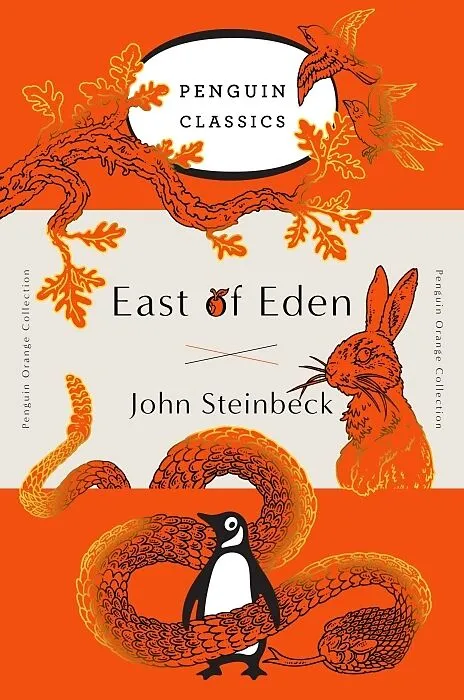
East of Eden
Beschreibung
Zusatztext By the Winner of the Nobel Prize in Literature A novel planned on the grandest possible scale . . . One of those occasions when a writer has aimed high and then summoned every ounce of energy! talent! seriousness! and passion of which he was capable...Format auswählen
- Kartonierter EinbandCHF 21.10
- BroschiertCHF 29.50
- Fester EinbandCHF 42.80

Wird oft zusammen gekauft
Andere Kunden kauften auch
Beschreibung
Zusatztext By the Winner of the Nobel Prize in Literature A novel planned on the grandest possible scale . . . One of those occasions when a writer has aimed high and then summoned every ounce of energy! talent! seriousness! and passion of which he was capable. . . . It is an entirely interesting and impressive book. The New York Herald Tribune A fantasia and myth . . . A strange and original work of art. The New York Times Book Review A moving! crying pageant with wilderness strengths. Carl Sandburg When the book club ended a year ago! I said I would bring it back when I found the book that was moving . . . and this is a great one. I read it for myself for the first time and then I had some friends read it. And we think it might be the best novel we've ever read! Oprah Winfrey Informationen zum Autor John Steinbeck (19021968) was born in Salinas, California. He worked as a laborer and a journalist, and in 1935, when he published Tortilla Flat , he achieved popular success and financial security. Steinbeck wrote more than twenty-five novels and won the Nobel Prize in 1962. Klappentext Part of the Penguin Orange Collection, a limited-run series of twelve influential and beloved American classics in a bold series design offering a modern take on the iconic Penguin paperback A Penguin Classic Winner of the 2016 AIGA + Design Observer 50 Books | 50 Covers competition For the seventieth anniversary of Penguin Classics, the Penguin Orange Collection celebrates the heritage of Penguin's iconic book design with twelve influential American literary classics representing the breadth and diversity of the Penguin Classics library. These collectible editions are dressed in the iconic orange and white tri-band cover design, first created in 1935, while french flaps, high-quality paper, and striking cover illustrations provide the cutting-edge design treatment that is the signature of Penguin Classics Deluxe Editions today. East of Eden The masterpiece of Steinbeck's later years, East of Eden is a sprawling epic in which Steinbeck created his most mesmerizing characters and explored his most enduring themes: the mystery of identity, the inexplicability of love, and the murderous consequences of love's absence. Chapter 1 [1] THE SALINAS VALLEY is in Northern California. It is a long narrow swale between two ranges of mountains, and the Salinas River winds and twists up the center until it falls at last into Monterey Bay. I remember my childhood names for grasses and secret flowers. I remember where a toad may live and what time the birds awaken in the summerand what trees and seasons smelled likehow people looked and walked and smelled even. The memory of odors is very rich. I remember that the Gabilan Mountains to the east of the valley were light gay mountains full of sun and loveliness and a kind of invitation, so that you wanted to climb into their warm foothills almost as you want to climb into the lap of a beloved mother. They were beckoning mountains with a brown grass love. The Santa Lucias stood up against the sky to the west and kept the valley from the open sea, and they were dark and broodingunfriendly and dangerous. I always found in myself a dread of west and a love of east. Where I ever got such an idea I cannot say, unless it could be that the morning came over the peaks of the Gabilans and the night drifted back from the ridges of the Santa Lucias. It may be that the birth and death of the day had some part in my feeling about the two ranges of mountains. From both sides of the valley little streams slipped out of the hill canyons and fell into the bed of the Salinas River. In the winter of wet years the streams ran full-freshet, and they swelled the river until sometimes it raged and boiled, bank full, an...
By the Winner of the Nobel Prize in Literature
“A novel planned on the grandest possible scale . . . One of those occasions when a writer has aimed high and then summoned every ounce of energy, talent, seriousness, and passion of which he was capable. . . . It is an entirely interesting and impressive book.” —The New York Herald Tribune
“A fantasia and myth . . . A strange and original work of art.” —The New York Times Book Review
“A moving, crying pageant with wilderness strengths.” —Carl Sandburg “When the book club ended a year ago, I said I would bring it back when I found the book that was moving . . . and this is a great one. I read it for myself for the first time and then I had some friends read it. And we think it might be the best novel we've ever read!” —Oprah Winfrey
Autorentext
John Steinbeck (1902–1968) was born in Salinas, California. He worked as a laborer and a journalist, and in 1935, when he published Tortilla Flat, he achieved popular success and financial security. Steinbeck wrote more than twenty-five novels and won the Nobel Prize in 1962.
Klappentext
**Now a Netflix series starring Florence Pugh
The masterpiece of Steinbeck’s later years—at once a family saga and a modern retelling of the Book of Genesis
Part of the Penguin Orange Collection, Winner of the 2016 AIGA + Design Observer 50 Books | 50 Covers competition and a limited-run series of American classics designed with a modern take on the iconic Penguin paperback.
A Penguin Classic
**
In his journal, Nobel Prize winner John Steinbeck called East of Eden “the first book,” and indeed it has the primordial power and simplicity of myth. Set in the rich farmland of California’s Salinas Valley, this sprawling and often brutal novel follows the intertwined destinies of two families—the Trasks and the Hamiltons—whose generations helplessly reenact the fall of Adam and Eve and the poisonous rivalry of Cain and Abel. Here is a work in which Steinbeck created his most mesmerizing characters and explored his most enduring themes: the mystery of identity, the inexplicability of love, and the murderous consequences of love’s absence. Adapted for the 1955 film directed by Elia Kazan introducing James Dean and read by thousands as the book that brought Oprah’s Book Club back, East of Eden has remained a touchstone of American literature for over half a century.
Penguin Classics is the leading publisher of classic literature in the English-speaking world, representing a global bookshelf of the best works throughout history and across genres and disciplines. Readers trust the series to provide authoritative texts enhanced by introductions and notes by distinguished scholars and contemporary authors, as well as up-to-date translations by award-winning translators.
Leseprobe
Chapter 1
[1]
THE SALINAS VALLEY is in Northern California. It is a long narrow swale between two ranges of mountains, and the Salinas River winds and twists up the center until it falls at last into Monterey Bay.
I remember my childhood names for grasses and secret flowers. I remember where a toad may live and what time the birds awaken in the summer—and what trees and seasons smelled like—how people looked and walked and smelled even. The memory of odors is very rich.
I remember that the Gabilan Mountains to the east of the valley were light gay mountains full of sun and loveliness and a kind of invitation, so that you wanted to climb into their warm foothills almost as you want to climb into the lap of a beloved mother. They were beckoning mountains with a brown grass love. The Santa Lucias stood up against the sky to the west and kept the valley from the open sea, and they were dark and brooding—unfriendly and dangerous. I always found in myself a dread of west and a love of east. Where I ever got such an idea I cannot say, unless it could be that the morning came over the peaks of the Gabilans and the night drifted back from …