Beschreibung
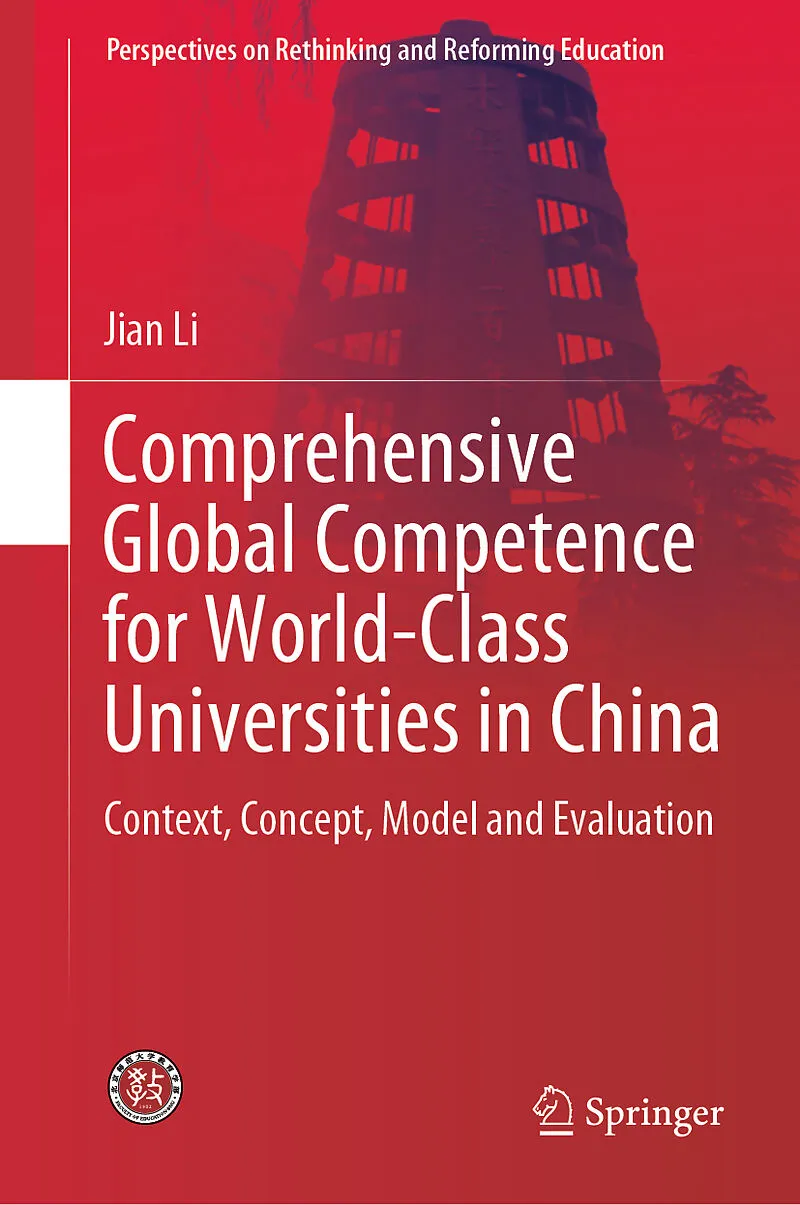
This book proposes the new concept of comprehensive global competence in order to explore how to advocate, cultivate, and implement global competence at China's higher education institutions. The concept essentially refers to an organizational, cross-cultural...
This book proposes the new concept of comprehensive global competence in order to explore how to advocate, cultivate, and implement global competence at China's higher education institutions. The concept essentially refers to an organizational, cross-cultural capacity involving students, faculty members, administrators, and staff in a multidimensional learning domain that values, shapes, and promotes global competitiveness at higher education institutions.
Unlike the other literature available, which has largely approached defining global competence it from four perspectives: an adaptationchange mode, an inputoutput mode, a willingnesstolerance mode, and a learningcompetence mode, this book draws on the theoretical framework put forward in Dimensions of Learning (Marzano, 1992) in order to explain the meaning, implications, and justification of the concept of comprehensive global competence. Specifically, Marzano's Dimensions of Learning Model offers a comprehensive research-oriented framework on learning cognition and the learning process. With the help of this resource, the book discusses in detail the conceptual, practical, and strategic aspects of creating comprehensive global competence.
Explores how to advocate, cultivate, and implement global competence at China's higher education institutions Illustrates the implicit connections between creating world-class universities and promoting comprehensive global competence Offers an intensive discourse on the conceptual, practical, and strategic aspects of creating comprehensive global competence
Autorentext
Xudong Zhu is a professor at the Institute of Teacher Education and Dean of the Faculty of Education at Beijing Normal University. His work focuses on teacher education, comparative education, and the history of education, with an emphasis on transforming the teacher education system in China, comparative studies on national development and education, and the history of ideas of education in the west. Much of his work has involved the policy and practice of teacher education and teacher professional development, aspects that he has researched in China, with the World Bank, UNESCO, Intel, etc. He is the Secretary of the National Expert Committee of Teacher Education of MOE in China and Director of the Center for Teacher Education Research among the Key Research Institutes of Humanities and Social Sciences in University of MOE. He is also Director of the Institute of Teacher Education at Beijing Normal University and Editor-in-Chief of the Journal of Teacher Education Research, China. Jian Li, Ph.D., is an assistant professor at the China Institute of Education and Social Development, Faculty of Education, Beijing Normal University. While pursuing her Ph.D. at Indiana University in Bloomington, USA, Dr. Li served as the Senior Research Consultant for the Office of the Vice Provost for Educational Inclusion and Diversity and in associate researcher positions at the Project on Academic Success, Center for Postsecondary Research at Indiana University. Dr. Li's general areas of scholarship are education policy and law, and comparative education policy. She has published over 40 articles, monographs, and book chapters.
Klappentext
This book proposes the new concept of comprehensive global competence in order to explore how to advocate, cultivate, and implement global competence at Chinäs higher education institutions. The concept essentially refers to an organizational, cross-cultural capacity involving students, faculty members, administrators, and staff in a multidimensional learning domain that values, shapes, and promotes global competitiveness at higher education institutions. Unlike the other literature available, which has largely approached defining global competence it from four perspectives: an adaptation change mode, an input output mode, a willingness tolerance mode, and a learning competence mode, this book draws on the theoretical framework put forward in Dimensions of Learning (Marzano, 1992) in order to explain the meaning, implications, and justification of the concept of comprehensive global competence. Specifically, Marzanös Dimensions of Learning Model offers a comprehensive research-oriented framework on learning cognition and the learning process. With the help of this resource, the book discusses in detail the conceptual, practical, and strategic aspects of creating comprehensive global competence.
Inhalt
Foreword.- Acknowledgements.- Part 1 Conceptualizing Comprehensive Global Competence.- Chapter 1 The Conception of Comprehensive Global Competence.- Chapter 2 Comprehensive Global Competence for Student.- Chapter 3 Comprehensive Global Competence for Faculty.- Part 2 Practical Framework of Comprehensive Global Competence.- Chapter 4 Mapping Global Comprehensive Global Competence Concept.- Chapter 5.- Constructing Comprehensive Global Competence of Higher Education Practice.- Chapter 6 Comprehensive Global Competence of Higher Education Practice.- Chapter 7 Constructing Comprehensive Global Competence of Higher Education Strategy.- Chapter 8 Trends and Implications of Comprehensive Global Competence of Higher Education Reform.- Chapter 9 Issues and Strategy of Constructing Comprehensive Global Competence at World-Class Universities.- Part 3 Conceptualizing Comprehensive Global Competence Model : Interviews of Chinese Experts.- Chapter 10 Conceptualizing Comprehensive Global Competence Model: Interviews with Experts.