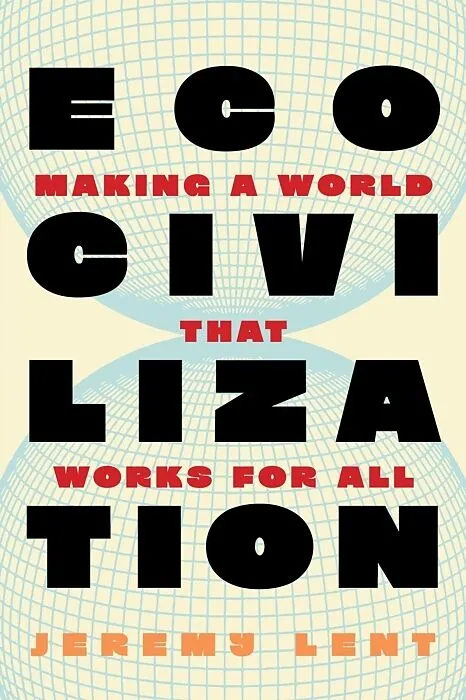
Ecocivilization
Beschreibung
“One of the greatest thinkers of our age" ( It has often been said that it is easer to imagine the end of the world than it is to imagine the end of capitalism--and yet that is what the historical moment urgently calls for. Climate change has reached an ...Format auswählen
- Fester EinbandCHF 29.15

Wird oft zusammen gekauft
Andere Kunden kauften auch
Beschreibung
“One of the greatest thinkers of our age" ( It has often been said that it is easer to imagine the end of the world than it is to imagine the end of capitalism--and yet that is what the historical moment urgently calls for. Climate change has reached an emergency state, inequality continues to grow, and, for many, the future has never seemed more bleak. Incremental policy improvements are no longer enough--we need a deep transformation of our current civilization to continue to survive.;; In From the global economy to universal housing and income, from infrastructure to agriculture, every major aspect of our society could be redesigned to work together as a coherent whole, setting the conditions for all people to flourish. <Reclaiming Our Future <shows how this future on a regenerated Earth is not only desirable, but entirely feasible.
Autorentext
Jeremy Lent described by Guardian journalist George Monbiot as “one of the greatest thinkers of our age,” is a speaker and author of the award-winning The Patterning Instinct and The Web of Meaning. He is the founder of the Deep Transformation Network and the nonprofit Liology Institute. He lives with his partner in Berkeley, California.
Klappentext
“One of the greatest thinkers of our age" (The Guardian) presents a new way of living—one modeled on nature’s design instead of capitalism's—for fans of Guns, Germs, and Steel and Doughnut Economics
It has often been said that it is easier to imagine the end of the world than it is to imagine the end of capitalism—and yet that is what the historical moment urgently calls for. As climate chaos, inequality, and social fragmentation intensify, humanity faces an imminent choice: continue with a system built on extraction and endless growth, or reimagine civilization itself. Incremental policy improvements are no longer enough—we need a deep transformation of our current civilization to continue to survive.
In Ecocivilization, leading thinker Jeremy Lent offers that reimagination, grounded in proven design principles of ecosystems and in humankind's evolved inclination toward justice, mutuality, and dignity.
What unfolds is a robust framework incorporating Lent’s own expertise, and the lived experiences of those on the ground already putting ecological civilization’s core tenets into practice—justice, mutuality, diversity, and symbiosis.
From the global economy to universal housing and income, from infrastructure to agriculture, every major aspect of our society could be redesigned to work together as a coherent whole, setting the conditions for all people to flourish. Ecocivilization shows how this future on a regenerated Earth is not only desirable, but entirely feasible.
Leseprobe
Introduction
Few people have had as much effect on the recent direction of the world as Tina. In virtually every major policy decision considered in just about every country on the planet, Tina has been the one to shape the debate. It’s Tina who tells people what they can, and can’t, talk about.
How come you’ve never heard of Tina or seen her picture in the press? Because Tina isn’t a person, but an idea. Or perhaps more accurately, a killer of ideas. TINA is the acronym of the famous statement made by Margaret Thatcher in 1980, “There Is No Alternative,” as she pushed through an unyielding assault on the delicate balance between government and private enterprise that had evolved in Great Britain since the end of the Second World War.
But the underlying creed of TINA was not limited to Thatcher’s Britain. Following the ascendancy of Ronald Reagan to the presidency of the United States, the duo unleashed onto the world an ideology that had been incubating for decades, and has since become the de facto governing doctrine of virtually every aspect of human endeavor, infiltrating its core beliefs into areas as wide-ranging as politics, finance, culture, education, technology, and agriculture. This ideology, generally referred to nowadays as neoliberalism, holds that humans are individualistic, selfish, calculating materialists, and because of this, unrestrained free-market capitalism provides the best framework for every kind of human activity.
A decade after neoliberalism took hold of the world, the Berlin Wall fell, signifying the end of the Cold War that had defined global politics for nearly half a century. It was a jubilant moment, liberating millions from the ruthless grip of a morally bankrupt regime. In the battle between capitalism and communism, capitalism had won. As one triumphant commentator infamously proclaimed, it was “the end of history.” There was no longer any alternative. Game over. TINA now reigned supreme.
Since that time, neoliberal adherents have succeeded in transforming the world into a gladiatorial arena where markets have become the ruling force of human activity. Regulations have been shredded across the globe. Billions of people are malnourished while mega-billionaires vie for planetary domination. Profit-seeking corporations have surpassed nation states in economic power. Animal populations have been decimated worldwide. And each year brings our civilization ever closer to the cataclysm of climate breakdown.
People increasingly intuit that the system is not working for them. Angry and desperate, they turn to the only voices that seem to recognize their plight—extremist authoritarians promising to dismantle the structures that have immiserated them.
Yet, most people—even those concerned about the dire state of the world—accept TINA unquestioningly. The only way to structure society, it is assumed, is in the form of growth-based consumer capitalism—a system in which corporate profits ultimately drive the decisions that affect the lives of everyone on the planet, the health of the living Earth, and the destiny of future generations. Virtually all policy proposals under serious consideration to fix our grave problems work within the framework of the current system rather than examining the system itself.
This book constitutes the dethronement of TINA. There is, in fact, an alternative.
A faulty operating system
The alternative we’ll be exploring, though, is not the kind that Thatcher, Reagan, and countless adherents of market-based capitalism had been railing against. Back in those days, and in fact throughout the entire twentieth century, the battle lines were clearly drawn between capitalism on one side and socialism (or, in its extreme form, communism) on the other. A society could either be organized primarily by the market or by the state. There were, of course, many countries that attempted a blend between the two, most notably European nations after the Second World War that explored possibilities of a welfare state with a meaningful safety net for those who fell through the holes ripped open by the market. In the United States, after FDR’s New Deal, the state played a significant role in people’s lives. But the choice was always between the poles of market and state, closing off any other possibility for organizing human activity.
Surprisingly perhaps, these opposing sides shared considerable common ground. Both prized their particular ideology over the dignity of normal human lives: Submit, people were told, either to the invisible hand of the market or the authoritarian fist of the state. Both worshiped at the altar of economic growth as the supreme aspiration of policymaking. And perhaps most consequentially, both viewed the entire Earth as nothing more than a resource to exploit in the interest of pursuing that growth.
This pursuit of endless growth on a planet with limited resources has propelled human civiliza…