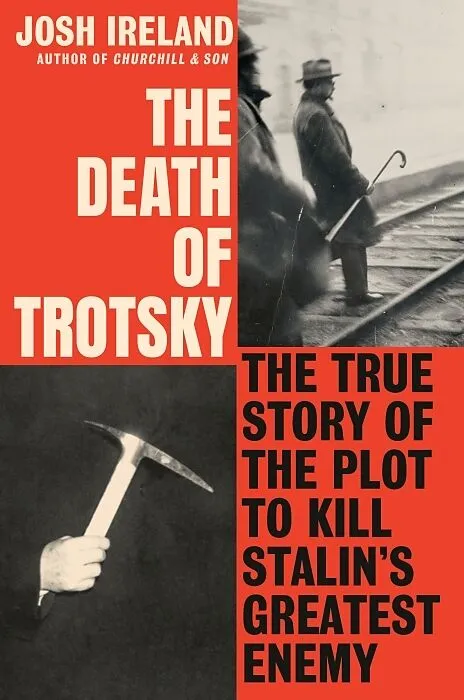
The Death of Trotsky
Beschreibung
For fans of Ben Macintyre, the gripping story of the assassination of Soviet revolutionary Leon Trotsky and the deadly game of cat and mouse that preceded it On August 20, 1940, Leon Trotsky invited a man he knew only as Jacques Mornard into his study. Mornard...Format auswählen
- Fester EinbandCHF 29.75

Wird oft zusammen gekauft
Andere Kunden kauften auch
Beschreibung
For fans of Ben Macintyre, the gripping story of the assassination of Soviet revolutionary Leon Trotsky and the deadly game of cat and mouse that preceded it On August 20, 1940, Leon Trotsky invited a man he knew only as Jacques Mornard into his study. Mornard waited for Trotsky to sit, then smashed an ice pick he had hidden in his raincoat into his skull. For over a decade, Trotsky’s greatest enemy, Joseph Stalin, had been trying to arrange his murder. His agents had hunted him across Europe and into a lonely, bitter exile in Mexico. He had liquidated Trotsky’s family and friends, and yet Trotsky had always escaped his clutches. The man who changed this all was Ramón Mercader, a minor Spanish aristocrat and Soviet agent who had posed as Mornard, a dissolute Belgian playboy, and infiltrated Trotsky’s inner circle. In <The Death of Trotsky<, Josh Ireland traces the separate paths walked by each of these protagonists as they steadily draw closer and closer to that fateful encounter on August 20. Blending intimate historical detail and thrilling historical narrative, swinging from Moscow to Paris to Mexico, and taking in a cast of morally conflicted Russian spies, fanatical Mexican painters, and innocent American idealists, <The Death of Trotsky <delves into the lives of two fascinating, complex men locked in a life-or-death struggle that will bend the course of history.
Autorentext
**Josh Ireland** is a writer and editor. He lives in London and is the author of The Traitors (2017), an Observer book of the year, and Churchill & Son (2021) a Daily Telegraph book of the year. He has also ghosted a number of top-five Sunday Times bestsellers and written for the Daily Telegraph, Prospect, Spectator and the Times Literary Supplement.**
Klappentext
**A LitHub and Parade Most Anticipated Book of the Year
For fans of Ben Macintyre and Erik Larson, the gripping story of the assassination of Soviet revolutionary Leon Trotsky and the deadly game of cat and mouse that preceded it**
On August 20, 1940, Leon Trotsky invited a man he knew only as Jacques Mornard into his study. Mornard waited for Trotsky to sit, then smashed an ice pick he had hidden in his raincoat into Trotsky’s skull.
For over a decade, Trotsky’s greatest enemy, Joseph Stalin, had been trying to arrange his murder. Stalin’s agents had hunted him across Europe and into a lonely, bitter exile in Mexico. He had liquidated Trotsky’s family and friends, and yet Trotsky had always escaped his clutches. The man who changed this all was Ramón Mercader, a minor Spanish aristocrat and Soviet agent who had posed as Mornard, a dissolute Belgian playboy, and infiltrated Trotsky’s inner circle.
In The Death of Trotsky, Josh Ireland traces the separate paths walked by each of these protagonists as they steadily draw closer and closer to that fateful encounter on August 20. Blending intimate historical detail and thrilling historical narrative, swinging from Moscow to Paris to Mexico, and taking in a cast of morally conflicted Russian spies, fanatical Mexican painters, and innocent American idealists, The Death of Trotsky delves into the lives of two fascinating, complex men locked in a life-or-death struggle that would bend the course of history.
Leseprobe
1 - Death Solves All Problems
When did Joseph Stalin decide to crush, or destroy, or kill Leon Trotsky?
Perhaps it was the first time these two men met-in 1907, at the Russian Social Democratic Labor Party's Fifth Party Congress in a damp, shabby church in London. Trotsky claimed later not to remember even seeing Stalin, who apparently remained mute for the whole three weeks of debates and arguments.
Trotsky was tall, with broad, muscular shoulders, a "great head," abundant hair, and curiously small hands. He looked, at times, like a bird of prey: most of all because of his "mouth-big, crooked, biting. A frightful mouth."
He was vain. There was something instinctively theatrical about him. He was always "calculating the effects of his gestures, his pauses and intonation." He loved dressing up in gloves and shapely clothing-the things that the revolution he identified with so closely was supposed to be sweeping away.
He was clever, with an insatiable desire to exceed others. Even when he became one of the most infamous figures on the planet, he never quite stopped being a clever schoolboy desperate to show others how much he had learned. Many thought he was the most dazzling speaker of his era. The kind of man who could make old, familiar ideas appear new and fresh. Even when he was wrong-and Trotsky was often wrong-he was still intoxicating. His arguments were original, surprising, and often brilliant. When he talked, his face lit up and his eyes flashed. Witnesses spoke wonderingly about his voice's "electric crackle."
And yet none of this would have mattered had he not married his fine words and fine gestures to immense courage and a queer instinct for those moments when history's tectonic plates were shifting.
This precocious son of an illiterate Jewish farmer from an obscure part of what is now Ukraine, he emerged as a national figure during the revolution in 1905 that briefly shook the Russian Empire's foundations. Somehow this shortsighted dandy who had never worked in a factory, nor spent a day in uniform, nor even studied at a university, found he could fire the imaginations and mirror the emotions of workers, soldiers, and students. He was just twenty-five, and yet, standing at the head of the St. Petersburg Soviet of Workers' Deputies, he spoke with an authority that exceeded even that of the tsar. (When a gendarme tried to arrest Trotsky while he was in full flow, the young revolutionary rounded on the startled police officer: "Please don't interfere with the work of the Soviet. If you wish to speak, kindly give your name and I will ask the assembly if they wish to hear you.") His glory was, of course, short-lived. Prison, then exile followed.
This was the second time he had been banished to Siberia. His earliest revolutionary activities, when he was still known as Lev Davidovich Bronstein, had been brought to a sharp halt by his arrest in 1898. He spent two years behind bars awaiting trial-during which he married his first wife, Aleksandra Sokolovskaya-before he was sentenced to four years in the farthest-flung corner of the Russian Empire. He studied philosophy, had two daughters with Aleksandra, and then, in 1902, urged by his wife ("Go, a great future awaits you"), he escaped in a hay wagon.
In my hands, I had a copy of the Iliad in the Russian hexameter of Gnyeditch; in my pocket, a passport made out in the name of Trotsky, which I wrote in it at random, without even imagining that it would become my name for the rest of my life. . . . Throughout the journey, the entire car full of passengers drank tea and ate cheap Siberian buns. I read the hexameters and dreamed of the life abroad. The escape proved to be quite without romantic glamour; it dissolved into nothing but an endless drinking of tea.
One thing led to another and he found himself in London, where he met Vladimir Ilyich Lenin, a man whose respectable clothes, neat beard, and "strange, faun's face" were scant disguise for the ruthless, uncompromising will to power that lay beneath. How, asked one of his political opponents, can you deal with a man who "for twenty-four hours of the day is taken up with the revolution, who has no other thoughts but thoughts of the revolution, and who, even in his sleep, dreams of nothing but revolution?" The party he led, the Russian Social Democratic Labor Party, was perhaps the most extreme of the many socialist groups formed in Russia during this period. They were "millenarian sectarians preparing for the apocalypse," willing to sacrifice every…