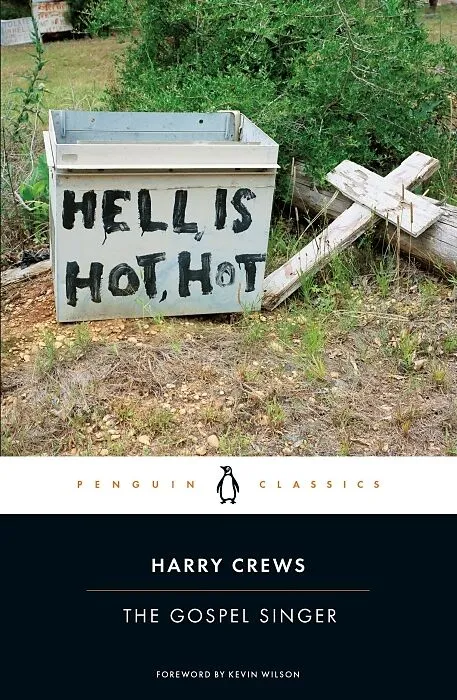
The Gospel Singer
Beschreibung
“Flannery O’Connor on steroids.” —John Williams, GQ “I don’t know where [Harry Crews’s] narrative magic comes from, but it is firmly there.” —Joseph Heller “…a bona fide Southern writer ...Format auswählen
- Poche format BCHF 20.30

Wird oft zusammen gekauft
Andere Kunden kauften auch
Beschreibung
“Flannery O’Connor on steroids.”
—John Williams, GQ
“I don’t know where [Harry Crews’s] narrative magic comes from, but it is firmly there.”
—Joseph Heller
“…a bona fide Southern writer in the vein of Flannery O’Connor, whose unvarnished language and absurdist take on life among the lower rungs of the region’s social ladder [is] shot through with a rough-and-tumble kind of empathy….it was with great pleasure that I spent last weekend reading The Gospel Singer,… a darkly funny tragedy…. The world he writes about is violent and ruthless….But there’s a point to Crews’ madness, and always present is a throughline of empathy…”
**—*Atlanta Journal Constitution
“Critics and awards anoint some authors as legends. Others depend on word-of-mouth and prose that stands the test of time….There is nothing folksy, never mind pastoral or genteel, about Crews. With caustic and fabulist writing, he exhumed the ghosts of America’s original sin…..Crews captured the raw essence of humanity in both fiction and nonfiction. Side by side, these reissues form the complete picture of an imperfect man who charged hard into extremes to escape his cultural inheritance.”
—Lauren Leblanc, Los Angeles Times*
Autorentext
Harry Crews; Foreword by Kevin Wilson
Klappentext
**“Harry Crews is magnificently twisted and brutally funny.” - Carl Hiaasen
A Penguin Classic
Golden-haired, with the voice of an angel and a reputation as a healer, the Gospel Singer appeared on the cover of LIFE and brought thousands to their knees in Carnegie Hall. But for all his fame, he is a man in mortal torment that drives him back to his obscure and wretched hometown of Enigma, Georgia. But by the time his Cadillac pulls into Enigma, he discovers an old friend is being held at tenuous bay from a lynch mob. As Harry Crews’s first novel unfolds, the Gospel Singer is forced to give way to his torment, and in doing so he reveals to the believers who have gathered at his feet just how little he is God’s man, and how much he has contributed to the corruption of each of them.
Leseprobe
Chapter 1
Enigma, Georgia, was a dead end. The courthouse had been built square in the middle of highway 229 where it stopped abruptly on the edge of Big Harrikin Swamp like a cut ribbon. From the window of the cell on the north side of the courthouse, Willalee Bookatee Hull could see the whole town. He swayed gently, shifting his weight from one foot to the other. Behind him on a wooden table a plate of peas was congealing in a gauze of pork fat. Two biscuits lay at the side of the plate. There was a slop bucket in one corner of the cell and above it at eye level a sheet of tablet paper on which someone had written in pencil the regulations of the Lebeau County jail.
Willalee Bookatee, in the breathless heat of the cell, swung before the brilliant square of windowlight like the pendulum of a clock. There was no sound except the steady drone of flies, stuck and sticking on the gummy edge of the plate behind him. The sun was in the west, dividing the street between shadow and light. At the far end of town where highway 229 burst free into the flat burning countryside, a mule was hitched in the sparse shade of a chinaberry tree. It was asleep under a wooden saddle and bloodfat flies swarmed languidly over it. On the sun side of the street, a 1948 Buick with a foxtail on the aerial and a Go Navy sticker in the rear window was parked in front of Marvin's Drugs, which was also the United States Post Office where a flag hung from an aluminum pole. The Buick was the only car in the street. It had not rained in two months.
Willalee Bookatee rocked on, half-dazed and lost in a kind of sleep, watching not the farmers or their hitched mules, but rather the tan canvas banner with red, white and blue lettering that stretched across the street. Anchored at one end to Harvey's Seed store and at the other end to Enigma Funeral Parlor, the banner read: welcome home gospel singer! Even though Willalee Bookatee was a preacher of the Gospel, with huge pieces of Scripture memorized, he could not read, but he knew-just as every living soul in Enigma knew-the Gospel Singer was coming home. They had prepared for it, looked forward to it, prayed for it. An unabated hunger raged in the whole town for the sight and the sound and-God willing-the touch of the Gospel Singer, who had single-handedly focused the attention of the world on Enigma, Georgia. The Gospel Singer had given their lives purpose and meaning simply because they could say "I come from the town where the Gospel Singer was born," or "I known him when he weren't nothin but a boy."
Willalee had watched the Gospel Singer time after time on the Muntz television that he had bought in Albany, Georgia, and brought home on the back of a turpentine wagon and set up in his cabin. Now the Gospel Singer was coming home again! He would be here, he would, in this very Enigma! He was going to walk again in that fine tall blond body, a body so fine and tall and blond that it insulted the clothes that covered it, no matter how expensive and tailored the clothing was. And of course the clothing had become more and more expensive as the Gospel Singer had gone from the television studio in Albany to the one in Tallahassee to the one in Atlanta to the one in Memphis to the one, finally, in New York City.
When Willalee Bookatee turned on that Muntz television and the Gospel Singer's voice slipped out into his cabin, it was balm poured into a wound. Nothing mattered. The world dropped down a great big hole. Everything-whether it was a razor cut, or a tar-scalded eye, or a burning case of clap off a Tifton high-yellow whore-everything quit but that voice and it went in his head and down his flesh to where his soul slept. And he could stand whatever it was for another week.
The white folks talked of nothing else. In the fields chopping cotton or breaking corn or sitting on the bench in front of Enigma Bank whittling tobacco plugs and spitting between their feet, the Gospel Singer was never far from them. Willalee Bookatee had once heard one of them say that the Gospel Singer carried enough clothes in the trunk of his car to put something on the back of every person in Enigma. Willalee Bookatee had seen the car, and it was big, but he knew that there couldn't be something in there for everybody in Enigma. And yet he believed it. Knowing had nothing to do with it. It was not impossible because he was the Gospel Singer, because everything turned to gold under his hand, the same as common air changed to angelmusic in his mouth. Yes sir! Albeeny, Tallerhassee, At-lanter, Memfis, Nu Yawk City. He had heard the white folks say the names so often they rang in his head like a bell. And he was glad to be able to sing them out-clicking over his tongue as a prayer wheel-just as everyone in the town was glad, because wherever the Gospel Singer had ultimately gone, he had started in Enigma, Georgia. Their Enigma. He had sprung from them and that was their pride. Out of their blanched flesh and hookwormed children and leached soil and poor-bone cattle-so starved that when they were murdered every winter at butchering time, their cut throats would not bleed a puddle larger than a lady's handkerchief-out of all the ills and evils of their world he had burst forth full as the sun and beautiful. Out of them, out of their kind, he had come, with nothing to foreshadow him or explain him. And every single soul felt, just as Willalee Bookatee felt, that someday in some mysterious and instantaneous way the Gospel Singer would save them from the tragedy that was …