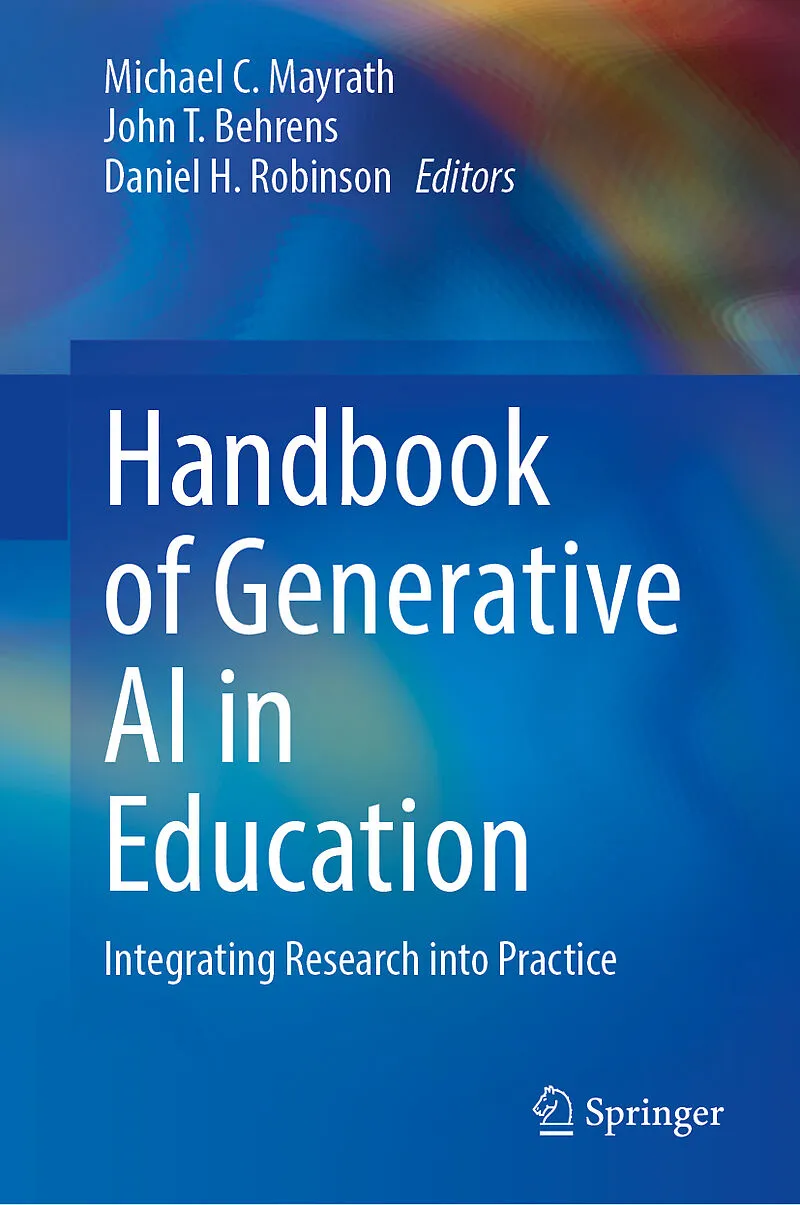
Handbook of Generative AI in Education
Beschreibung
Generative AI is transforming educational systems at a pace that challenges researchers, practitioners, and institutions to develop principled approaches to understanding, evaluating, and implementing these technologies responsibly. In response to this need, ...
Format auswählen
- Fester EinbandCHF 333.60
Wird oft zusammen gekauft
Andere Kunden kauften auch
Beschreibung
Generative AI is transforming educational systems at a pace that challenges researchers, practitioners, and institutions to develop principled approaches to understanding, evaluating, and implementing these technologies responsibly. In response to this need, this volume synthesizes research on the use of Generative Artificial Intelligence (GAI) in education from leading global scholars across disciplines. The book explores effective methodologies and frameworks for advancing research and applications of GAI in higher education and related domains while addressing new possibilities for both the research and application of teaching, learning, and assessment. It examines the ways in which GAI can be used to transform education within the context of risks, ethical concerns, and other potential negative impacts, addressing the significant new challenges GAI may pose for instructors, students, administrators and researchers.
Key areas of coverage include:
• Foundational frameworks for understanding GAI systems and their implications for educational research and practice
• Empirical evaluation of AI tutors, agentic systems, and automated feedback against rigorous learning science standards
• Innovations in assessment that expand what can be measured and at what scale
• Applications and findings across K12, higher education, health sciences, and workforce training, with attention to equity and institutional implementation
• Ethical implications of GAI use in educational research and applications
The Handbook of Generative AI in Education is an essential resource for researchers, professors, educators, and graduate students as well as professionals and practitioners in instructional design, educational technology, educational psychology, health science education, teacher education, and educational practice and policy.
Discusses GenAI use in transforming education within the context of risks, ethical concerns, and other negative impacts Explores how GenAI may create new possibilities for research and application in teaching, learning, and assessment Addresses significant challenges GenAI use may pose for instructors, students, administrators and researchers
Autorentext
Michael Mayrath, Ph.D., is a Senior Research Fellow at Ponce Health Sciences University (PHSU) and the President of Tiber Health Innovation (THI), an educational technology company. THI works with universities and organizations in the U.S. and beyond to utilize AI and analytics for teaching, learning, and assessment. THI supports PHSU's MD and health science programs with an AI tutoring platform and predictive analytics for the USMLE Step 1. Dr. Mayrath has launched innovative undergraduate and graduate degree programs around the world, ranging from Kenya to Guyana to Malaysia. He has published numerous peer-reviewed articles, including publications in top medical education journals such as AAMC's Academic Medicine. He was the lead editor of the book Technology-Based Assessments for 21st Century Skills. Dr. Mayrath received his Ph.D. in educational psychology from the University of Texas at Austin and subsequently worked as a postdoctoral fellow at Harvard University. His professional mission for more than 25 years has been to increase student outcomes and empower educators by combining innovative technologies with educational psychology research.
John T. Behrens, Ph.D., is a Professor of the Practice and Director of the Technology & Digital Studies Program, and Concurrent Professor of the Practice in the Department of Computer Science and Engineering at the University of Notre Dame where he also serves as Director of the Office of Digital Strategy in the College of Arts & Letters. Dr. Behrens has more than 20 years of industry experience developing globally deployed intelligent software systems to advance learning and assessment. He has published widely in areas of learning science, data science (including artificial intelligence), educational assessment and measurement, and the enhancement of learning and assessment systems with these technologies. Prior to entering industry, he was a tenured Associate Professor of Psychology in Education at Arizona State University focused on improving learning systems with statistical and measurement methods. His research interests include the impact of users mental models of intelligent systems on their interactions, system transparency and explanability, social impacts of AI, and the application of AI methods to learning and research systems development.
Daniel H. Robinson, Ph.D., M.Ed.,
Inhalt
Part I. Vision, Context, and Core Frameworks .- Chapter 1. Introduction to Generative AI in Education.- Chapter 2. A Primer on Generative AI Technologies and Their "Psychology".- Chapter 3. Exploring the Effects of Generative AI on Learning Using the ISAR Model.- Chapter 4. Scaling Generative and Agentic AI in Education: Market Dynamics, Workforce Transformation, and the Reality Gap.- Chapter 5. Social and Ethical Dimensions to GenAI in Higher Education.- Chapter 6. From Consumers to Creators: Why Educators Must Shape the GenAI Future.- Part II. Human-Centered Learning Sciences .- Chapter 7. Science Literacy: Generative AI as Enabler of Coherence in the Teaching, Learning, and Assessment of Scientific Knowledge and Reasoning.- Chapter 8. Harnessing Generative AI to Foster Self-Regulated Learning in Game-Based Simulations: A Multimodal Trace Data Approach.- Chapter 9. Generative Artificial Intelligence and Independent Learning: Evaluating Emerging Tools for Effectiveness.- Chapter 10. Human-Centered Approaches to Generative AI in Education.- Chapter 11. HumanAI Interaction in Higher Education: A Cognitive Perspective on AI-Supported Student Learning.- Part III. Pedagogical Innovation and Instructional Design .- Chapter 12. From Prompt to Practice: Using the PROSE Model for Constructive Alignment in Course Design and Teaching with Generative AI.- Chapter 13. Generative AI in Adult Online Learning: A Systematic Review of Research and Practice.- Chapter 14. Advancing Medical Education: The AI-Powered Dynamic Classroom.- Chapter 15. Reimagining Pedagogy with AI: Toward a Future of Learning Through Creation.- Part IV.Assessment, Evidence, and Learning Analytics .- Chapter 16. Tracking Changes in JeepyTA's Feedback Across Writing Assignments.- Chapter 17. Exploring the Use of Neuro-Symbolic Approaches to Identify and Aggregate Evidence in Educational Assessment.- Chapter 18. Modeling Interactions Between Learners and Generative Artificial Intelligence Using Epistemic Frameworks.- Chapter 19. How Generative AI Helps Educational Assessment: Various Roles It Plays in Educational Measurement Research.- Chapter 20. The Semblance of Sense: A Quantitative Ethnographic Framework for Analyzing HumanAI Collaboration.- Chapter 21. Assessing and Supporting Collaboration Skills Through Generative AI.- Chapter 22. Conversational Assessment Powered by Generative AI.- Part V. Emerging Horizons and Closing Perspectives .- Chapter 23. Using GenAI with Knowledge-Based AI to Support Metacognition in AI Agents.- Chapter 24.Future Directions in Research and Practice.