Beschreibung
Microscopic models 226 The intrinsic limitations of the theory of phase transitions 229 5. 3 Quantum Field Theory 230 5. 4 Spontaneous Symmetry Breaking 239 5. 5 Non-ideal models of emergence 249 5. 5. 1 Neural networks 250 5. 5. 2 Cellular Automata 261 5. 5. ...Microscopic models 226 The intrinsic limitations of the theory of phase transitions 229 5. 3 Quantum Field Theory 230 5. 4 Spontaneous Symmetry Breaking 239 5. 5 Non-ideal models of emergence 249 5. 5. 1 Neural networks 250 5. 5. 2 Cellular Automata 261 5. 5. 3 Artificial Life 265 5. 6 The role of noise 273 5. 7 The relationships between traditional and non-traditional models 279 Chapter 6. The Role of Ergodicity 291 6. 1 Some definitions related to ergodicity 293 6. 1. 1 Ergodic 293 6. 1. 2 Disciplinary definitions 293 6. 2 Ergodicity and stationarity 300 6. 3 Ergodicity in Collective Beings 302 6. 4 Emergence, Collective Beings, and Ergodicity 306 6. 5 Further considerations 309 6. 6 Some remarks and possible lines of research 313 Chapter 7. Applications to Social Systems (1): growth, development, sustainable development and ethics 321 7. 1 Growth, Development and Sustainable Development 323 7. 1. 1 Representing Growth 324 7. 1. 2 Development 326 7. 1. 3 Managing for development 334 7. 2 Ethics 336 7. 2. 1 Ethics and Quality 340 7. 2. 2 Effectiveness and advantages of Ethics 342 7. 2. 3 Ethics for quality and effectiveness 343 7. 2. 4 Ethics and Globalization 346 viii Contents Chapter 8. Applications to Social Systems (2): systems archetypes, virtual systems, knowledge management, organizational learning, industrial districts 353 8. 1 Systems archetypes and collective beings 353 8. 2 Virtual systems 359 8. 2.
The attribute 'systemic' means that this framework fits within Systemics, a thinking movement which originated from General System Theory (proposed by Von Bertalanffy) and from Cybernetics (introduced by Wiener and developed by Ashby and Von Foerster) The two appendices on systemics characteristics and on various critical questions concerning systemics (e.g., on systemics as a discipline, on the possibility of its falsification) are highly informative Includes supplementary material: sn.pub/extras
Autorentext
Gianfranco Minati, Mathematician, Founder and president of the Italian Systems Society (AIRS); Doctoral lecturer at the Polytechnic of Milan; Member of the scientific committee of Conferences and Systems Societies. He is author of 32 chapters in books; editor of 7 books and journals; author or co-author of 15 books; author of 30 articles and of academic publications. His current research interest focuses on 1) Modelling processes of emergence by using Meta-Structures; 2) the emerging of a post-Bertalanffy Systemics; 3) the Dynamic Usage of Models (DYSAM), Logical Openness; 4) Architecture and Design as the design of social meta-structures to influence processes of emergence in social systems. Eliano Pessa, Theoretical Physicist, is actually Full Professor of General Psychology and Cognitive Modeling at the University of Pavia, Italy. He has already been Dean of the Department of Psychology and of the Inter-departmental Research Center on Cognitive Science in the same university. In the past he has been Associate Professor of Artificial Intelligence at the University of Rome "La Sapienza", Faculty of Psychology. He is author or co-author of 10 books and of a large number of papers on scientific journals, books, proceedings of international conferences. His scientific research interests include: quantum theories of brain operation, computational neuroscience, artificial neural networks, models of emergence processes, quantum field theory, models of phase transitions in condensed matter, models of human memory and visual perception, models of decision making, models of statistical reasoning.
Klappentext
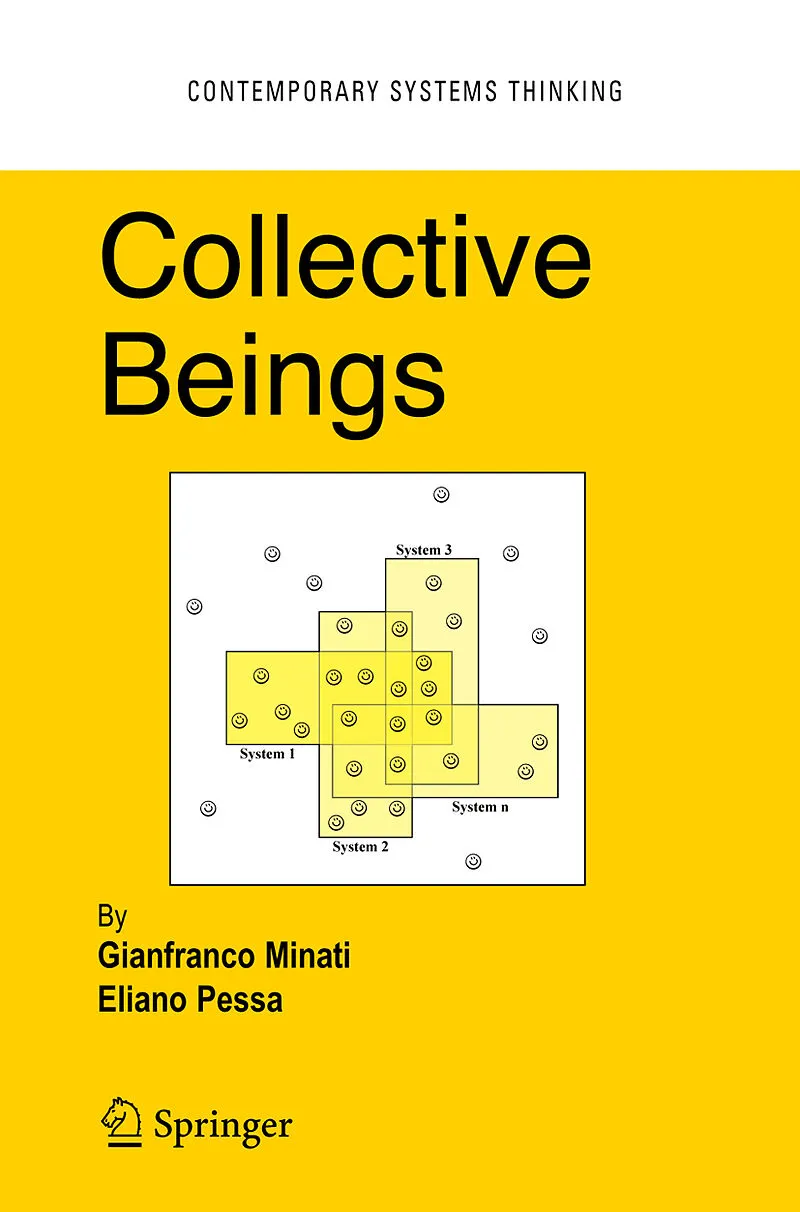
With collective behaviors playing a fundamental role in many scientific and technical disciplines, COLLECTIVE BEINGS focuses its attention on socio-economic applications to be used, for example, to increase corporate profitability and productivity. To this end, the book provides the reader with deep insights into modern conceptual tools of economy based on systemics.
In the book, collective behaviors are shown by systems composed of individual parts or agents. Moreover, COLLECTIVE BEINGS illuminates the interplay between system and individual in a remarkable new way: their collective beings give rise to systems having quite different behavior, namely that of the group and that of the individual agent. The authors always take the various aspects into account - for instance, the components of one system may be simultaneously the components of another system as well. They stress the importance of cognitive models used by the interacting agents, of the role of the observer and of the dynamic use of many cognitive models. The concept of being virtual in contradistinction to being actual is examined, and the role of ethical agreements is underlined, along with a careful discussion of different concepts of ethics as well as their relation to quality. Systemics is viewed as a cultural framework crossing disciplines and the final result is a book coined by a profound humanitarian attitude, in which the authors state that often 'technological solutions are designed for problems rather than for people having these problems.'
Inhalt
The Background to Systemics.- Generalizing Systemics and the Role of the Observer.- Emergence.- How to Model Emergence: Traditional Methods.- How to Model Emergence: Non-Traditional Methods.- The Role of Ergodicity.- Applications to Social Systems (1).- Applications to Social Systems (2).- Applications to Cognitive Systems: Beyond Computationalism.
10%