Haben Sie noch nichts passendes gefunden? Stöbern Sie durch unser komplettes Sortiment.
Oder melden Sie sich an bzw. registrieren Sie sich.


Beschreibung
This is the third volume of a three-volume series on Frontiers of Longevity Science. The series unites global experts to map the rapidly expanding field of longevity medicine. Co-edited by David Barzilai, Max Rangeley, Regina R. Monaco, and David Wood, the se...
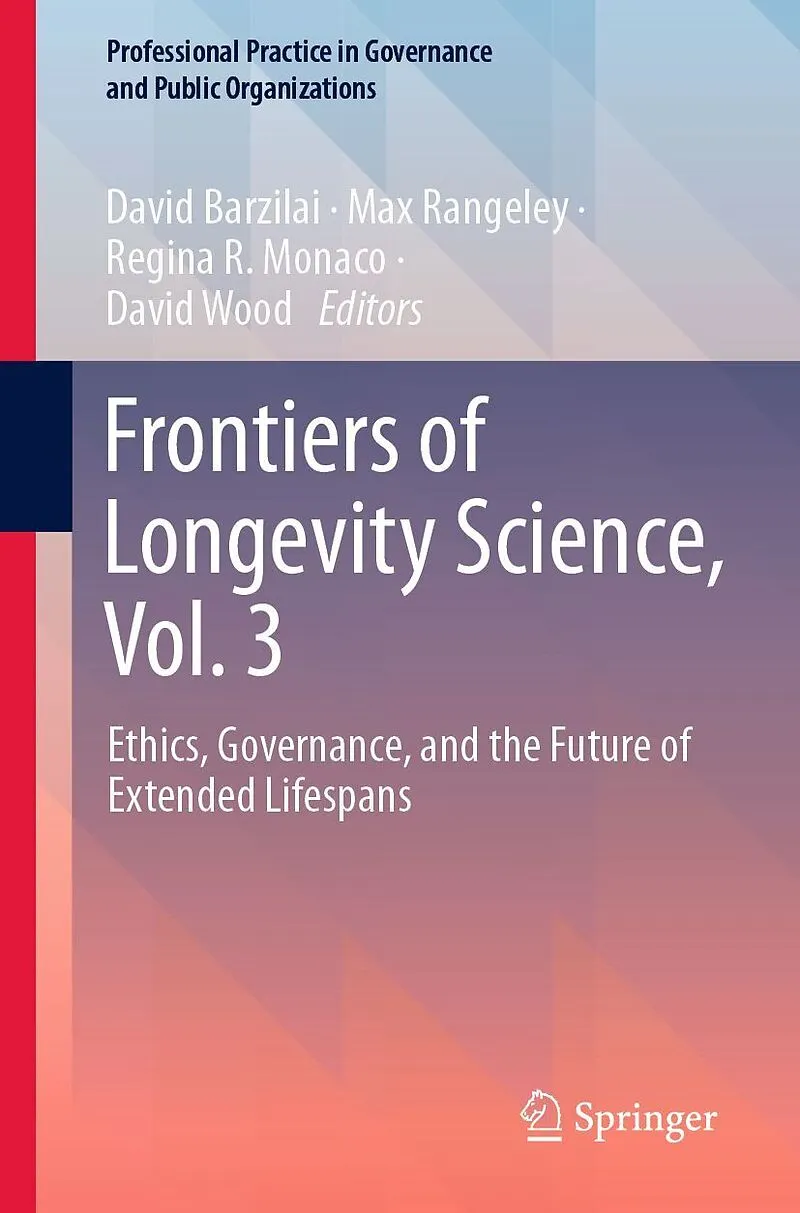
This is the third volume of a three-volume series on Frontiers of Longevity Science. The series unites global experts to map the rapidly expanding field of longevity medicine. Co-edited by David Barzilai, Max Rangeley, Regina R. Monaco, and David Wood, the series bridges molecular mechanisms, translational innovation, economics, and policy. Contributors from geroscience and the social sciences debate a central question: can we merely slow age-related diseases, or can the biology of aging itself be fundamentally changed?
Volume 3, Ethics, Governance, and the Future of Extended Lifespans , anticipates the profound societal and philosophical implications of radically longer lives. From ethical debates around the elimination of aging to breakthroughs in decentralized research and biomedical infrastructure, contributors explore how longevity will reshape human values. This volume considers how extended healthspans could transform economies and culture, outlining what it takes to navigate this global transition responsibly.
Discusses the economic, social, and political impacts of radical longevity Highlights revolutionary technologies for extending lifespan Offers new insights for scholars and professionals at international institutions such as the WHO
Autorentext
Max Rangeley runs a think tank founded by a member of Parliament in the UK and has served on the boards of other think tanks in London and Brussels. He has put an emphasis on the importance of emerging technologies, including organising and moderating the artificial intelligence roundtable discussions in the European Parliament. Max has authored and co-edited several books with Springer Nature, on central banking, trade, artificial intelligence, the future of money and the power of the mind in medicine among other topics. He studied at the London School of Economics, the University of Aberdeen, and HEC Paris.
Dr. David Barzilai is a longevity physician, thought leader in evidence-based best practices, and Founder and CEO of Barzilai Longevity Consulting. A Lecturer at Harvard Medical School, global speaker, and founding faculty member and Trustee of the Geneva College of Longevity Science, he holds an MD and PhD in health services research and is board-certified in lifestyle medicine. Through Agingdoc.com, he serves individuals, executives, and organizations in consulting and advisory roles, translating advances in longevity science into precise, personalized strategies that optimize healthspan and long-term performance.
Dr. Regina R. Monaco is a theoretical chemist with a PhD in chemistry and biochemistry from the University of Texas at Austin. She is a Senior Research Fellow at the City University of New York and a scientific consultant affiliated with the Courant Institute at New York University. She has held fellowships at NASA Ames Research Center, the Santa Fe Institute, the Max Planck Institute for Biophysical Chemistry, and the Aaron Diamond AIDS Research Center. Her research spans mechanistic and thermodynamic studies of biopolymers, including ras p21, p53, and small-molecule DNA interactions. Her current work focuses on information transfer in complex dynamical networks, with applications to biological and networked systems.
David W. Wood is a futurist and author of 12 books, including The Abolition of Aging , Vital Foresight , and The Singularity Principles . He chairs London Futurists, where he has organized over 350 public events on technoprogressive topics since 2008. David is the executive director of the LEV Foundation and was previously a pioneer in mobile computing, co-founding Symbian and serving as CTO of Accenture Mobility. He holds an M.A. in Mathematics from Cambridge University and completed postgraduate work in the History and Philosophy of Science. He also holds an honorary doctorate from the University of Westminster.
Inhalt
Part I. Philosophical objections and responses.- Chapter 1. The Moral Imperative for Prioritizing Longevity Research and Investment (Carolyn Ringel).- Chapter 2. Eliminating Aging: Motivations, Objections and Counterarguments (Karl Pfleger).- Chapter 3. The Case against Death (Patrick Linden).- Part II. Transformational narratives.- Chapter 4. Regenerate: Rewriting the Rules of Aging (Melissa King).- Chapter 5. Decentralized Biomedical Innovation as a Catalyst for 'Radical' Longevity (Jasmine Smith).- Chapter 6. The Geroscience Revolution: Driving the Next Era of Nutraceutical and Pharmaceutical Innovation (Yu-Xuan Lyu).- Chapter 7. The Preventative Medicine Playbook: A Three Horizon Strategy for Developing the First Gerotherapeutic (James Peyer).- Part III. Education, Economics, Infrastructure, and Investing in Longevity.- Chapter 8. Longevity Science as National Infrastructure: A Strategic Investment in Healthy Lifespan Extension (Todd White).- Chapter 9. Longevity Capital: Competitive Advantage and Margin of Safety in a Speculative Sector (Ethan Berg).- Chapter 10. Longevity Capital: Fueling the Future of Lifespan Innovation (Marc Bernegger).- Chapter 11. Longevity Cities: Prospects, Challenges, and Opportunities (José Cordeiro).- Chapter 12. Blueprints for radical longevity: Building a research ecosystem for human life extension (Roman Bauer).- Chapter 13. Longevity Medicine as a Discipline in Formation:
Institutional Education, Governance, and the Future of Healthspan-Oriented Care (Dominik Thor).- Chapter 14. The Imperative for Investing in High-Risk, High-Impact Longevity Companies (Boyang Wang).- Chapter 15. Capital, Culture, and Care: Realizing the Longevity Economy (Heather Carter).