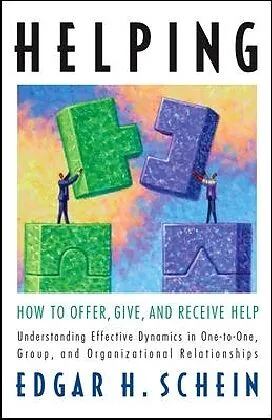
Helping How to Offer, Give, and Receive Help
Beschreibung
Helping is a fundamental human activity, but it can also be a frustrating one. All too often, to our bewilderment, our sincere offers of help are resented, resisted, or refused--and we often react the same way when people try to help us. Why is it so difficult...Format auswählen
- BroschiertCHF 25.90

Wird oft zusammen gekauft
Andere Kunden kauften auch
Beschreibung
Helping is a fundamental human activity, but it can also be a frustrating one. All too often, to our bewilderment, our sincere offers of help are resented, resisted, or refused--and we often react the same way when people try to help us. Why is it so difficult to provide or accept help? How can we make the whole process easier? In this seminal book on the topic, corporate culture and organizational development guru Ed Schein analyzes the social and psychological dynamics common to all types of helping relationships, explains why help is often not helpful, and shows what any would-be helpers must do to ensure that their assistance is both welcomed and genuinely useful. The moment of asking for and offering help is a delicate and complex one, fraught with inequities and ambiguities. Schein helps us navigate that moment so we avoid potential pitfalls, mitigate power imbalances, and establish a solid foundation of trust. He identifies three roles a helper can play, explaining which one is nearly always the best starting point if we are to provide truly effective help. So that readers can determine exactly what kind of help is needed, he describes an inquiry process that puts the helper and the recipient on an equal footing. These dynamics not only apply to all kinds of one-on-one helping in personal and professional relationships, teaching, social work, and medicine but also can be usefully applied to teamwork and to organizational leadership. Using examples from many types of relationships--doctors and patients, consultants and clients, husbands and wives--Ed Schein offers a concise, definitive analysis of what it takes to establish successful, mutually satisfying helping relationships.
ldquo;An uncommonly wise book about a topic achingly overlooked and so indispensable for how we live our lives, professional or personal. I honestly cannot imagine any leader, teacher, consultant, therapist, anybody who wouldn’t benefit from reading this masterpiece.”
**—Warren Bennis, Distinguished Professor of Business Administration, University of Southern California, and coauthor of Judgment and Transparency
“At once conceptually rigorous and eminently practical, Schein has given us a new classic—a highly readable, indispensable work that is bound to be read and reread, each time offering the reader new and profound insights into one of life's most important forms of social interaction.”
—Marc Gerstein, PhD, President, Organization Design Forum, and author of *Flirting with Disaster: Why Accidents Are Rarely Accidental
“This little book is a treasure; I will not be able to offer help again without thinking about and using these simple but powerful tools of communication. Ed Schein’s personal stories are heartfelt and ones to which we can all relate; his tips for giving and receiving truly desirable and effective help are clear gems of wisdom.”
**—Tania Zouikin, former Chair and CEO, Batterymarch Financial
**
Autorentext
Ed Schein was educated at the University of Chicago, Stanford University (where he received a master’s degree in psychology in 1949), and Harvard University (where he received his Ph.D. in social psychology in 1952). He has taught at the MIT Sloan School of Management since 1956 and was named the Sloan Fellows Professor of Management in 1978. He is currently professor emeritus. He is the author of many articles and books, most recently Process Consultation Revisited (1999), The Corporate Culture Survival Guide (1999), and DEC Is Dead: Long Live DEC (2003). His book Organizational Culture and Leadership, 3rd ed. (2004) has defined the field of organizational culture. He has consulted with many organizations in the United States and overseas on organizational culture, organization development, process consultation, and career dynamics. What has distinguished Schein’s work is his combination of sociology, anthropology, and social psychology, as illustrated in this book.
Klappentext
Helping is a fundamental human relationship. From a mother feeding her infant to a friend or spouse helping to make something happen, to a group member playing his or her role to help the group to succeed, to a therapist helping a patient, to an organizational consultant or coach helping to improve individual, group or organizational functioning, helping is the basic relationship that moves things forward. Yet, paradoxically, we know relatively little about the social and psychological dynamics of that relationship.In this seminal book on the topic, corporate culture and organizational development guru Ed Schein analyzes the dynamics of helping relationships, explains why help is often not helpful, and shows what any would-be-helper must do to insure that help is actually provided.Many different words are used for helping assisting, aiding, advising, coaching, consulting, counseling, guiding, mentoring, supporting, teaching, and many more but they all have common dynamics and processes. Schein exposes and shows how to resolve the inequities and role ambiguities of helping relationships, describes the different roles that helpers can take once the relationship is balanced, and explains how to build a balanced relationship and how to intervene as that relationship develops, In this short but profound book Schein examines the social dynamics that are at play in helping relationships in order to better understand why offers of help are sometimes refused or resented, and how to make help more useful and effective.
Zusammenfassung
**A Strategy+Business Best Leadership Book of the Year: An “uncommonly wise” analysis of the psychological and social dynamics of helping relationships (Warren Bennis, author of On Becoming a Leader).**
Helping is a fundamental human activity, but it can also be a frustrating one. All too often, to our bewilderment, our sincere offers of help are resented, resisted, or refused—and we often react the same way when people try to help us. Why is it so difficult to provide or accept help? How can we make the whole process easier?
Many words are used for helping: assisting, aiding, advising, caregiving, coaching, consulting, counseling, guiding, mentoring, supporting, teaching, and more. In this seminal book on the topic, corporate culture and organizational development guru Ed Schein analyzes the social and psychological dynamics common to all types of helping relationships, explains why help is often not helpful, and shows what any would-be helpers must do to ensure that their assistance is both welcomed and genuinely useful. He shows how to navigate the delicate acts of asking for or offering help; avoid pitfalls; mitigate power imbalances; and establish a solid foundation of trust—and how these techniques can be applied to teamwork and organizational leadership.
From the bestselling author of Organizational Culture and Leadership, and illustrated with examples from many types of relationships—husbands and wives, doctors and patients, consultants and clients—Helping is a concise, definitive analysis of what it takes to establish successful, mutually satisfying helping relationships.
Leseprobe
Helpful and Unhelpful Help
Helping is a complex phenomenon. There’s helpful help and unhelpful help. This book is written to shed light on the difference between the two. In my career as a professor and sometimes consultant I often reflect on what is helpful and what is not, why some classes go well and others do not, why coaching and experiential learning are often more successful than formal lectures. When I am with organizational clients, why does it work better to focus on process rather than content, or how things are done rather than what is done? My goal in this book is to provide the re…