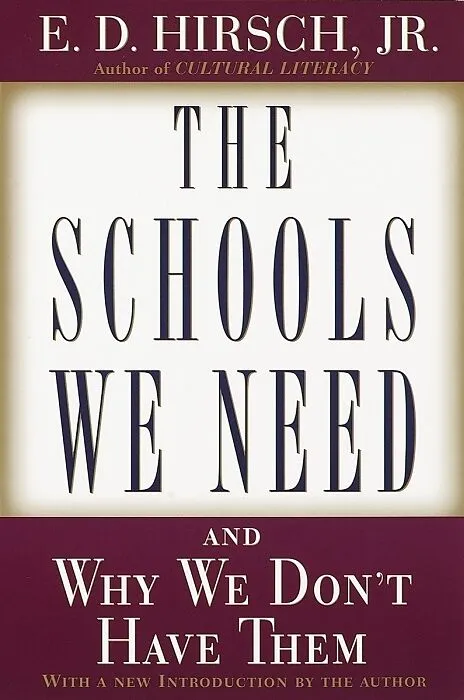
The Schools We Need
Beschreibung
Zusatztext "Offers a penetrating and compelling analysis of how! despite the good intentions of educators! bad ideas and failed theories now characterize American education." -- The Indianapolis Star "A brilliant! combative! and intensely practical discussion ...Format auswählen
- Kartonierter EinbandCHF 21.10

Wird oft zusammen gekauft
Andere Kunden kauften auch
Beschreibung
Zusatztext "Offers a penetrating and compelling analysis of how! despite the good intentions of educators! bad ideas and failed theories now characterize American education." -- The Indianapolis Star "A brilliant! combative! and intensely practical discussion of how our education system got into its current mess and what we must do to pull it out." --Donna Fowler! American Federation of Teachers "A damning! highly provocative! full-scale assault on today's educational establishment." -- Publishers Weekly Informationen zum Autor E.D. Hirsch, Jr. Klappentext This paperback edition, with a new introduction, offers a powerful, compelling, and unassailable argument for reforming America's schooling methods and ideas--by one of America's most important educators, and author of the bestselling Cultural Literacy. For over fifty years, American schools have operated under the assumption that challenging children academically is unnatural for them, that teachers do not need to know the subjects they teach, that the learning "process" should be emphasized over the facts taught. All of this is tragically wrong. Renowned educator and author E. D. Hirsch, Jr., argues that, by disdaining content-based curricula while favoring abstract--and discredited--theories of how a child learns, the ideas uniformly taught by our schools have done terrible harm to America's students. Instead of preparing our children for the highly competitive, information-based economy in which we now live, our schools' practices have severely curtailed their ability, and desire, to learn. With an introduction that surveys developments in education since the hardcover edition was published, The Schools We Need is a passionate and thoughtful book that will appeal to the millions of people who can't understand why America's schools aren't educating our children. Leseprobe Take a young boy or girl from a typical American family who goes to a typical American school, and imagine that child growing up in France or Germany, Japan or Taiwan. Few would choose to make the experiment. Most Americans believe, as do I, that this country, with its traditions of political freedom and its generous optimism, is the greatest country in the world. But the evidence is strong that that very same young child would grow up more competent in those other countries than in the United States--through having learned much, much more at school in the early grades. Although our political traditions and even our universities may be without peer, our K-12 education is among the least effective in the developed world. Its controlling theories, curricular incoherencies, and what I call its "naturalistic fallacies" are positive barriers to a good education. Scholars from abroad who study American schools are astonished that our children, who score very low in international comparisons, are actually as competent as they manage to be. Considering their very American vitality and independent-mindedness, one thinks ruefully of what these children could become under a good, demanding, and fair educational system! The importance of theories in human affairs was memorably stated by John Maynard Keynes: "Practical men, who believe themselves to be quite exempt from any intellectual influences, are usually the slaves of some defunct economist. It is ideas, not vested interests, that are dangerous for good or evil." Keynes's observation was confirmed on a grand scale by the fall of communism, which consisted less in a failed political arrangement than in a failed socioeconomic theory that did not accord with the realities it claimed to describe and predict. If thousands of Marxist thinkers could have been caught for decades in the grip of a wrong socioeconomic theory, it is not beyond imagination that a cadre of American educational experts could have been captivated by wrong theories over roug...
"Offers a penetrating and compelling analysis of how, despite the good intentions of educators, bad ideas and failed theories now characterize American education."
--The Indianapolis Star
"A brilliant, combative, and intensely practical discussion of how our education system got into its current mess and what we must do to pull it out."
--Donna Fowler, American Federation of Teachers
"A damning, highly provocative, full-scale assault on today's educational establishment."
--Publishers Weekly
Autorentext
E.D. Hirsch, Jr.
Klappentext
This paperback edition, with a new introduction, offers a powerful, compelling, and unassailable argument for reforming America's schooling methods and ideas--by one of America's most important educators, and author of the bestselling Cultural Literacy.
For over fifty years, American schools have operated under the assumption that challenging children academically is unnatural for them, that teachers do not need to know the subjects they teach, that the learning "process" should be emphasized over the facts taught. All of this is tragically wrong.
Renowned educator and author E. D. Hirsch, Jr., argues that, by disdaining content-based curricula while favoring abstract--and discredited--theories of how a child learns, the ideas uniformly taught by our schools have done terrible harm to America's students. Instead of preparing our children for the highly competitive, information-based economy in which we now live, our schools' practices have severely curtailed their ability, and desire, to learn.
With an introduction that surveys developments in education since the hardcover edition was published, The Schools We Need is a passionate and thoughtful book that will appeal to the millions of people who can't understand why America's schools aren't educating our children.
Leseprobe
Take a young boy or girl from a typical American family who goes to a typical American school, and imagine that child growing up in France or Germany, Japan or Taiwan. Few would choose to make the experiment. Most Americans believe, as do I, that this country, with its traditions of political freedom and its generous optimism, is the greatest country in the world. But the evidence is strong that that very same young child would grow up more competent in those other countries than in the United States--through having learned much, much more at school in the early grades. Although our political traditions and even our universities may be without peer, our K-12 education is among the least effective in the developed world. Its controlling theories, curricular incoherencies, and what I call its "naturalistic fallacies" are positive barriers to a good education. Scholars from abroad who study American schools are astonished that our children, who score very low in international comparisons, are actually as competent as they manage to be. Considering their very American vitality and independent-mindedness, one thinks ruefully of what these children could become under a good, demanding, and fair educational system!
The importance of theories in human affairs was memorably stated by John Maynard Keynes: "Practical men, who believe themselves to be quite exempt from any intellectual influences, are usually the slaves of some defunct economist. It is ideas, not vested interests, that are dangerous for good or evil." Keynes's observation was confirmed on a grand scale by the fall of communism, which consisted less in a failed political arrangement than in a failed socioeconomic theory that did not accord with the realities it claimed to describe and predict. If thousands of Marxist thinkers could have been caught for decades in the grip of a wrong socioeconomic theory, it is not beyond imagination that a cadre of American educational experts could have been captivated by wrong theories over roughly the same period.
For as long as there has been a historical record, educational theories have wavered in emphasis between two opposed but equally important need…