
IHR WARENKORB IST AKTUELL LEER.
Haben Sie noch nichts passendes gefunden? Stöbern Sie durch unser komplettes Sortiment.
Oder melden Sie sich an bzw. registrieren Sie sich.
- Kostenlose Lieferung
- Kauf auf Rechnung
- Ex Libris Tiefpreis
- Filiallieferung und 650+ Abholorte
- Rabatt-Bons als Club-Mitglied
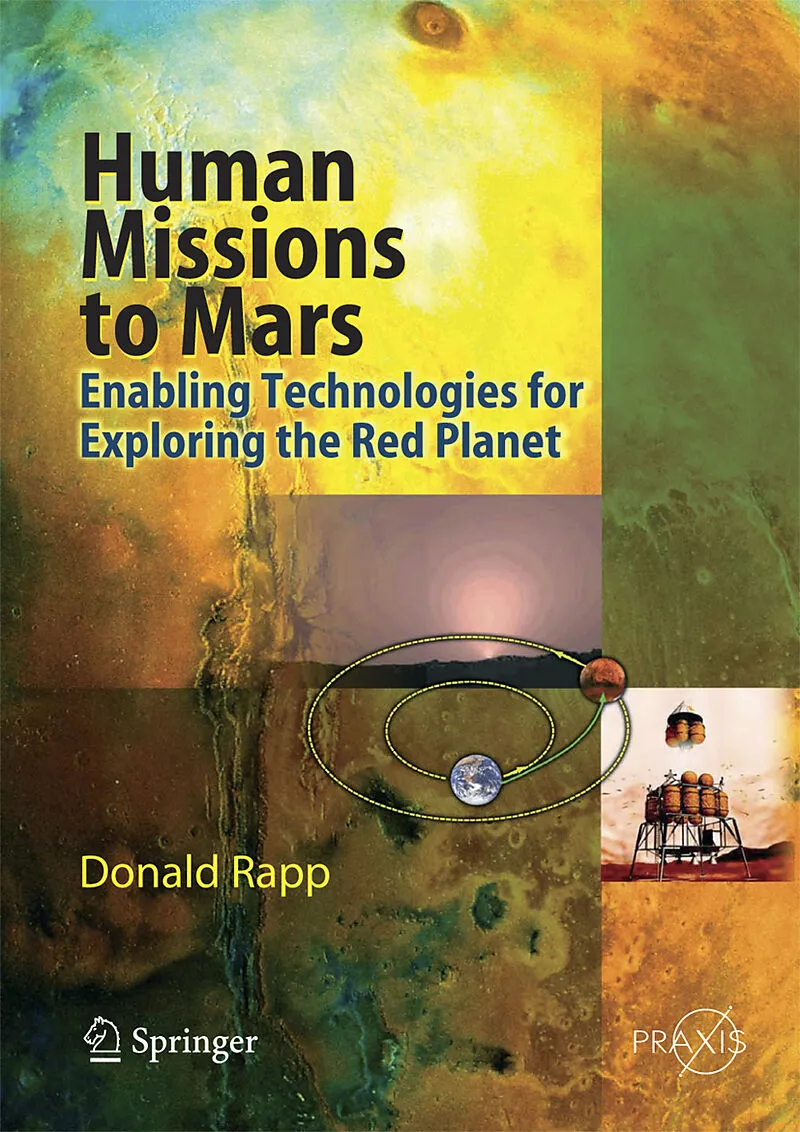
Human Missions to Mars
Beschreibung
In Human Missions to Mars Donald Rapp looks at human missions to Mars from an engineering perspective. He begins by describing the pros and cons of robotic exploration versus human exploration and then examines the ideas for sending humans to Mars from the po...
Format auswählen
- Kartonierter Einband (Kt)CHF 179.20

Wird oft zusammen gekauft
Andere Kunden kauften auch
Beschreibung
In Human Missions to Mars Donald Rapp looks at human missions to Mars from an engineering perspective. He begins by describing the pros and cons of robotic exploration versus human exploration and then examines the ideas for sending humans to Mars from the point of view of both the enthusiast and the skeptic. Chapter 2 describes how space missions are planned and how they may be achieved as a sequence of separate steps. Chapter 3 deals with the complex issues relating to the outward journey to Mars and the return leg. The author deals with propulsion systems and with the analysis of the various trajectories which may be utilized for such a mission. He divides mission into a number of stages: Earth's surface to low-Earth orbit (LEO); departing from LEO; Mars orbit insertion and landing; ascent from Mars; trans-Earth injection from Mars orbit and Earth orbit insertion and landing. Chapter 4 discusses a wide range of elements critical to a human Mars mission, including life support consumables, radiation effects and shielding, microgravity effects, abort options and mission safety, possible habitats on the Martian surface and aero assisted orbit insertion and entry decent and landing.
For any human mission to the Red Planet the possible utilization of any resources indigenous to Mars would be of great value and such possibilities are discussed in Chapter 5. The use of indigenous resources on the Moon is described as a precursor to the availability of similar resources on Mars and issues such as fuelling Mars-bound craft from lunar resources, the use of lunar ferries, staging, assembly and refueling in near-Earth space are all discussed. The important applications arising from the transportation of hydrogen to Mars are also described. Chapter 6 deals with a range of previous Mars mission studies and the technologies they employed. Chapter 7 looks as how NASA is planning for its return to the Moon, and the use of the Moon as a stepping stoneto Mars. Chapter 8 presents the author's detailed analysis of why, in his opinion, the current NASA approach will fail to send humans to Mars before 2080. The book concludes with three appendices describing the use of solar energy on the Moon and on Mars and the value of indigenous water on Mars.
A highly readable yet realistic view of the possibilities for human missions to Mars Provides for the first time a 'level-headed' assessment of plans for human exploration of Mars to counteract the tendency of space agencies to take an over-optimistic approach to such interplanetary missions Collects together into a single, handy reference, a wide range of material on human missions to Mars that is currently widely dispersed and fragmented in the literature Describes in detail the requirements and characteristics of human missions to Mars and assesses current space agency plans in the light of such requirements Contains a large number of black and white and colour illustrations and line diagrams illustrating the many practical aspects of planning and executing human missions to Mars
Autorentext
Donald Rapp was full professor of physics at the University of Texas 1969-1979, and Chief Technologist of the Mechanical and Chemical Engineering Division of JPL from 1979 to 2002. He was manager of the Mars Exploration Technology Program at JPL for a period, and he was manager of the In Situ Propellant Production (ISPP) task in this Program. He wrote a landmark report on converting Mars resources into usable propellants for return to Earth. He wrote the Mars Technology Program Plan in 2001. He was proposal manager at JPL for two missions that were implemented in space: Suess-Urey mission to collect solar wind, and Deep Impact to observe interior of a comet. During the period 2001-2002, he played an important role in JPL efforts in developing concepts for utilization of extraterrestrial resources in Mars missions. In 2002 he wrote the NASA Office of Space Science Technology Blueprint for Harley Thronson, NASA Technology Director, a 100-page assessment of technology needs and capabilities for future missions. In the period 2003-2006, he prepared a revised and expanded version of the Technology Blueprint for Harley Thronson at NASA HQ. In 2004, he was Proposal Manager for a proposal for a ground-penetrating radar experiment for the Mars Science Laboratory as well as a glider mission on Mars. In the period 2004-2006, he concentrated on mission design for Mars and lunar human missions. This work led to his writing the book Human Missions to Mars that was published by Praxis/Springer in 2007. This was a major work, comprising 520 pages with over 200 figures. It included a chapter on in situ resource utilization (ISRU) on Mars. He was the lead person at JPL for ISRU technology for several decades. In this role, he carried out research and analysis leading to a number or reports and publications through the 1980s, 1990s and into the 2000s. Since 2014, he has been Co-Investigator on the Mars OXygen In Situ Experiment(MOXIE) that operated on Mars in 2021-022 to routinely produce oxygen from Martian carbon dioxide. The original book Human Missions to Mars was updated to a second edition in 2015, and is now presented as a third edition in 2022 with many new references and updates.
Klappentext
In Human Missions to Mars Donald Rapp looks at human missions to Mars from an engineering perspective. He begins by describing the pros and cons of robotic exploration versus human exploration and then examines the ideas for sending humans to Mars from the point of view of both the enthusiast and the skeptic. Chapter 2 describes how space missions are planned and how they may be achieved as a sequence of separate steps. Chapter 3 deals with the complex issues relating to the outward journey to Mars and the return leg. The author deals with propulsion systems and with the analysis of the various trajectories which may be utilized for such a mission. He divides mission into a number of stages: Earth s surface to low-Earth orbit (LEO); departing from LEO; Mars orbit insertion and landing; ascent from Mars; trans-Earth injection from Mars orbit and Earth orbit insertion and landing. Chapter 4 discusses a wide range of elements critical to a human Mars mission, including life support consumables, radiation effects and shielding, microgravity effects, abort options and mission safety, possible habitats on the Martian surface and aero assisted orbit insertion and entry decent and landing. For any human mission to the Red Planet the possible utilization of any resources indigenous to Mars would be of great value and such possibilities are discussed in Chapter 5. The use of indigenous resources on the Moon is described as a precursor to the availability of similar resources on Mars and issues such as fuelling Mars-bound craft from lunar resources, the use of lunar ferries, staging, assembly and refueling in near-Earth space are all discussed. The important applications arising from the transportation of hydrogen to Mars are also described. Chapter 6 deals with a range of previous Mars mission studies and the technologies they employed. Chapter 7 looks as how NASA is planning for its return to the Moon, and the use of the Moon as a stepping stoneto Mars. Chapter 8 presents the author s detailed analysis of why, in his opinion, the current NASA approach will fail to send humans to Mars before 2080. The book concludes with three appendices describing the use of solar energy on the Moon and on Mars and the value of indigenous water on Mars.
Inhalt
Why explore Mars?.- Planning space campaigns and missions.- Getting there and back.- Critical Mars mission elements.- In situ utilization of indigenous resources.- Mars mission analysis.- How NASA is dealing with return to the Moon.- Why the NASA approach will likely fail to send humans to Mars prior to c. 2080.


