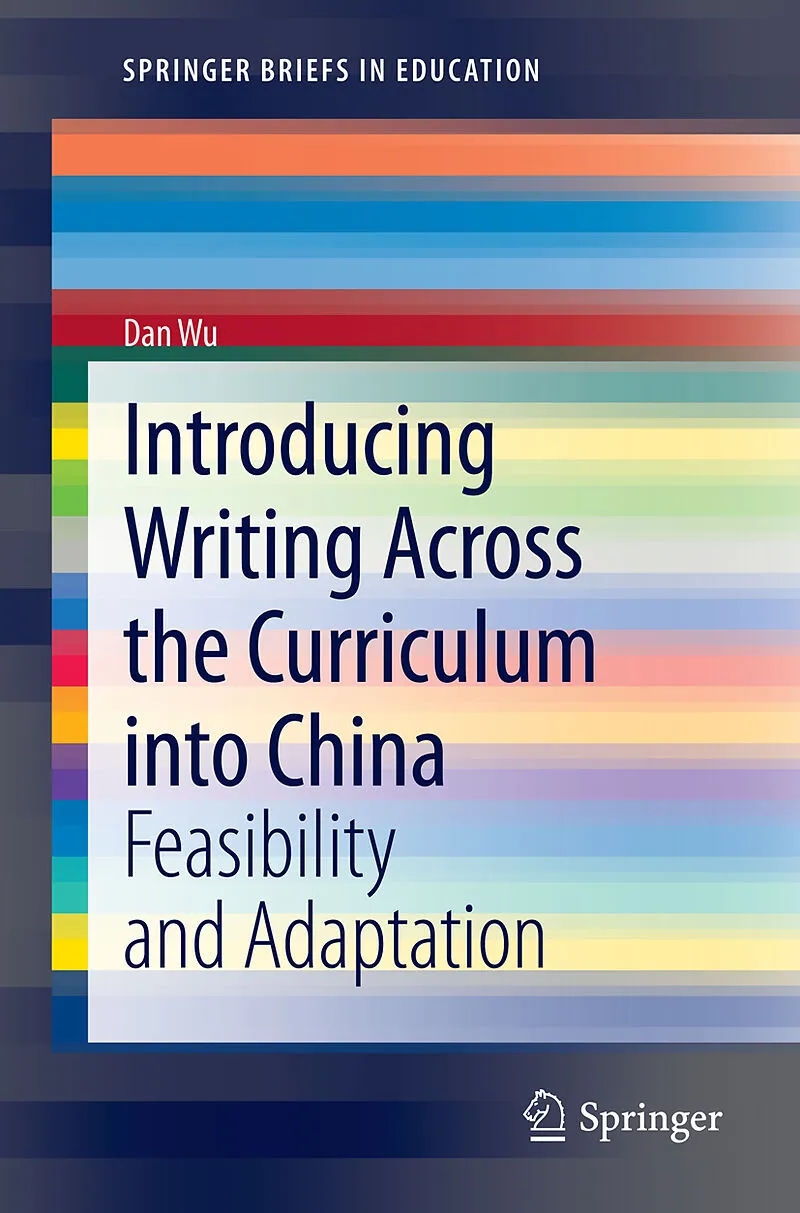
Introducing Writing Across the Curriculum into China
Beschreibung
Dr. Wu Dan's Introducing Writing Across the Curriculum into China is an important and provocative research study that is broadly international in scope. Of particular significance for education in China, this book provides a historical analysis of writing inst...Format auswählen
- Kartonierter EinbandCHF 62.40
- E-Book (pdf)CHF 66.90

Wird oft zusammen gekauft
Andere Kunden kauften auch
Beschreibung
Dr. Wu Dan's Introducing Writing Across the Curriculum into China is an important and provocative research study that is broadly international in scope. Of particular significance for education in China, this book provides a historical analysis of writing instruction in China and an original application of activity theory used to analyze problems and possibilities for Writing Across the Curriculum (WAC) in higher education. Through an examination of important aspects of WAC as it has developed in the United States, Dr. Wu Dan brings together various perspectives in support of developing and sustaining WAC programs in China and by analogy throughout the world. Her work opens new avenues for research in writing and for the teaching of courses throughout the curriculum using a writing-in-the-disciplines approach. A major contribution to international WAC scholarship, Introducing Writing Across the Curriculum into China will be invaluable to English faculty and to all readers interested in educational innovations in China.
Numerous step-by-step tutorials help the reader to learn quickly A special chapter on next generation Flash prepares readers for the future Includes ten tips on how to protect flash sites from hackers Includes supplementary material: sn.pub/extras
Autorentext
Xin Wei is a professor at Nanjing University of Posts and Telecommunications, China. He earned his Bachelor's degree from Nanjing University of Posts and Telecommunications in 2005, and obtained his Ph.D. from Southeast University, China, in 2009. From 2010 to 2011, he conducted postdoctoral research at Zhejiang University in China. His research interests include the areas of multimedia communications, educational technology, smart buildings. In recent years, he has published numerous academic papers in journals like IEEE JSAC, IEEE TCOM, IEEE TCSVT, IEEE TMM, IEEE WCM, Computers & Education, Interactive Learning Environments, Building and Environment, Energy & Buildings. He won the IEEE TMM Best Paper Award in 2024. Dan Wu is professor in Army Engineering University of PLA, China. She earned her Bachelor's, Master's, and Ph. D. degrees from the Institute of Communications Engineering, PLA University of Science and Technology, China in 2006, 2009, and 2012, respectively. Her research interests are in the areas of multimedia communications and wireless communications. Liang Zhou is a professor and vice president at Nanjing University of Posts and Telecommunications, China. He earned his Bachelor's and Master's degrees from Nanjing University of Posts and Telecommunications in 2003 and 2006, respectively, and obtained his Ph.D. from Paris-Saclay University, France, and Shanghai Jiao Tong University, China, in 2009. Following this, he conducted postdoctoral research at ParisTech in France and the MIT in the USA. From 2010 to 2011, as a Humboldt Scholar, he carried out research at the Technical University of Munich in Germany. He has been honored with titles such as Distinguished Professor by the Ministry of Education (2020), National Excellent Young Scientist Fund (2013); His research primarily focuses on multimedia communications and intelligent communications. In recent years, he has published numerous academic papers in journals like Nature Communications, IEEE JSAC. He has led key projects funded by the National Natural Science Foundation of China, as well as industry-academia collaboration projects with companies like Huawei and ZTE. Currently, he serves as the Chair of the Multimedia Communications Technical Committee of the IEEE Communications Society, Director of the Professional Committee of the China Institute of Communications, and is an editorial board member for academic journals such as IEEE Transactions on Communications, IEEE Transactions on Vehicular Technology, IEEE Internet of Things Journal, IEEE Wireless Communications, and IEEE Network. He is an IEEE Fellow/IET Fellow/BCS Fellow/AAIA Fellow.
Klappentext
Dr. Wu Dan's Introducing Writing Across the Curriculum**into China is an important and provocative research study that is broadly international in scope.
Of particular significance for education in China, this book provides a historical analysis of writing instruction in China and an original application of activity theory used to analyze problems and possibilities for Writing Across the Curriculum (WAC) in higher education. Through an examination of important aspects of WAC as it has developed in the United States, Dr. Wu Dan brings together various perspectives in support of developing and sustaining WAC programs in China and by analogy throughout the world.
Her work opens new avenues for research in writing and for the teaching of courses throughout the curriculum using a writing-in-the-disciplines approach. A major contribution to international WAC scholarship, Introducing Writing Across the Curriculum into China will be invaluable to English faculty and to all readers interested in educational innovations in China.
Inhalt
I. INTRODUCTION.-Research Problem, Questions, and Significance.-Methods.-Organization of the Study.-II. A REVIEW OF WAC .-WAC Evolution.-CAC Evolution.-Activity Theory and WAC Research.-The International Dissemination of WAC.-III. CHINESE HIGHER EDUCATION.-The Chinese Higher Education System.-Reforms and Current Issues.-Chinese Political Culture and Its Impacts on Higher Education.-Opportunities and Challenges for Introducing WAC.-IV. METHODS.-Participants.-Materials.-Interview Questions.-Table of Contents (Continued).-Administration.-V. CHINA INTERVIEWS QUALITATIVE RESULTS.-A Thematic Analysis of Chinese Interviews Results.-Chinese Interview Results Reflected in Activity Systems.-VI. US WAC INTERVIEWS QUALITATIVE RESULTS.-US WAC Interviews Results.-A Comparison/Contrast of the Results from the US and China Interviews.-VII. CONCLUSION.-Critical Findings.-Theoretical Implications.-Empirical Implications.-Limitations.-Directions for Future Research.-Conclusion.-APPENDICES.-A: Chinese Interview Questions.-B: US WAC Interview Questions.-REFERENCES.