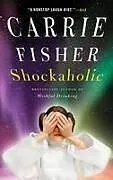
Shockaholic
Beschreibung
Presents a memoir about the actress' relationship with her father, singer Eddie Fisher, her electroconvulsive therapy, and her past encounters with such recently-deceased celebrities as Michael Jackson, Elizabeth Taylor, and Senator Edward Kennedy. Autorentext...Format auswählen
- Kartonierter EinbandCHF 17.00

Wird oft zusammen gekauft
Andere Kunden kauften auch
Beschreibung
Presents a memoir about the actress' relationship with her father, singer Eddie Fisher, her electroconvulsive therapy, and her past encounters with such recently-deceased celebrities as Michael Jackson, Elizabeth Taylor, and Senator Edward Kennedy.
Autorentext
Carrie Fisher
Klappentext
This memoir from the bestselling author of Postcards from the Edge and Wishful Drinking gives you an intimate, gossip-filled look at what it’s like to be the daughter of Hollywood royalty.
Told with the same intimate style, brutal honesty, and uproarious wisdom that locked Wishful Drinking on the New York Times bestseller list for months, Shockaholic is the juicy account of Carrie Fisher’s life. Covering a broad range of topics—from never-before-heard tales of Hollywood gossip to outrageous moments of celebrity desperation; from alcoholism to illegal drug use; from the familial relationships of Hollywood royalty to scandalous run-ins with noteworthy politicians; from shock therapy to talk therapy—Carrie Fisher gives an intimate portrait of herself, and she’s one of the most indelible and powerful forces in culture at large today. Just as she has said of playing Princess Leia—“It isn’t all sweetness and light sabers”—Fisher takes readers on a no-holds-barred narrative adventure, both laugh-out-loud funny and poignant.
Leseprobe
Oy! My Pa - Pa
I didn’t see my father all that much growing up, which resulted in him becoming a kind of mythic figure to me. I probably knew as much about him as some of his more rabid fans. I’d been told stories by other relatives of ours about how he would make plans to come pick up Todd and me and then not show up. This apparently occurred enough so that by the time I was three, when someone would tell me, “Your dad’s coming!” I would shrug as near to indifferently as possible and say, “Maybe.”
Several years later, after his marriage to Elizabeth Taylor had come to an end, he was living in an Asian-looking house in a development called Beverly Estates, located up on a hill overlooking, of all things, other Asian-looking houses in what is now part of Benedict Canyon. Now, my father was not what you might think of as an industrious type person. I mean, if you could get something done for you by someone else, my dad would have it done (obviously with the exception of having sex), so, to assist him in his very basic existence, he had this very capable, imposing black man named Willard, a man who he referred to as his “butler” as people still did in those days. Willard, who actually dressed like a butler, in a white jacket and black pants, pretty much took care of my dad for about twenty years. You might say he made my father—an extremely charming womanizing drug enthusiast—possible. He looked after him and cleaned up after him and even sometimes fed him (on the rare occasions that he ate, because by then he was shooting speed, courtesy of the original Dr. Feelgood, Dr. Max Jacobson).
I remember this one time, when my father was living with this beautiful Scandinavian Playboy model named Ula, my brother and I were going to spend the night. Amazing, right!? A sleepover at Dad’s! But somehow my mom found out that he was living in sin with Ula, who also happened to be a Playboy model. So, when the four of us got back from the movies, there was my mom’s Cadillac in the driveway, with her leaning against it, furiously smoking a cigarette. Then she waited while we gathered up our overnight bags and drove us home in uncomfortable silence, Todd and I staring gloomily into our laps.
On another occasion, when I was about thirteen, I remember taking a walk with him down the road near his home. So, you know, what do you say to someone who really didn’t know how to ask questions and coincidentally happened to be your father? I mean, our exchanges never really went much beyond an assortment of, “How are you?” or “What grade are you in now?” or “What’s your favorite subject?” This time though he turned to me quite casually and said, “I see you’re developing breasts.”
Naturally, I didn’t really know how to respond to this. I mean, maybe it would have been different if he’d been more of a . . . well, a more present sort of parent, you know? Like where there are a sufficient assortment of other subjects that we could discuss that might, say, provide us with any kind of context where that exchange could maybe occur, right? But all out there on its own . . . I have to say, well, it was awkward, to say the least.
Here’s the thing. Very early on in my father’s life it became obvious that he possessed a beautiful singing voice. Untrained, undeveloped, it just emerged—strong, pure, remarkable. So, from a very early age he was singing professionally, performing initially at bar mitzvahs. And somehow there wasn’t a huge leap from being the most gifted bar mitzvah boy to headlining in the Catskills.
I could go back and check one of his two autobiographies, but from what I can recall, my father was winning talent contests and appearing on local radio shows beginning at the age of twelve or thirteen, so that by the time he was fifteen, he had officially been “discovered” by none other than Eddie Cantor.
The upshot of this early career download is, my father was treated like a celebrity from a very early age. He had six siblings, but his mother doted on him. Clearly, he was her favorite, her Sonny Boy, dark haired and adorable. And it did not stop with his mom. No, from the first, all the girls loved him. And as such, whatever rules there were simply didn’t apply to him. He was young, he was talented, he was handsome, and he was Jewish. What more could you ask for? So by the time he was eighteen, my father was making more money than his father, and by the time he was twenty-one, he was making more than his father ever had. So what all this came tumbling down to was that my father could do no wrong, or if he did do what might ordinarily be considered “wrong” for someone else, for him these were just some of the quirks that might be found in the very blessed and gifted.
In his universe, from the very earliest of formative years, his every gesture, every utterance, every otherwise inappropriate action was not only indulged but in many cases celebrated. I don’t say this to excuse him, but in a way he was somehow guileless. I don’t know how else to describe it. I mean, he just . . . he always seemed to be able to assume the best about others—especially women, of course—and he was always ALWAYS up for a good time.
After the developing breasts talk, I think there was a seven-year gap where, instead of merely having no relationship, we had no relationship at all. Then, suddenly somehow it was 1977, the year everything changed. I was living in New York on the Upper West Side. Star Wars had opened recently, and I happened to be in it, and my life . . . I mean, what can you say after that? No, I’m really asking you? What can you say? Well, whatever it is, there’s every chance it would be said in a very weird robotic voice. Coincidentally, this happened at almost the exact same time when my term as a teenager was up. But because I had been in Star Wars, for the first time I could afford my very own apartment. I paid the rent with checks that had my name on them, money I’d earned by playing Princess Leia Organa in a movie that was so popular—so unbelievably popular—that it took whatever my life had been up to that point and transformed it into this very different thing. I mean, sure I’d spent my whole life around …