Beschreibung
Autorentext Arran Hamilton is Group Director of Education at Cognition Education. Previously he has held senior positions at Cambridge University Press & Assessment, Education Development Trust, the British Council, Nord Anglia Education, and a research fellow...Autorentext
Arran Hamilton is Group Director of Education at Cognition Education. Previously he has held senior positions at Cambridge University Press & Assessment, Education Development Trust, the British Council, Nord Anglia Education, and a research fellowship at Warwick University. His core focus is on translating evidence into impact at scale, and he has overseen the design, delivery, and evaluation of education programs across the Pacific Islands, East Asia, the Middle East, United Kingdom, Australia, and New Zealand. Arran's recent publications include The Gold Papers and The Lean Education Manifesto.
John Hattie is Emeritus Laureate Professor at the Melbourne Graduate School of Education at the University of Melbourne, Co-Director of the Hattie Family Foundation, and Chair of the Board of the Australian Institute for Teaching and School Leadership. He is an award-winning education researcher and best-selling author with nearly 30 years of experience examining what works best in student learning and achievement. His research, better known as Visible Learning, is a culmination of nearly 30 years synthesizing more than 1,700 meta-analyses comprising more than 100,000 studies involving over 300 million students around the world. He has presented and keynoted in over 350 international conferences and has received numerous recognitions for his contributions to education. His notable publications include Visible Learning, Visible Learning for Teachers, Visible Learning and the Science of How We Learn, and Building to Impact.
Dylan Wiliam is emeritus professor of educational assessment at UCL Institute of Education. He started his career teaching in inner-city London schools before transitioning to educational research. He was dean of the School of Education at King's College London, senior research director at the Educational Testing Service in Princeton, US, and deputy director of the Institute of Education, University of London. His research has focused on the use of assessment to support learning (sometimes called formative assessment), and he now works with groups of teachers all over the world on developing formative assessment practices. Dylan's recent books include Creating the Schools Our Children Need and Embedded Formative Assessment.
Klappentext
Dial back and make room for impact
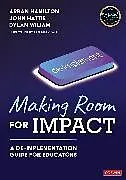
With teacher and leader workloads and burnout at an all-time high, it's time for de-implementation: de-prioritizing and deleting the less effective, higher-cost initiatives we implement in schools. De-implementation allows us to focus on practices that have more supporting evidence and a higher probability of positive impact on students, and at the same time gain much-needed work-life balance.
In Making Room for Impact, the internationally respected education experts and authors provide a clear four-stage process for winnowing down teaching and learning to high-effect practices. Informed by the latest research in learning, education, healthcare, and psychology, each step and tool is designed to move educators through the hard parts of letting go. Inside, you'll find:
Inhalt
Foreword by Dr. Lyn Sharatt
Part 1: The Big Picture
Chapter 1: Why We Need to De-Implement (and Why it's Hard)
Chapter 2: Room for Impact: The Helicopter Overview
Part 2: Discover Stage
Chapter 3: Permit
Chapter 4: Prospect
Chapter 5: Postulate
Part 3: Decide Stage
Chapter 6: Propose
Chapter 7: Prepare
Chapter 8: Picture
Part 4: De-Implement Stage
Chapter 9: Proceed
Part 5: Re-Decide Stage
Chapter 10: aPpraise
Chapter 11: Propel
Conclusion