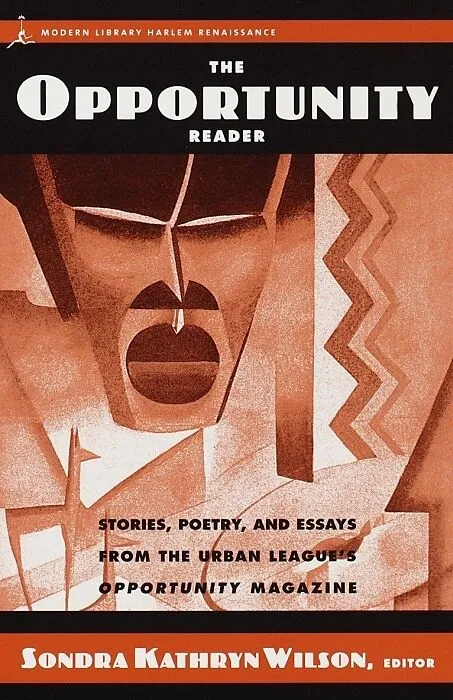
The Opportunity Reader
Beschreibung
Modern Library Harlem Renaissance In 1923, the Urban League's Opportunity magazine made its first appearance. Spearheaded by the noted sociologist Charles S. Johnson, it became, along with the N.A.A.C.P.'s Crisis magazine, one of the vehicles that drove the ar...Format auswählen
- Kartonierter EinbandCHF 37.50

Wird oft zusammen gekauft
Andere Kunden kauften auch
Beschreibung
Modern Library Harlem Renaissance In 1923, the Urban League's Opportunity magazine made its first appearance. Spearheaded by the noted sociologist Charles S. Johnson, it became, along with the N.A.A.C.P.'s Crisis magazine, one of the vehicles that drove the art and literature of the Harlem Renaissance. As a way of attracting writers such as Langston Hughes and Zora Neale Hurston, Johnson conducted literary contests that were largely funded by Casper Holstein, the infamous Harlem numbers gangster, who contributed several essays in addition to money. Dorothy West, Nella Larsen, and Arthur Schomburg were among Opportunity's contributors. Many of the pieces included in The Opportunity Reader have not been seen since their publication in the magazine, whose motto was "Not alms, but opportunity." The fertile artistic period now known as the Harlem Renaissance (1920-1930) gave birth to many of the world-renowned masters of black literature and is the model for today's renaissance of black writers.
Autorentext
Sondra Kathryn Wilson, Ph.D., is a researcher at Harvard University's W. E. B. Du Bois Institute. She is the literary executor of the James Weldon Johnson estate, and the editor of several volumes of his work. She is also the editor of Modern
Library's The Crisis Reader. She lives in New York City.
Klappentext
Modern Library Harlem Renaissance
In 1923, the Urban League's Opportunity magazine made its first appearance. Spearheaded by the noted sociologist Charles S. Johnson, it became, along with the N.A.A.C.P.'s Crisis magazine, one of the vehicles that drove the art and literature of the Harlem Renaissance. As a way of attracting writers such as Langston Hughes and Zora Neale Hurston, Johnson conducted literary contests that were largely funded by Casper Holstein, the infamous Harlem numbers gangster, who contributed
several essays in addition to money.
Dorothy West, Nella Larsen, and Arthur Schomburg were among Opportunity's contributors. Many of the pieces included in The Opportunity Reader have not been seen since their publication in the magazine, whose motto was "Not alms, but opportunity."
The fertile artistic period now known as the Harlem Renaissance (1920-1930) gave birth to many of the world-renowned masters of black literature and is the model for today's renaissance of black writers.
Leseprobe
INTRODUCTION
The story of African-Americans, the oldest minority group in this nation, began in 1619. For more than three centuries, black cultural sources and experiential themes have been the chief basis of African-American literature and art. Scholars have noted that this literary tradition was perpetuated because black writers studied the vernaculars, techniques, and themes by earlier writers with whom they felt a kindred spirit. This tradition, handed down from slavery, has always been dependent on its ability to relate to the political, social, and cultural aspects of African-American life. To the extent that Harlem Renaissance writers and writers of today exemplify this purpose is the extent to which they are really successful.
The prosperity of Harlem Renaissance writers like Eric D. Walrond, Alain Locke, James Weldon Johnson, Zora Neale Hurston, and Jessie Redmon Fauset reduced racial barriers and left conditions much more receptive for artists of today like Toni Morrison, Alice Walker, BeBe Campbell Moore, and Walter Moseley. As did their predecessors, today's black writers reflect in their writings the intellectual and cultural history of African-American life. This long-established literary tradition is uniquely significant, because when a race becomes successful in literature and art, that race has achieved one of its greatest guarantees of success.*
*See Joanne Braxton's introduction to The Work of the Afro-American Woman by Mrs. N. F. Mossell (New York: Oxford University Press, 1988), in the Schomburg Library of Nineteenth-Century Women Writers.
The writings in this volume were first published in the National Urban League's magazine, Opportunity- A Journal of Negro Life, between 1923 and 1931. These works exemplify a body of literature that generated the black literary movement of the 1920s known as the Harlem Renaissance.
Founded in New York City in 1910, the National Urban League was incorporated in 1913. The organization was established to service black migrants from rural areas by aiding them in securing sufficient education, employment, and housing. In essence, the Urban League's objective was to help blacks acclimatize to the unfamiliar hardships of urban life. The civil rights organization founded its official organ, Opportunity, in 1923. The new journal quickly became an apparatus for jump-starting the Harlem Renaissance. (The Crisis Reader, another volume in this series, discusses the role of the NAACP's Crisis magazine in the birth and development of the Harlem Renaissance.) Scholar David Levering Lewis writes that the Harlem Renaissance was "a somewhat forced phenomenon, a cultural nationalism of the parlor, institutionally encouraged and directed by leaders of the national civil rights establishment for the paramount purpose of improving race relations."
The Harlem Renaissance writer Arna Bontemps divided the black literary movement into two phases. Phase 1 (1921-1924) he deemed the period of black propaganda. Bontemps cited the NAACP's Crisis magazine and Opportunity as the most important supporters of phase 2 (1924-1931). These two influential journals devoted space to literature and social and political writings. Their efforts must be credited with generating interest in the artistic and intellectual side of Harlem. Phase 2 eventually connected Harlem writers to those members of the white intelligentsia who had access to establishment publishing entities. This connection proved essential in promulgating the Harlem Renaissance.
Prior to the 1920s, barriers based on race prejudice had prevented black artists from attaining the respect of the white publishing establishment. They had often been reduced to publishing either with unscrupulous publishing outfits or out of their own pockets. According to David Levering Lewis, no more than five significant literary writings by African-Americans were published between 1908 and 1923: Sutton Grigg's Pointing the Way (1908), WE.B. Du Bois's The Quest of the Silver Fleece (1908), James Weldon Johnson's The Autobiography of an Ex-Colored Man (1912), Du Bois's Darkwater (1920), Claude McKay's Harlem Shadow (1922), and Jean Toomer's Cane (1923).
During the first decade of their existence, in the early 1920s, both the NAACP and the Urban League proved effective in their respective arenas. The NAACP waged an unprecedented battle for justice OD the political front, while the Urban League aptly addressed the social ills of the day. Notwithstanding the efforts by the two leading civil rights organizations regarding the social and political questions, there was no cultural agenda for African Americans. It was during this time that WE.B. Du Bois noted that "until the art of black folk compels recognition, they will not be regarded as human." Black literature was a susceptible point for America because it had been malformed, misrepresented, and distributed by an established white literary system; black literature was inauthentic and represented an insolent imitation of an aspect of American literary history. Black leadership had to remedy this invalidity, which had exploited and skewed virtually every external view of African-American life. By the advent of the 1920s, though the NAACP and the Urban League were battling racism on political and social fronts, the time had come for these organizations to make a foray into American culture.
The NAACP and the Urban League, through their respective journals, met the challenge to reclaim through art and literature the status of black Ameri…