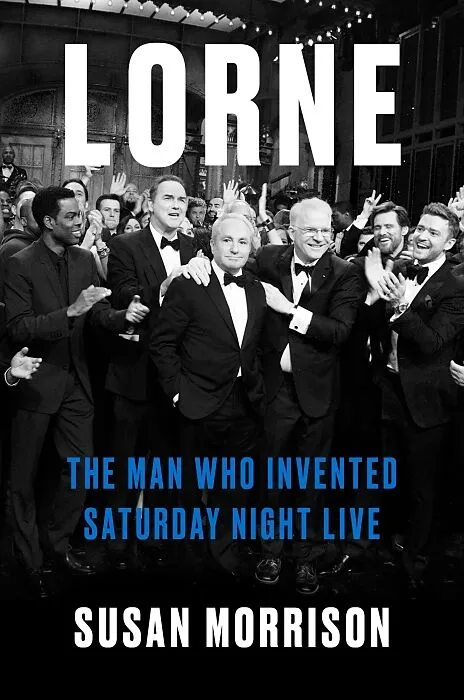
Lorne
Beschreibung
A definitive biography of Lorne Michaels, the man behind America’s most beloved comedy show Over the fifty years that Lorne Michaels has been at the helm of Drawn from hundreds of interviews--with Michaels, his friends, and SNL’s iconic stars and w...Format auswählen
- Fester EinbandCHF 38.00

Wird oft zusammen gekauft
Andere Kunden kauften auch
Beschreibung
A definitive biography of Lorne Michaels, the man behind America’s most beloved comedy show Over the fifty years that Lorne Michaels has been at the helm of Drawn from hundreds of interviews--with Michaels, his friends, and SNL’s iconic stars and writers, from Will Ferrell to Tina Fey to John Mulaney to Chris Rock to Dan Aykroyd--<Lorne< is a deeply reported, wildly entertaining account of a man singularly obsessed with the show that would define his life--and have a profound impact on American culture.
Autorentext
Susan Morrison is the articles editor of The New Yorker. She is the former editor in chief of the New York Observer and an original editor of SPY magazine. She lives in New York City.
Klappentext
**NEW YORK TIMES BESTSELLER • The definitive biography of Lorne Michaels, the man behind America’s most beloved comedy show
“The kind of biographical monument usually consecrated to founding fathers, canonical authors and world-historical scientific geniuses.”—The New York Times (Editors’ Choice)
“Readers are treated to the Holy Grail for any journalist hoping to crack the show: a warts-and-all week in the life of SNL, where Morrison gets to see the real process of putting the thing together.”—Variety
LONGLISTED FOR THE PEN/JACQUELINE BOGRAD WELD AWARD FOR BIOGRAPHY • A BEST BOOK OF THE YEAR: NPR, The New Yorker, Elle, Kirkus Reviews, Denver Public Library**
Over the fifty years that Lorne Michaels has been at the helm of Saturday Night Live, he has become a revered and inimitable presence in the entertainment world. He’s a tastemaker, a mogul, a withholding father figure, a genius spotter of talent, a shrewd businessman, a name-dropper, a raconteur, the inspiration for Dr. Evil, the winner of more than a hundred Emmys—and, essentially, a mystery. Generations of writers and performers have spent their lives trying to figure him out, by turns demonizing and lionizing him. He’s “Obi-Wan Kenobi” (Tracy Morgan), the “great and powerful Oz” (Kate McKinnon), “some kind of very distant, strange comedy god” (Bob Odenkirk).
Lorne will introduce you to him, in full, for the first time. With unprecedented access to Michaels and the entire SNL apparatus, Susan Morrison takes readers behind the curtain for the lively, up-and-down, definitive story of how Michaels created and maintained the institution that changed comedy forever.
Drawn from hundreds of interviews—with Michaels, his friends, and SNL’s iconic stars and writers, from Will Ferrell to Tina Fey to John Mulaney to Chris Rock to Dan Aykroyd—Lorne is a deeply reported, wildly entertaining account of a man singularly obsessed with the show that would define his life and have a profound impact on American culture.
Leseprobe
Chapter One
Toronto the Good
When Lorne Lipowitz was five years old, he decided to run away from home. His mother, Florence, played along, packing a little bag for him and walking him to the door of their house in the leafy Forest Hill neighborhood of Toronto. She asked him if he knew where he would be staying. “I’m going to live with a family that loves me,” he told her. Lorne’s little brother, Mark, who had been sitting on the stairs crying, looked up at his brother in the doorway. “What if they don’t have a television?” he asked. It was 1950, and the Lipowitzes were one of the families on the block whose living room contained a TV set. Lorne paused at the threshold. He put the suitcase down.
Before television, there were the movies. For as long as Michaels can remember, his parents would sit around the kitchen table with his mother’s parents and talk about Humphrey Bogart and Spencer Tracy and James Cagney. His maternal grandparents, Moishe and Sarah Becker, owned a movie theater, the College Playhouse, near the University of Toronto. (Florence had met her husband, Henry, whom she called “Lefty,” when she was working in the box office.) Each week they went downtown to the film exchange to choose a new picture. Natural programmers, they had a feel for what their neighborhood audience would show up for. The family had passionate opinions about movie stars, and discussed them with an easy intimacy. “They would stick with Jimmy Cagney in a bad movie because, on some level, they didn’t want to let him down,” Michaels recalled. The movie-star talk was so fond and familiar that Lorne grew up assuming that his parents and grandparents were friends with Bogart and the rest.
After school, Lorne would often walk to the College Playhouse to be looked after by his grandmother. Some days he would do his homework in the lobby; sometimes he’d slip into the theater and watch a bit of whatever was on, maybe a Randolph Scott picture.
If Lorne’s grandmother babysat the boys at night, she would turn on The Colgate Comedy Hour with Martin and Lewis, or Sid Caesar’s Your Show of Shows, and explain how the people on the small black-and-white screen fit into the larger ecosystem of show business. Lorne listened as she described the almost Darwinian way the performers had adapted, as vaudeville gave way to radio, and radio to movies, and movies to television. “She’d explain that Jack Benny had been a handsome young vaudeville player, then became a gray-haired man in radio; then, for television, he dyed his hair black,” Michaels remembers. His durable interest in the overlapping and interweaving of Hollywood generations began here.
Michaels and his friends went to the movies every Saturday afternoon, and whatever was playing is what they saw. He and Mark would ride their bikes to a theater on Eglinton Avenue. (Their sister, Barbara, nine years younger than Lorne, was too small for the movie outings.) Every so often, their father would drive them, a notable occasion for Lorne, who was always hungry for time with his dad. They saw westerns, Bowery Boys features, or adventure pictures, like The Crimson Pirate with Burt Lancaster. Lorne’s favorite movies, Casablanca for example, were hard-boiled with a core of sweetness. He did not like scary movies and still doesn’t. Like many kids, at four he was undone by The Wizard of Oz. “Nobody prepared me for the idea of pure evil,” he told me. When the flying monkeys darkened the screen, he had to be carried out of the theater.
Henry Lipowitz’s father, Aaron, had been a furrier who didn’t have great business sense. As an adult, Henry took over the family fur concern and turned it around, becoming successful enough to put his brother Harold through medical school and to go into an early semi-retirement. Henry was quiet, Florence a talker. The marriage wasn’t a great love affair, but Michaels remembers his parents as being close. Florence was an archetypal Jewish mother. “They had their way of dealing with each other,” Michaels recalled. “If she was driving him crazy with her anxiety, he would go out for the late edition of The Globe and Mail at ten o’clock at night. She’d say, ‘When will you be back?’ He’d say, ‘Soon.’ ”
Family friends describe Florence as having a “foghorn voice” and being “a real character.” Paul Pape, a schoolmate of Lorne’s, recalls her saying—for years on end—that a doctor had given her six months to live. “Comedy in that household was a defense,” Lorne’s cousin Neil Levy said. Rosie Shuster, a neighborhood girl who met Lorne when they were teenagers, said of Florence, “She would build Lorne up like he was a god amongst men. Unless he was there. Then she would te…