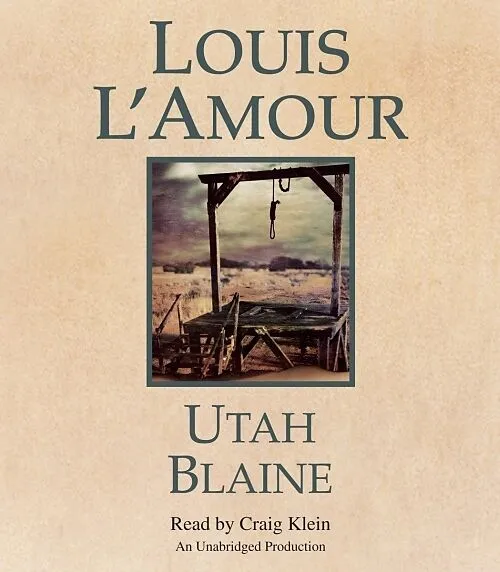
Utah Blaine
Beschreibung
Colonel Utah Blaine, held captive by the Army of the Revolution, broke out of jail and headed north from Mexico with nothing but the clothes on his back. Then he found new trouble struggling at the end of a noose–and stepped in just in time to save the l...Format auswählen
- Audio CD (CD/SACD)CHF 32.70

Wird oft zusammen gekauft
Andere Kunden kauften auch
Beschreibung
Colonel Utah Blaine, held captive by the Army of the Revolution, broke out of jail and headed north from Mexico with nothing but the clothes on his back. Then he found new trouble struggling at the end of a noose–and stepped in just in time to save the life of a Texas rancher. The would-be executioners were the rancher’s own men, looking to steal his land. Now Utah has a unique proposition: Have the wealthy Texan play dead, introduce himself as the spread’s new foreman, and take care of the outlaws one by one. The wage to fight another man’s war? A hundred a month plus expenses. The cost of falling in love while he earns that wage? It wasn’t exactly part of the original agreement, but Utah will soon find out–unless the bad guys get to him first.
Autorentext
LOUIS L’AMOUR is the only novelist in history to receive both the Presidential Medal of Freedom and the Congressional Gold Medal. He has published eighty-nine novels; twenty-seven short-story collections; two works of nonfiction; a memoir, Education of a Wandering Man; and a volume of poetry, Smoke from This Altar. There are more than 300 million copies of his books in print.
Leseprobe
Chapter One
HE WAS ASLEEP and then he was awake. His eyes flared wide and he held himself still, staring into the darkness, his ears reaching for sound.
He could smell the dry grass on which his blankets were spread and he could smell the night. And then he heard again the sound that had awakened him. It was the stir of hoofs on the dusty trail some thirty yards away-not the sound of one horse alone, but of several horses.
Carefully, he lifted himself to one elbow. This was strange country and he was unarmed. What motives might inspire whoever was out there he could not guess, but large groups of riders do not move silently along midnight trails without adequate reason.
This was no celebrating bunch of cowhands headed for the home ranch. These men were quiet, and their very stillness was a warning. No stranger to trouble, he lay perfectly still, feeling the muscles back of his ears tighten with suspense.
They had stopped. A horse moved nervously, and then there was a voice. "Right above your head." There was a pause. "That's it."
Another and deeper voice spoke. "Lead his horse over here." There was movement, a click of hoof on stone. "Hold it."
Saddle leather creaked, easily heard in the still night air. Then that second voice came again. "There!"
The word held satisfaction, a gloating born from some dark well of hatred and rolled on the tongue as if the speaker had waited long for this moment and wished to prolong it.
"Easy with that horse!" There was harsh impatience. "Don't let him drop! Ease him down! I want him to know what he's gettin'!"
"Hurry it up!" The voice held impatience and obvious distaste. "Do it, if you're goin' to, an' let's get out of here!"
"Take it easy!" There was a snarl in the deep voice. "I'm runnin' this show an' I've waited too long for this chance. How d'you like it, Neal?"
The voice that spoke now was that of the man being hanged. He spoke coldly. "You always were a double-crossin' rat, Lud, an' you ain't changed any."
There was the sharp crack of a slap, and then the same voice spoke again. "Lucky my hands are tied, Lud. Old as I am I'd take you apart."
There was another blow, and the sharp creaking of leather that implied more blows. The man in the blankets was sweating. He eased from the blankets and grasped his boots, drawing them on. Then he stood up.
"Hurry it up, Lud! It'll soon be light an' we've miles to go!"
The listener held himself still. To be found here would mean certain death, and he was utterly defenseless. Against one man, or even two, he might have taken a chance, but without a gun he was helpless against this number.
This was no committee of honest citizens but some dark and ugly bunch out to do business that demanded night and secrecy. They could not afford to be seen or known.
"All right," Lud's voice was thick, irritated, "lead his horse out easy. I want this to last."
A horse moved and the listener heard the creak of a rope taking strain; then he heard the jerking of it as the hanged man kicked and struggled. The listener knew. He had seen a lynching before this.
"Never thought I'd live to see the day," the first speaker said. "After Neal the rest of them will be easy. This was the one had me bothered."
"Huh!" Lud grunted. "You leave it to me. This was the one I wanted. Now we'll get the rest. Let's get out of here!"
There was a sudden pound of horses' hoofs and the listener moved swiftly. Yet it was a movement without sound. Like a shadow he slid into the brush, the branches not even whispering on his clothing.
The chance was slight, but there was a chance. The last few feet he ran soundlessly on the thick leaves and grass. He went up the tree with swift agility and with a quick slash, he cut the rope and let the body tumble into the dust. Grasping the branch he swung out and dropped lightly beside the body, then bent swiftly and loosened the noose. Almost at once the man began to gasp hoarsely.
So far as could be seen the trail was empty, but this was no healthy place. Picking up the older man as if he were a child, the rescuer went quickly through the brush to his bed and placed the man on the ground. Then he loosened the man's shirt and got his own canteen. Gasping painfully, his neck raw from the manila rope, the man drank. Then he sank back on the blankets.
Restlessly, the young man paced, staring up the trail through the brush. One of the riders might come back, and the sooner they got away from here, the better. He knew the folly of mixing in other people's business in a strange country.
The old man lay on the ground and stared up at the sky. His fingers fumbled at the raw flesh of his throat and came away bloody. His gray eyes turned toward his rescuer. "Fig . . . figured they . . . had me." His voice was thick and hoarse.
"Save the talk. Only reason you're alive is that Lud hombre. He wanted you to choke slow instead of break your neck with a drop."
The old man rolled over to his elbow and sat up. He stared around, looking at the two worn blankets, then at the canteen. He took it in trembling hands and drank slowly. Then he said, "Where's your horse?"
"Don't have one."
The older man stared at him. The young man's possessions appeared to be nothing but the blankets and canteen. The flannel shirt he wore was ragged and sunfaded, the jeans did not fit him, and he had no hat. His only weapon was a Bowie knife with a bone handle. Yet beneath the ragged shirt the shoulders and chest bulged with raw power and the man's face was hard and brown, his green eyes steady. Moreover there was about him a certain undefined air of command that arrested the older man's curiosity.
"My name's Joe Neal," he volunteered. "Who are you? What are you?"
The big man squatted. He reached for a piece of brown grass and snapped it off. "What's this all about?" he jerked his head at the trail. "Who were they?"
"Vigilantes," Neal's voice was still hoarse. "That's the devil of it, stranger. I helped organize 'em."
He stretched his neck gingerly. His face was brown and seamed with wrinkles. "My brand's the 46 Connected. The country was overrun with rustlers so we got them vigilantes together. Them rustlers was well organized with spies everywhere. Nobody ever knew who was behind 'em until Lud Fuller turned it up that Gid Blake was the man. I'd never have believed it."
"They hung him?"
"Nope. He got him a gun first an' shot it out. Fuller handled it."
"Blake a gambler?"
"Lord, no! He was a rancher. The B-Bar, almost as big as my outfit."
The man got to his feet. "If you're up t…