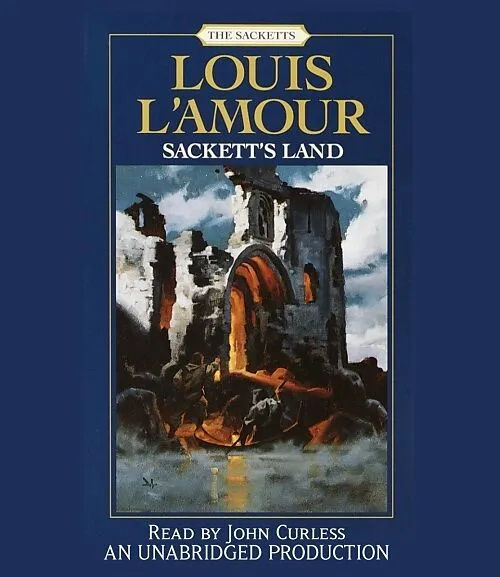
Sackett's Land: The Sacketts
Beschreibung
Informationen zum Autor Our foremost storyteller of the American West, Louis L'Amour has thrilled a nation by chronicling the adventures of the brave men and woman who settled the frontier. There are more than three hundred million copies of his books in print...Format auswählen
- Audio CD (CD/SACD)CHF 33.50

Wird oft zusammen gekauft
Andere Kunden kauften auch
Beschreibung
Informationen zum Autor Our foremost storyteller of the American West, Louis L'Amour has thrilled a nation by chronicling the adventures of the brave men and woman who settled the frontier. There are more than three hundred million copies of his books in print around the world. Klappentext After discovering six gold Roman coins buried in the mud of the Devil's Dyke, Barnabas Sackett enthusiastically invests in goods that he will offer for trade in America. But Sackett has a powerful enemy: Rupert Genester, nephew of an earl, wants him dead. A battlefield promise made to Sackett's father threatens Genester's inheritance. So on the eve of his departure for America, Sackett is attacked and thrown into the hold of a pirate ship. Genester's orders are for him to disappear into the waters of the Atlantic. But after managing to escape, Sackett makes his way to the Carolina coast. He sees in the raw, abundant land the promise of a bright future. But before that dream can be realized, he must first return to England and discover the secret of his father's legacy. Zusammenfassung After discovering six gold Roman coins buried in the mud of the Devil's Dyke! Barnabas Sackett enthusiastically invests in goods that he will offer for trade in America. But Sackett has a powerful enemy: Rupert Genester! nephew of an earl! wants him dead. A battlefield promise made to Sackett's father threatens Genester's inheritance. So on the eve of his departure for America! Sackett is attacked and thrown into the hold of a pirate ship. Genester's orders are for him to disappear into the waters of the Atlantic. But after managing to escape! Sackett makes his way to the Carolina coast. He sees in the raw! abundant land the promise of a bright future. But before that dream can be realized! he must first return to England and discover the secret of his father's legacy.
Autorentext
Our foremost storyteller of the American West, Louis L’Amour has thrilled a nation by chronicling the adventures of the brave men and woman who settled the frontier. There are more than three hundred million copies of his books in print around the world.
Klappentext
After discovering six gold Roman coins buried in the mud of the Devil's Dyke, Barnabas Sackett enthusiastically invests in goods that he will offer for trade in America. But Sackett has a powerful enemy: Rupert Genester, nephew of an earl, wants him dead. A battlefield promise made to Sackett's father threatens Genester's inheritance. So on the eve of his departure for America, Sackett is attacked and thrown into the hold of a pirate ship. Genester's orders are for him to disappear into the waters of the Atlantic. But after managing to escape, Sackett makes his way to the Carolina coast. He sees in the raw, abundant land the promise of a bright future. But before that dream can be realized, he must first return to England and discover the secret of his father's legacy.
Zusammenfassung
After discovering six gold Roman coins buried in the mud of the Devil’s Dyke, Barnabas Sackett enthusiastically invests in goods that he will offer for trade in America. But Sackett has a powerful enemy: Rupert Genester, nephew of an earl, wants him dead. A battlefield promise made to Sackett’s father threatens Genester’s inheritance. So on the eve of his departure for America, Sackett is attacked and thrown into the hold of a pirate ship. Genester’s orders are for him to disappear into the waters of the Atlantic. But after managing to escape, Sackett makes his way to the Carolina coast. He sees in the raw, abundant land the promise of a bright future. But before that dream can be realized, he must first return to England and discover the secret of his father’s legacy.
Leseprobe
Chapter 1
It was my devil’s own temper that brought me to grief, my temper and a skill with weapons born of my father’s teaching.
Yet without that skill I might have emptied my life’s blood upon the cobblestones of Stamford, emptied my body of blood … and for what?”
Until that moment in Stamford it would have been said that no steadier lad lived in all the fen-lands than Barnabas Sackett, nor one who brought better from his fields than I, or did better at the eeling in the fens that were my home.
Then a wayward glance from a lass, a moment of red, bursting fury from a stranger, a blow given and a blow returned, and all that might have been my life vanished like a fog upon the fens beneath a summer sun.
In that year of 1599 a man of my station did not strike a man of noble birth and expect to live—or if he lived, to keep the hand that struck the blow.
Trouble came quickly upon me, suddenly, and without warning.
It began that day near Reach when I slipped and fell upon the Devil’s Dyke.
The Dyke is a great rampart of earth some six miles long and built in the long ago by a people who might have been my ancestors. These were the Iceni, I have been told, who lived in my country long before the Romans came to Britain.
When I slipped I caught myself upon my outstretched palms to keep the mud from my clothing, and I found myself staring at the muddy edge of what appeared to be a gold coin.
Now coins of any kind were uncommon amongst us, for we did much in the way of barter and exchange. Merchants saw coins, but not many came our way. Yet here it was, a gold coin.
Shifting my position a bit I closed my fingers over first one coin and, then, yet another.
I stood up slowly, and making as if to brush the mud from my hands, I knocked and wiped the mud from the coins. In a pool of muddy water at my feet, I washed them clean.
They were old … very, very old.
No English coins these, nor was the wording English, nor the faces of the men upon them. The first coin was heavy, of quite some value judging by the weight. The second was smaller, thinner, and of a different kind.
Slipping them casually into my pocket, I stood there looking about.
The hour was before dawn of what bid to be a gray day. Clouds were thick above, and during the night there had been heavy rain. It was a lonely place, where I stood, a place about half the distance from Reach to Wood Ditton. We had worked in the quarries at Reach, some of us, and slept the night on a tavern floor to be near the fire.
Long before day I awakened, lying there thinking of the distance I had yet to go, with the work now ended. So, quietly I had risen, put my cloak about my shoulders, and took my way to the Dyke, the easiest route in any weather.
It was a time when few men got more than a mile or two from their door, unless following the sea or the fishing, but I was a restless one, moving about and working wherever an extra hand might be needed, for it was in my mind to save money, buy a bit more land and so better my position.
Now I had come upon gold, more than I was likely to earn with my hands in a year, although it was little enough I knew of gold. Had my father stood by me he could have told me what each coin was worth.
I made a thing of brushing my knees, which gave me time to look more carefully about.
I was alone. There were willows yonder, farther away oaks and a hedge, but nowhere in the vague light of beginning day did I see movement or sign of men. Carefully I studied the ground where I had fallen. For where there had been two coins there might be three … or four.
Something had scarred the slope here, and rain had found it, as rain will, gouging a small ditch to escape over the Dyke’s edge. Where the trickle of water was, I could see what appeared to be the rotting edge of a leather purse, …