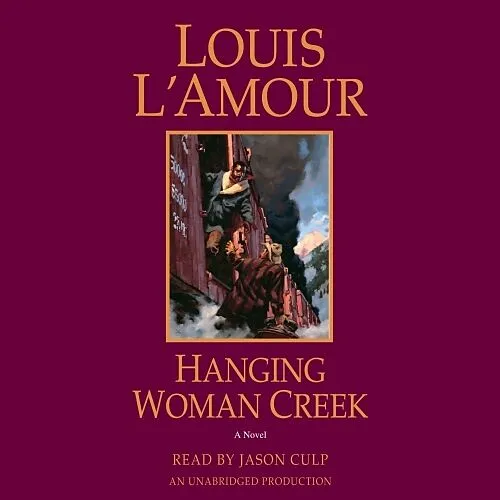
Hanging Woman Creek
Beschreibung
Informationen zum Autor Louis L'Amour Klappentext Barnabus Pike is no gunfighter and not much of a street fighter. Eddie Holt is a black boxer in a white man's world. They've both taken their share of hard knocks. Now they're looking to survive a brutal winter...Format auswählen
- Audio CD (CD/SACD)CHF 38.50

Wird oft zusammen gekauft
Andere Kunden kauften auch
Beschreibung
Informationen zum Autor Louis L'Amour Klappentext Barnabus Pike is no gunfighter and not much of a street fighter. Eddie Holt is a black boxer in a white man's world. They've both taken their share of hard knocks. Now they're looking to survive a brutal winter in a remote Montana line shack, collect their pay, and settle down for good. Then they cross paths with a hardworking Irish immigrant and his beautiful, spirited sister, who've been burned off their land. It's a fight Pike and Holt don't want, don't need, and don't dare turn their backs on-especially when one of the perpetrators might be one of Pike's old friends. Hunted like animals across the frozen countryside, Pike and Holt will risk everything-including their reputations, their dreams-and their lives. Chapter One It was raining by the time we reached the railroad bridge. Evening was coming on, and the pelting rain was cold. We dug in our heels and slid down the embankment to get under the bridge, where there was shelter of a sort. We built a fire, then huddled over it wondering what had become of our summer's wages. Three of us were there, strangers until a few hours ago, now joined in the idea of going west. I'd be going home, or to as much of a home as I could lay claim to, being rootless as a tumbleweed, blowing on, resting here and there against this fence or that, but staying nowhere long. As for the others, I had no idea. The black skeleton frame of the trestle danced in the wavering light from the fire, and from time to time the flames guttered and hissed as the wind blew down the draw, spattering us with cold drops from off the bridge. Rustling around for wood reminded me of a winter I spent in Montana one time . . . at the Hartman & Liggett horse camp. No snow on the ground all winter long, only flurries from time to time, but cold. The ice froze rock-hard on the creek that year, and never broke until late spring. Taking all in all, that had been a good winter. The cabin was snug against the wind, the pot-bellied stove gave off almost too much heat, and there were old magazines and a couple of books lying around. When not in a mind to read, I'd sit and ponder. Whilst only a youngster I had taken to rebuilding places in my mind, places I'd lived in or seen, and when I'd nothing else to do I would put a place together, every single thing in place, then bit by bit I'd recall the folks I'd known there and what was said--what we talked about, and the like. It gave me something to do, but no great respect for the high art of conversational talk. When a man sets out to recall in detail as I did, he sets more to working than he's figured on, for he never looks at anything after that without thinking how he'll recall it in time to come. It also sets a man to thinking about himself, and when a man stands himself up to ponder at, he can't always be pleased at what he sees. No working cowhand is going to get very far unless he's a hand to notice. Punching cows takes you over a lot of rough country, and pretty soon you get to know every draw, hill, or clump of brush. You notice the game trails and the springs, and where the cattle go for shelter, and a lot more besides. A man has to notice or he won't get very far at punching cows. Back there at the Hartman & Liggett horse camp there'd always been a brown crock of baked beans, and I'd never had my fill of beans. Sitting there beside that hateful fire under the trestle with night coming on, I kept thinking back to that horse camp and those crocks of beans. They would be tasty, mighty tasty, right now. That big colored boy, he looked at me and he said, "You look like you been in a fight." "Here an' there," I said. "You fight with the mitts?" "Nobody ever showed me. I just fight the best way I know how." "I've boxed," he said. He was a big boy, maybe a year o...
Autorentext
Louis L'Amour
Klappentext
Barnabus Pike is no gunfighter and not much of a street fighter. Eddie Holt is a black boxer in a white man's world. They've both taken their share of hard knocks. Now they're looking to survive a brutal winter in a remote Montana line shack, collect their pay, and settle down for good. Then they cross paths with a hardworking Irish immigrant and his beautiful, spirited sister, who've been burned off their land. It's a fight Pike and Holt don't want, don't need, and don't dare turn their backs on-especially when one of the perpetrators might be one of Pike's old friends. Hunted like animals across the frozen countryside, Pike and Holt will risk everything-including their reputations, their dreams-and their lives.
Leseprobe
Chapter One
It was raining by the time we reached the railroad bridge. Evening was coming on, and the pelting rain was cold.
We dug in our heels and slid down the embankment to get under the bridge, where there was shelter of a sort. We built a fire, then huddled over it wondering what had become of our summer's wages.
Three of us were there, strangers until a few hours ago, now joined in the idea of going west. I'd be going home, or to as much of a home as I could lay claim to, being rootless as a tumbleweed, blowing on, resting here and there against this fence or that, but staying nowhere long. As for the others, I had no idea.
The black skeleton frame of the trestle danced in the wavering light from the fire, and from time to time the flames guttered and hissed as the wind blew down the draw, spattering us with cold drops from off the bridge.
Rustling around for wood reminded me of a winter I spent in Montana one time . . . at the Hartman & Liggett horse camp. No snow on the ground all winter long, only flurries from time to time, but cold. The ice froze rock-hard on the creek that year, and never broke until late spring.
Taking all in all, that had been a good winter. The cabin was snug against the wind, the pot-bellied stove gave off almost too much heat, and there were old magazines and a couple of books lying around.
When not in a mind to read, I'd sit and ponder. Whilst only a youngster I had taken to rebuilding places in my mind, places I'd lived in or seen, and when I'd nothing else to do I would put a place together, every single thing in place, then bit by bit I'd recall the folks I'd known there and what was said--what we talked about, and the like. It gave me something to do, but no great respect for the high art of conversational talk.
When a man sets out to recall in detail as I did, he sets more to working than he's figured on, for he never looks at anything after that without thinking how he'll recall it in time to come. It also sets a man to thinking about himself, and when a man stands himself up to ponder at, he can't always be pleased at what he sees.
No working cowhand is going to get very far unless he's a hand to notice. Punching cows takes you over a lot of rough country, and pretty soon you get to know every draw, hill, or clump of brush. You notice the game trails and the springs, and where the cattle go for shelter, and a lot more besides. A man has to notice or he won't get very far at punching cows.
Back there at the Hartman & Liggett horse camp there'd always been a brown crock of baked beans, and I'd never had my fill of beans. Sitting there beside that hateful fire under the trestle with night coming on, I kept thinking back to that horse camp and those crocks of beans. They would be tasty, mighty tasty, right now.
That big colored boy, he looked at me and he said, "You look like you been in a fight."
"Here an' there," I said.
"You fight with the mitts?"
"Nobody ever showed me. I just fight the best way I know how."
"I've boxed," he said.
He was a big boy, maybe a year or two older than my twenty-six years, standing around six feet, and built strong. And he had good hands.
That was the first thing he said about me. "You got good hands." He doubled up my fist. "Flat acro…