
IHR WARENKORB IST AKTUELL LEER.
Haben Sie noch nichts passendes gefunden? Stöbern Sie durch unser komplettes Sortiment.
Oder melden Sie sich an bzw. registrieren Sie sich.
- Kostenlose Lieferung
- Kauf auf Rechnung
- Ex Libris Tiefpreis
- Filiallieferung und 650+ Abholorte
- Rabatt-Bons als Club-Mitglied
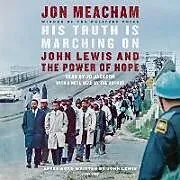
His Truth Is Marching On
Beschreibung
“A valuable discussion of an extraordinary man who deserves our everlasting admiration and gratitude.”—The Washington Post “Meacham tells this story with his customary eloquence . . . a welcome reminder of the heroic sacrifices and rema...Format auswählen
- Audio CD (CD/SACD)CHF 49.50
Wird oft zusammen gekauft
Andere Kunden kauften auch
Beschreibung
“A valuable discussion of an extraordinary man who deserves our everlasting admiration and gratitude.”—The Washington Post
“Meacham tells this story with his customary eloquence . . . a welcome reminder of the heroic sacrifices and remarkable achievements of those young radicals—20th-century America’s greatest generation.”—Eric Foner, The New York Times Book Review
“His Truth Is Marching On is well worth reading, especially for readers with an abiding interest in the intersection of religion and progressive politics . . . an inspiring book that comes at a time when the world desperately needs inspiration.”—NPR
“An elegant, moving portrait of a giant of post-1950 American history.”—Kirkus Reviews
“Meacham talks directly to the reader, his eyes burning, his voice calm but quaking with emotion. . . . Meacham takes the familiar story of the scars and bruises on John Lewis’ body as literally an embodiment of the struggles of the civil rights era, and brings alive with cinematic conviction the backstory of how specifically those blows came about.”—San Francisco Chronicle
“His Truth Is Marching On combines careful reporting, historic photographs, and detailed notes and appendices. But the book ultimately shines brightest as a story of how one man made a difference by believing in justice and offering hope for a nation in difficult times.”—Chapter 16
Autorentext
Jon Meacham is a Pulitzer Prize-winning presidential historian. A contributing writer for The New York Times Book Review and a contributing editor of Time magazine, he is the author of the New York Times bestsellers The Hope of Glory, Destiny and Power: The American Odyssey of George Herbert Walker Bush, Thomas Jefferson: The Art of Power, American Lion: Andrew Jackson in the White House, American Gospel, and Franklin and Winston. Meacham lives in Nashville, Tennessee.
Zusammenfassung
An intimate and revealing portrait of civil rights icon and longtime U.S. congressman John Lewis, linking his life to the painful quest for justice in America from the 1950s to the present—from the Pulitzer Prize–winning author of The Soul of America
John Lewis, who at age twenty-five marched in Selma, Alabama, and was beaten on the Edmund Pettus Bridge, was a visionary and a man of faith. Drawing on decades of wide-ranging interviews with Lewis, Jon Meacham writes of how this great-grandson of a slave and son of an Alabama tenant farmer was inspired by the Bible and his teachers in nonviolence, Reverend James Lawson and Martin Luther King, Jr., to put his life on the line in the service of what Abraham Lincoln called “the better angels of our nature.” From an early age, Lewis learned that nonviolence was not only a tactic but a philosophy, a biblical imperative, and a transforming reality. At the age of four, Lewis, ambitious to become a minister, practiced by preaching to his family’s chickens. When his mother cooked one of the chickens, the boy refused to eat it—his first act, he wryly recalled, of nonviolent protest. Integral to Lewis’s commitment to bettering the nation was his faith in humanity and in God—and an unshakable belief in the power of hope.
Meacham calls Lewis “as important to the founding of a modern and multiethnic twentieth- and twenty-first-century America as Thomas Jefferson and James Madison and Samuel Adams were to the initial creation of the Republic itself in the eighteenth century.” A believer in the injunction that one should love one's neighbor as oneself, Lewis was arguably a saint in our time, risking limb and life to bear witness for the powerless in the face of the powerful. In many ways he brought a still-evolving nation closer to realizing its ideals, and his story offers inspiration and illumination for Americans today who are working for social and political change.
This audiobook includes a PDF of the book’s Appendix.
Leseprobe
Chapter One
A Hard Life, a Serious Life
Troy, Alabama: Beginnings to 1957
Work and put your trust in God, and God’s gonna take care of his children. God’s gonna take care of his children.
—Oft-repeated counsel from Willie Mae Carter Lewis, John’s mother
Costly grace . . . is costly because it costs a man his life, and it is grace because it gives a man the only true life.
—Dietrich Bonhoeffer
For John Lewis, slavery wasn’t an abstraction. It was as real to him as his great-grandfather, Frank Carter, who lived until his great-grandson was seven. Light-skinned, hardworking, and self-confident, Carter, whom Lewis called “Grandpapa,” had been born into enslavement in Pike County, Alabama, in 1862. The family has long believed that a white man was likely Frank Carter’s father—Carter and his own son, whose name was Dink, were, Lewis recalled, “light, very fair, and their hair was different, what we could call good hair”—but the subject was shrouded in secrecy and silence. This much is clear: The trajectory of the infant Frank Carter’s life was fundamentally changed on Thursday, January 1, 1863, when President Lincoln declared the enslaved in the seceded Confederate States of America were now free, and by the ratification, in December 1865, of the Thirteenth Amendment to the Constitution, which abolished slavery “within the United States, or any place subject to their jurisdiction.”
Coming of age in Reconstruction and under Jim Crow, Carter was driven and skilled in the world available to him. Yet the “new birth of freedom” of which Lincoln had spoken at Gettysburg in 1863 had failed to come fully into being after the Confederate surrender at Appomattox in 1865. Within eight months of the war’s end, Alabama’s legislature had instituted a Black Code to curtail the rights of African Americans and give the old ways new form and new force. In 1866, the federal government, driven by Republicans in Congress, sought to bring interracial democracy to the South. The reactionary Black Code was repealed; new constitutions were written; black people were by and large allowed to vote; and African American candidates were elected to federal, state, and local office.
White reaction was fierce. The Ku Klux Klan was founded in these postbellum years—a Confederate general named Edmund Pettus was a grand dragon—and, by 1901, when Frank Carter was nearly forty, white Alabama had reverted as much as it could to an antebellum order by legalizing segregation, circumscribing suffrage, and banning interracial marriage. At the dawn of a new century, then, the old color line had been redrawn and reinforced.
Alabama’s 1901 constitution establishing white supremacy had been debated in Montgomery from May to September of that year, ending in time for the cotton harvest. Fifty miles away from the state capitol, Frank Carter leased his land from J. S. “Big Josh” Copeland, a major figure in Troy, the Pike County seat. Carter worked his way to an unusual level of sharecropping called “standing rent,” which meant he paid Copeland to lease the land but did not owe the landlord any of his yield beyond the rent. Diligent, resourceful, and determined, Lewis’s great-grandfather did the best he could under the constraints of his time. “He couldn’t read or write,” his great-grandson said, “but he could do financial transactions in his head faster than the man on the other side of the desk could work them out with a pen and paper.” Carter took great pride in just about everything he di…