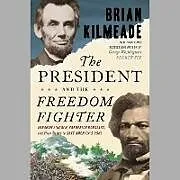
The President and the Freedom Fighter
Beschreibung
“What makes The President and the Freedom Fighter so compelling is that Kilmeade lets the actual history speak for itself.”—Shelby Steele, senior fellow at the Hoover Institution; author of Shame and White Guilt “A riveting page-...Format auswählen
- Audio CD (CD/SACD)CHF 44.50

Wird oft zusammen gekauft
Andere Kunden kauften auch
Beschreibung
“What makes The President and the Freedom Fighter so compelling is that Kilmeade lets the actual history speak for itself.”—Shelby Steele, senior fellow at the Hoover Institution; author of Shame and White Guilt
“A riveting page-turner that illuminates the fascinating and history-altering relationship between President Abraham Lincoln and Frederick Douglass.”—Ben Carson, MD
“This compelling account of Lincoln and Douglass’s friendship is the story of America itself and shows how intertwined race is with our history. Kilmeade understands that if we don’t acknowledge our complex past, we’ll never be the country we dream to be.”—Brad Meltzer, coauthor of The Lincoln Conspiracy
**
“Nothing less than the fate of America is at stake in this riveting and utterly fascinating Civil War–era narrative. Highly recommended!”—Douglas Brinkley, Katherine Tsanoff Brown Professor in Humanities and professor of history at Rice University; author of American Moonshot**
“Accessible, accurate, inspiring, and timely.”—Victor Davis Hanson, senior fellow at the Hoover Institution; author of The Dying Citizen
“The President and the Freedom Fighter should be in every home, school, and library in our country.”—John Cribb, author of Old Abe
“At a time when our heroes are being abused and statues trashed, how refreshing it is to see two genuine giants of history being given the generous historical treatment they deserve in this well-researched, crisply written, and compelling account.”—Andrew Roberts, author of Churchill
“Brian Kilmeade is a master!”—Tim Green, author of Football Genius and Unstoppable
“To the immense benefit of the nation, two giants of America’s story are beautifully captured in this highly readable account of how their extraordinary lives intertwined. A must read to understand today’s complex discussions of race and social justice!”—Admiral James Stavridis, PhD, U.S. Navy (Retired)
Autorentext
Brian Kilmeade
Klappentext
Abraham Lincoln was White, born impoverished on a frontier farm. Frederick Douglass was Black, a child of slavery who had risked his life escaping to freedom in the North. Neither man had a formal education, and neither had had an easy path to influence. No one would have expected them to become friends, or to transform the country. But Lincoln and Douglass believed in their nation's greatness. They were determined to make the grand democratic experiment live up to its ideals. Lincoln's problem: he knew it was time for slavery to go, but how fast could the country change without being torn apart? And would it be possible to get rid of slavery while keeping America's Constitution intact? Douglass said no, that the Constitution was irredeemably corrupted by slavery, and he wanted Lincoln to move quickly. Sharing little more than the conviction that slavery was wrong, the two men's paths eventually converged. Over the course of the Civil War, they'd endure bloodthirsty mobs, feverish conspiracies, devastating losses on the battlefield, and a growing firestorm of unrest that would culminate on the fields of Gettysburg.
Zusammenfassung
NEW YORK TIMES BESTSELLER
The New York Times bestselling author of George Washington's Secret Six and Thomas Jefferson and the Tripoli Pirates turns to two other heroes of the nation: Abraham Lincoln and Frederick Douglass.
In The President and the Freedom Fighter, Brian Kilmeade tells the little-known story of how two American heroes moved from strong disagreement to friendship, and in the process changed the entire course of history.
Abraham Lincoln was White, born impoverished on a frontier farm. Frederick Douglass was Black, a child of slavery who had risked his life escaping to freedom in the North. Neither man had a formal education, and neither had had an easy path to influence. No one would have expected them to become friends—or to transform the country. But Lincoln and Douglass believed in their nation’s greatness. They were determined to make the grand democratic experiment live up to its ideals.
Lincoln’s problem: he knew it was time for slavery to go, but how fast could the country change without being torn apart? And would it be possible to get rid of slavery while keeping America’s Constitution intact? Douglass said no, that the Constitution was irredeemably corrupted by slavery—and he wanted Lincoln to move quickly. Sharing little more than the conviction that slavery was wrong, the two men’s paths eventually converged. Over the course of the Civil War, they’d endure bloodthirsty mobs, feverish conspiracies, devastating losses on the battlefield, and a growing firestorm of unrest that would culminate on the fields of Gettysburg.
As he did in George Washington's Secret Six, Kilmeade has transformed this nearly forgotten slice of history into a dramatic story that will keep you turning the pages to find out how these two heroes, through their principles and patience, not only changed each other, but made America truly free for all.
Leseprobe
From the Bottom Up
I do not remember to have ever met a slave who could tell of his birthday.
-Frederick Douglass, 1845
Abraham Lincoln had a problem. His flatboat, carried by the rush of spring waters, had run aground atop a mill dam in the Sangamon River. The square bow of the eighty-foot-long boat hung over the dam, cantilevered like a diving board. Meanwhile, the stern was sinking lower and lower as it took on water. If Lincoln didn't think of something quickly, the vessel might break apart.
The young man had built the boat with a plan in mind. Along with his cousin, he would take on cargo, travel down the river from central Illinois to New Orleans, and there dismantle the boat, selling both its timber and the cargo on behalf of a man willing to underwrite the venture. Together, he and his cousin had cut down trees for lumber upstream from where they were now marooned. They had built the boat and loaded it with dried pork, corn, and live hogs. All had seemed well when they set off only hours before, but now, on April 19, 1831, far from his intended destination, Lincoln had to do something to save his boat and his cargo.
As goods slid slowly astern in the tilting craft, Lincoln went into action. Removing his boots, hat, and coat, he improvised. First, he and his two-man crew shifted most of the goods to the nearby shore. Next, while he hurriedly bored a large hole with a hand drill, his team began rolling the remaining cargo of heavy barrels forward, thereby shifting the boat's center of gravity.
The strategy worked: As the flatboat's bow began to tilt downward, water poured out the hole. As the boat got lighter, it rose in the water. After plugging the hole, Lincoln and his men, helped by the spring currents, managed to ease the box-like craft clear of the dam.
The crowd of villagers that had gathered to observe the spectacle of a sinking boat was astonished. No one had seen anything like it. But then they had also never met Abraham Lincoln, just two months beyond his twenty-second birthday. At first sight, he was unmistakably a country bumpkin, dressed in ill-fitting clothes that exaggerated his six-foot, four-inch height, with long arms and exposed ankles sticking out of too-short shirts and homespun trousers. He made, said one observer, "a rather Singular grotesque appearance." But the young man who saved the boat possessed a loose-limbed grace that disguised both unexpected strength and a driving ambition to make …