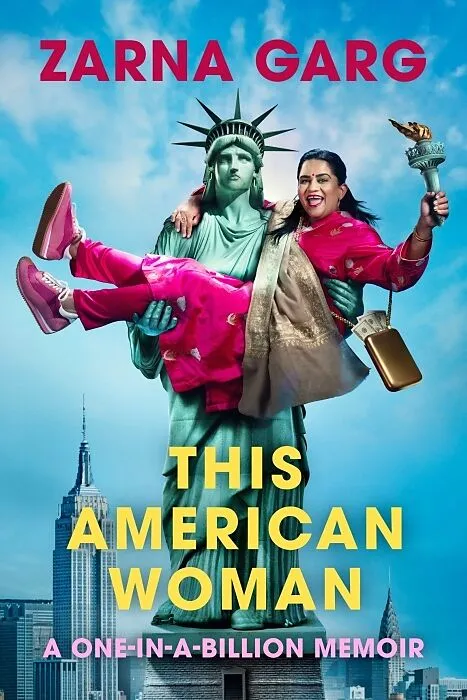
This American Woman
Beschreibung
Award-winning comedian Zarna Garg turns her astonishing life story into a;hilarious memoir--from narrowly escaping an arranged marriage in India to carving her own path in America and launching a dazzling second act in midlife. Growing up in India, everyone ca...Format auswählen
- Fester EinbandCHF 31.60

Wird oft zusammen gekauft
Andere Kunden kauften auch
Beschreibung
Award-winning comedian Zarna Garg turns her astonishing life story into a;hilarious memoir--from narrowly escaping an arranged marriage in India to carving her own path in America and launching a dazzling second act in midlife. Growing up in India, everyone called Zarna “so American” just for reading the newspaper, having deep thoughts, and talking back to anyone over the age of;thirty. When Zarna’s dad tried to marry her off at age;fourteen, Zarna fled the whole subcontinent for the glittering paradise of Akron, Ohio, where she got to become American for real. On Zarna’s very American quest to find herself and her calling, she threw herself whole-heartedly into roles like dog-bite lawyer, crazy perfectionist stay-at-home mom, Indian matchmaker, prize-winning screenwriter, and more. It wasn’t until a dare led her to a stand-up comedy open mic that Zarna finally found her spiritual home: getting paid cold hard cash for her big fat mouth. And as Zarna discovered,;after surviving the brutal streets of Mumbai, the cutthroat world of stand-up comedy is nothing. <This American Woman< is an exuberant story of fighting for your right to determine your own destiny and triumphing beyond what you ever dreamed was possible. And as Zarna always reminds us: If Zarna can do it, you can too.
Autorentext
Zarna Garg is a force of nature with a mic. America’s first Indian immigrant mom comedian burst onto the scene in 2023 with her first special, One in a Billion. Her follow-up special, Practical People Win, hits Hulu in 2025. Zarna cut her teeth opening for icons Tina Fey and Amy Poehler. Her acting debut in the indie hit A Nice Indian Boy earned rave reviews, while her hugely popular Zarna Garg Family Podcast explores modern family life with her husband and kids. With millions of social media followers and billions of views, Zarna just can’t stop laughing her way to the top.
Klappentext
NEW YORK TIMES BESTSELLER • Award-winning comedian Zarna Garg turns her astonishing life story into a hilarious memoir, spilling all the chai on her wild ride from escaping an arranged marriage and homelessness in India to carving her own path in America and launching a dazzling second act in midlife.
**“A deeply honest and hilarious book about how you always win if you bet on yourself.”—Amy Poehler**
Throughout Zarna’s whole childhood in India, everyone called her “so American” just for reading the newspaper, having deep thoughts, and talking back to anyone over the age of thirty. When Zarna’s dad tried to marry her off at age fourteen, Zarna fled—first to the streets of Mumbai and ultimately to the glittering paradise of Akron, Ohio, where she got to become American for real.
On Zarna’s very American quest to find herself and her calling, she threw herself wholeheartedly into roles like dog-bite lawyer, crazy perfectionist stay-at-home mom, Indian matchmaker, prizewinning screenwriter, and more. It wasn’t until a dare led her to a stand-up comedy open mic that Zarna finally found her spiritual home: getting paid cold hard cash for her big fat mouth.
And as Zarna discovered, after surviving the brutal streets of Mumbai, the cutthroat world of stand-up comedy is nothing.
This American Woman is an exuberant story of fighting for your right to determine your own destiny and triumphing beyond what you ever dreamed was possible. Zarna’s mantra becomes a call to action: It’s never too late. If Zarna can do it, you can, too.
Leseprobe
Chapter 1
Unleashed
Once upon a time, before I ran away, I was the youngest of four happy kids growing up on Nepean Sea Road, the Park Avenue of Mumbai.
We lived in a sprawling, 5,000-square-foot apartment in a beautiful limestone building, smack in the middle of bustling shops, big shady trees, and, of course, riotous traffic of every shape and size. We were not the richest of the rich, but we were rich enough to live very, very well in India: servants, drivers, cooks, nice cars, and air-conditioning (the ultimate status symbol). My friends were the children of business moguls and movie stars.
Unlike my friends’ dads, my dad had not been installed as some princely heir to the family business. My father had clawed his way out of the Mumbai chawls, put himself through law school, and started an innovative—and lucrative—import-export business that took him all over the world. He brought back wild tales and rare objets d’art from exotic locales, like Tokyo, Milan, and New Jersey!
We, the subjects of my father’s lush new kingdom, were expected to obey his unquestionable worldly authority. In practical terms, this usually just meant staying out of his way. That came naturally. While he never laid a finger on us, my dad’s domineering aura was repellent for servants and children. If he was in the room, no one said anything, because we never knew what might trigger him. Since he always sat in the massive living room, that meant all four of us kids were heaped in one of our tiny bedrooms giggling and talking about movies and food and music. The servants even fed us our dinners in our bedrooms because they themselves were trying to keep out of his way.
My dad was the only member of his family who had finished high school. Afterward, he’d found law professors and begged to attend their lectures. He even offered to clean their homes if he could sleep there at night. And yet it wasn’t my father’s law degree that opened the door to his stunning success. It was something he had that his classmates didn’t: grit.
“All these people with big degrees will sign away their whole life of freedom for an ounce of security,” my dad would say. “But taking risks—now that is where real money is made.”
My dad eventually concluded with disgust that too much education actually ruined people: It made them too proud and too scared to do real work. “Everyone should be a work-alcoholic,” he would say—years before the term “workaholic” became commonplace!
So my dad only educated us to the extent that it would help us thrive in the universe he inhabited. From an early age, we learned “the language of success”—English. And we were to be married off to the heirs of other successful entrepreneurs, ideally before we hit twenty years old.
But even though it was actively discouraged, especially for a girl, I loved to read.
And I couldn’t understand why my dad couldn’t understand, because I thought everything you could read was riveting. Every bit of pocket money I had, I spent on novels, film magazines, comic books. Fortune, Forbes, Inc., Adweek. “How the rich live!” “How the frazzled simplify their lives!” “How film stars fight!” I would even read cookbooks to see what types of dishes were in season. Anything I could get my hands on.
I especially adored reading The Times of India first thing in the morning, and I still do to this day. But my dad hated that I would touch it and shuffle the pages around. He wanted the copy to be fresh and crisp when he was ready to read it.
The only way I could get hold of it was if I woke up early, waited in bed until I could hear the newspaper plopped outside our apartment door around 5 a.m., and rush to read through it all as fast as I could. Then I would put the newspaper under the sofa cushions and bounce on it with my bum so that it was neatly pressed back into position. When my dad finally emerged from his room at 6 a.m., the newspaper would be lying outside the apartment front door, perfectly flat.
If there was any suspicion that I had touched the paper, my dad would summon the servants and scream at t…