Beschreibung
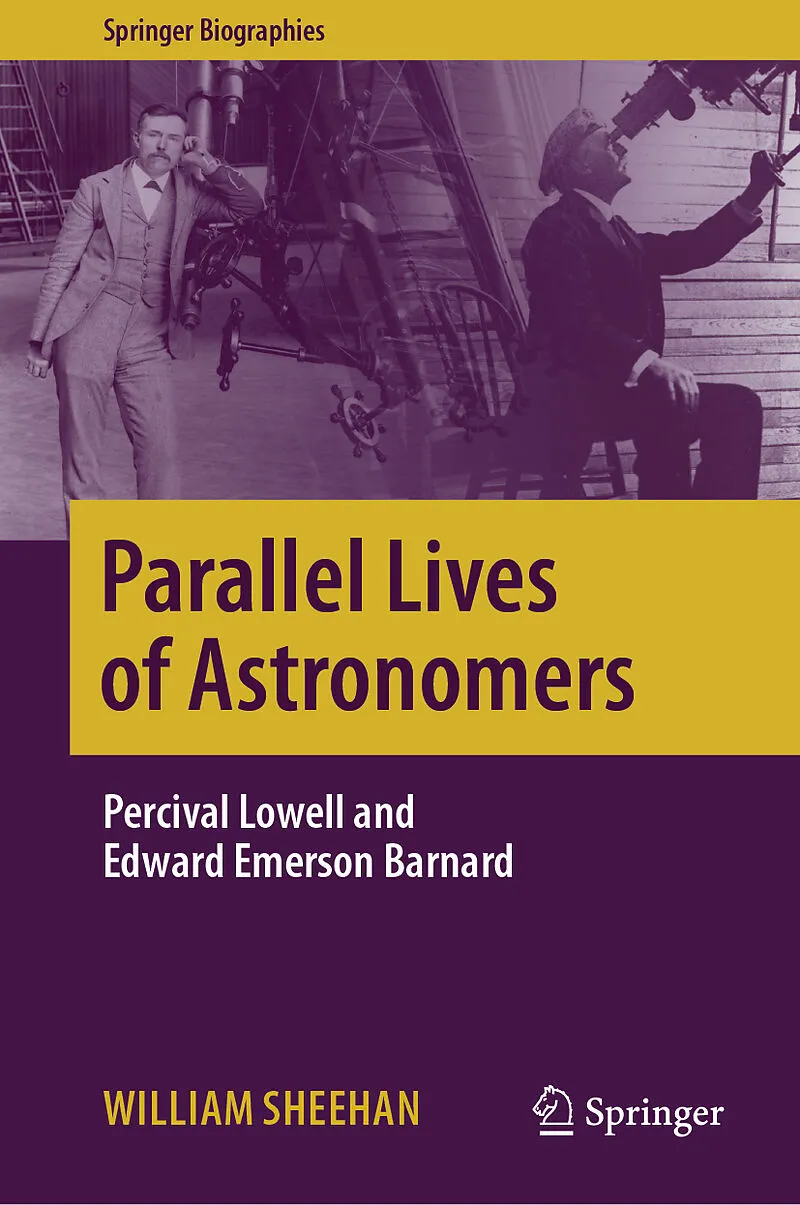
Using the "Parallel Lives" approach adopted by the Greek biographer Plutarch, noted historian of astronomy William Sheehan contrasts the lives and research careers of two famous astronomers, Percival Lowell and Edward Emerson Barnard. Drawing on vast archival...
Using the "Parallel Lives" approach adopted by the Greek biographer Plutarch, noted historian of astronomy William Sheehan contrasts the lives and research careers of two famous astronomers, Percival Lowell and Edward Emerson Barnard. Drawing on vast archival materials and hitherto unpublished source materials, Sheehan documents in detail the contributions of these two late 19th and early 20th astronomers.
Living at a time when controversies about Mars peaked, when great observatories were being built, and when research increasingly turned away from the Solar System toward the stellar and extra-galactic universe, these observers made spectacular contributions to astronomy. Their work still inspires, and continues in Perseverance rover's explorations of the surface of Mars carrying forward Lowell's dream of showing that Mars may once have been "the abode of life," and in Barnard's pioneering wide-angle photographs of the Milky Way which first showed the sweep, majesty and complexity of the Galaxy.
The work of decades of research and writing, Sheehan has produced what is likely to become the definitive work on these two great astronomers.
" Parallel Lives marks an important contribution to the history of astronomy. The book is masterful and inventive. William Sheehan could hardly have chosen two more compellingor contrastingpersonalities to analyze in this fascinating dual biography."
"Sheehan has united scientific acumen, detailed historical research, penetrating insight into character, and narrative virtuosityand adapted it all to an ancient Greek modela remarkable achievement!"
William Sheehan's many books include the authoritative biography The Immortal Fire Within: The Life and Work of Edward Emerson Barnard and (with Jim Bell) Discovering Mars: A History of Observation and Exploration of the Red Planet , which has been called the "gold standard of books on Mars" (Michio Kaku).
Presents and contrasts the lives and achievements of two famous astronomers; Percival Lowell and Edward Barnard Considers the psychological and sociological aspects of humans traveling to Mars and other celestial objects Highlights the challenges involved in trying to understand big questions in the field of space science and astronomy
Autorentext
William Sheehan has written many books on astronomy, including: Planets and Perception (1988), The Immortal Fire Within: the life and work of Edward Emerson Barnard (1995), The Planet Mars (1996), In Search of Planet Vulcan (with Richard Baum; 1997), Epic Moon (with Thomas Dobbins; 2001), and Transits of Venus (with John Westfall; 2004). He is a consultant to the International Astronomical Union's Working Group on Planetary System Nomenclature, a Special Research Fellow in history of astronomy at the Lowell Observatory, a contributing editor to Sky & Telescope magazine and an Honorary Fellow of the Royal Astronomical Society of Canada. He is also past fellow of the John Simon Guggenheim Memorial Foundation, and a recipient of the Gold Medal of the Oriental Astronomical Association. Asteroid no. 16037 has been named Sheehan in his honor by the I.A.U. With Springer, he has published a translation of James Lequeux's biography of the French astronomer U.J.J. Leverrier:Le Verrier-Magnificent and Detestable Astronomer (with Bernard Sheehan; 2013); Galactic Encounters (with Chris Conselice; 2014); and a translation of Camille Flammarion's The Planet Mars (with the late Sir Patrick Moore; 2014). Professionally, William Sheehan is a psychiatrist. He is married, with two sons. He divides his time between his psychiatric and astronomical activities and between homes in Willmar, Minnesota and Flagstaff, Arizona. Among Sheehan's most recent observations have been those of Venus's atmosphere made at Lowell Observatory, during the transit of Venus of June 5-6, 2012, as a member of the international Venus Twilight Experiment. For most of his life a denizen of the Bay Area, Dr. Westfall majored in geography at the University of California, Berkeley (BA 1960) and the George Washington University (MA 1964, PhD 1969). Employed by the (then) Coast and Geodetic Survey from 1961-64, he joined the faculty of San Francisco State University's Department of Geography and Human Environmental Studies in 1968, teaching courses in quantitative and historical geography and remote sensing, retiring in 2005. Dr. Westfall's interest in astronomy dates back to the late 1940s, when he joined the Eastbay Astronomical Society, becoming a member of the Association of Lunar and Planetary Observers (ALPO) in 1953. He currently serves on the ALPO board of directors and is the coordinator of its Mercury/Venus Transit Section and an assistant coordinator in its Jupiter Section (Galilean satellite events). He has authored the book Atlas of the Lunar Terminator (Cambridge) and coauthored Transits of Venus (Prometheus) with William Sheehan. He has chased 12 total solar eclipses, three annular eclipses and three planetary transits (plus two from home). Dr. Westfall currently observes lunar eclipses, asteroid occultations of stars, and Jupiter satellite eclipses from his backyard in the relatively clear skies of Antioch, his favorite telescopesbeing a C14 and a C5.
Inhalt
Chapter 1: The Flower and the Bee.- Chapter 2: Astronomy from the Top Down: Percival Lowell.- Chapter 3: Astronomy from the Bottom Up: Edward Emerson Barnard.- Chapter 4: Rivals of Mars.- Chapter 5: A Tale of Two Telescopes.- Chapter 6: The Spokes of Venus.- Chapter 7: Adventures with the Bruce.- Chapter 8: Percival Returns.- Chapter 9: Canali! Canali!.- Chapter 10: Wisps, Tores, and Good and Bad Reviews.- Chapter 11: A Barnard Ally Ups the Ante.- Chapter 12: Vale Percival.- Chapter 13: Ad Astra Edward.- Chapter 14: Lowell and Barnard Compared.