
IHR WARENKORB IST AKTUELL LEER.
Haben Sie noch nichts passendes gefunden? Stöbern Sie durch unser komplettes Sortiment.
Oder melden Sie sich an bzw. registrieren Sie sich.
- Kostenlose Lieferung
- Kauf auf Rechnung
- Ex Libris Tiefpreis
- Filiallieferung und 650+ Abholorte
- Rabatt-Bons als Club-Mitglied
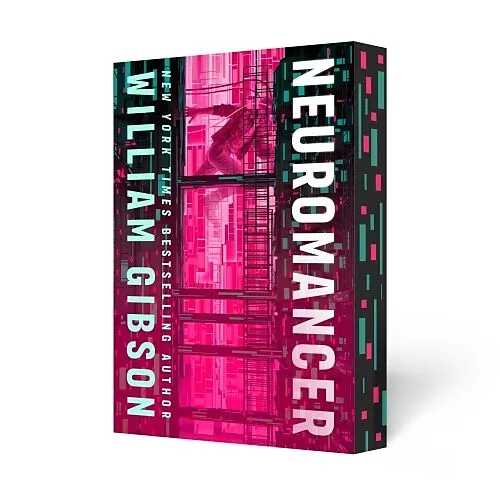

Neuromancer: Deluxe Edition
Beschreibung
This deluxe trade paperback edition of Winner of the Hugo, Nebula, and Philip K. Dick Awards, Case was the sharpest data-thief in the matrix--until he crossed the wrong people and they crippled his nervous system, banishing him from cyberspace. Now a mysteriou...Format auswählen
- Kartonierter EinbandCHF 26.80

Wird oft zusammen gekauft
Andere Kunden kauften auch
Beschreibung
This deluxe trade paperback edition of Winner of the Hugo, Nebula, and Philip K. Dick Awards, Case was the sharpest data-thief in the matrix--until he crossed the wrong people and they crippled his nervous system, banishing him from cyberspace. Now a mysterious new employer has recruited him for a last-chance run at an unthinkably powerful artificial intelligence. With a dead man riding shotgun and Molly, a mirror-eyed street-samurai, to watch his back, Case is ready for the adventure that upped the ante on an entire genre of fiction. <Neuromancer< was the first fully-realized glimpse of humankind’s digital future--a shocking vision that has challenged our assumptions about technology and ourselves, reinvented the way we speak and think, and forever altered the landscape of our imaginations.
Autorentext
William Gibson
Klappentext
**SOON TO BE AN APPLETV SERIES
This deluxe trade paperback edition of Neuromancer features stunning new cover art, art printed inside the front and back covers, and sprayed edges.
Winner of the Hugo, Nebula, and Philip K. Dick Awards, Neuromancer is a science fiction masterpiece—a classic that ranks as one of the twentieth century’s most potent visions of the future.**
Case was the sharpest data-thief in the matrix—until he crossed the wrong people and they crippled his nervous system, banishing him from cyberspace. Now a mysterious new employer has recruited him for a last-chance run at an unthinkably powerful artificial intelligence. With a dead man riding shotgun and Molly, a mirror-eyed street-samurai, to watch his back, Case is ready for the adventure that upped the ante on an entire genre of fiction.
Neuromancer was the first fully-realized glimpse of humankind’s digital future—a shocking vision that has challenged our assumptions about technology and ourselves, reinvented the way we speak and think, and forever altered the landscape of our imaginations.
Zusammenfassung
**SOON TO BE AN APPLETV+ SERIES
This deluxe trade paperback edition of Neuromancer features stunning new cover art, art printed inside the front and back covers, and sprayed edges.
Winner of the Hugo, Nebula, and Philip K. Dick Awards, Neuromancer is a science fiction masterpiece—a classic that ranks as one of the twentieth century’s most potent visions of the future.**
Case was the sharpest data-thief in the matrix—until he crossed the wrong people and they crippled his nervous system, banishing him from cyberspace. Now a mysterious new employer has recruited him for a last-chance run at an unthinkably powerful artificial intelligence. With a dead man riding shotgun and Molly, a mirror-eyed street-samurai, to watch his back, Case is ready for the adventure that upped the ante on an entire genre of fiction.
Neuromancer was the first fully-realized glimpse of humankind’s digital future—a shocking vision that has challenged our assumptions about technology and ourselves, reinvented the way we speak and think, and forever altered the landscape of our imaginations.
Leseprobe
The Sky Above The Port
By
William Gibson
It took at least a decade for me to realize that many of my readers, even in 1984, could never have experienced Neuromancer’s opening line as I’d intended them to. I’d actually composed that first image with the black-and-white video-static of my childhood in mind, sodium-silvery and almost painful—a whopping anachronism, right at the very start of my career in the imaginary future.
But an invisible one, interestingly; one that reveals a peculiar grace enjoyed by all imaginary futures as they make their way up the timeline and into the real future, where we all must go. The reader never stopped to think that I might have been thinking, however unconsciously, of the texture and color of a signal-free channel on a wooden-cabinet Motorola with fabric-covered speakers. Readers compensated for me, shouldering an additional share of the imaginative burden, and allowed whatever they assumed was the color of static to take on the melancholy of the phrase “dead channel”.
In my teens, in the Sixties, I read a great deal of science fiction dating from the Forties, a very fertile period for the genre, and recall being aware of making just this sort of effort on behalf of fictions that had grown a bit long in the technological tooth, or whose imagined futures had been blindsided by subsequent history. I cut such fictions just the sort of extra slack, in exchange for whatever other value the narrative might offer, that some readers must be cutting Neuromancer today––not for invisible anachronisms like my color of television, but for unavoidable sins of omission on the order of a complete absence of tiny and ubiquitous portable telephones. (Indeed, one of my own favorite moments in the book hinges around the sequenced ringing of a row of pay-phones.
Imagine a novel from the Sixties whose author had somehow fully envisioned cellular telephony circa 2004, and had worked it, exactly as we know it today, into the fabric of her imaginary future. Such a book would have seemed highly peculiar in the Sixties, even though innumerable novels had already been written in which small personal wireless communications devices were taken for granted. A genuinely prescient cell-phone novel would have moved in a most unsettling way, its characters acting, out of an unprecedented degree of connectivity, in ways that would quickly overwhelm the narrative.
In hindsight, I suspect that Neuromancer owes much of its shelf-life to my almost perfect ignorance of the technology I was extrapolating from. I was as far from the Sixties author who knew everything about cell-phones as it was possible to be. Where I made things up from whole cloth, the colors remain bright. Where I was unlucky enough to actually have some small bit of real knowledge, the reader finds things like the rattling keys of a mechanical printer, or Case’s puzzlingly urgent demand, when the going gets tough, for a modem. Unlike the absence of cell-phones, those are sins of commission. Another vast omission is my failure to have quietly collapsed the Soviet Union and swept the rubble offstage when nobody was looking.
Though there was a strategic reason for my not having done that. I had already done it to the United States, which cannot be proven to exist in the world of Neuromancer. It’s deliberately never mentioned as such, and one vaguely gathers that it’s somehow gone sideways in a puff of what we today would call globalization, to be replaced by some less dangerous combine of large corporations and city-states. Having disappeared the USA, I though I’d better have the USSR in there for the sake of continuity. (Had I disappeared the USSR instead, I might eventually have been burned as a witch, so just as well.)
Today’s reader might keep in mind that I wrote Neuromancer with absolutely no expectation that it would be in print twenty years later. I knew that it was to be published, if I could finish it and if the editor accepted the manuscript, both of which seemed constantly unlikely, as a paperback original—that most ephemeral of literary units, a pocket-sized slab of prose meant to fit a standard wire rack, printed on high-acid pape…