
IHR WARENKORB IST AKTUELL LEER.
Haben Sie noch nichts passendes gefunden? Stöbern Sie durch unser komplettes Sortiment.
Oder melden Sie sich an bzw. registrieren Sie sich.
- Kostenlose Lieferung
- Kauf auf Rechnung
- Ex Libris Tiefpreis
- Filiallieferung und 650+ Abholorte
- Rabatt-Bons als Club-Mitglied
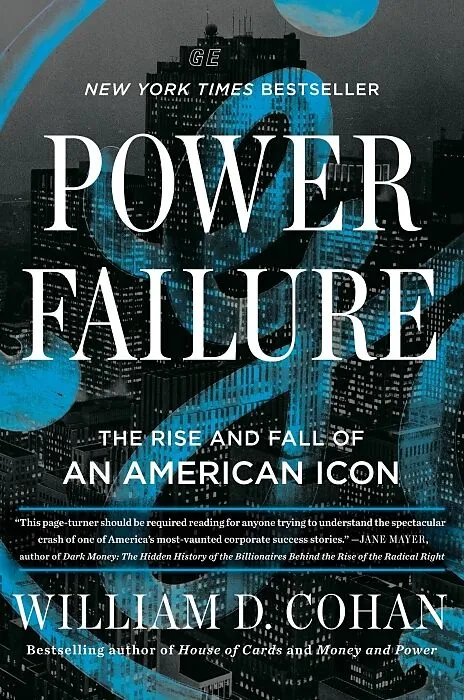
Power Failure
Beschreibung
Informationen zum Autor William D. Cohan Klappentext NEW YORK TIMES BESTSELLER The New Yorker Best Books of 2022 • Financial Times Best Books of 2022 • The Economist Best Books of 2022 The dramatic riseand unimaginable fallof America's most iconic co...Format auswählen
- Livre ReliéCHF 42.80

Wird oft zusammen gekauft
Andere Kunden kauften auch
Beschreibung
Informationen zum Autor William D. Cohan Klappentext NEW YORK TIMES BESTSELLER The New Yorker Best Books of 2022 • Financial Times Best Books of 2022 • The Economist Best Books of 2022 The dramatic riseand unimaginable fallof America's most iconic corporation by New York Times bestselling author and pre-eminent financial journalist William D. Cohan No company embodied American ingenuity, innovation, and industrial power more spectacularly and more consistently than the General Electric Company. GE once developed and manufactured many of the inventions we take for granted today, nearly everything from the lightbulb to the jet engine. GE also built a cult of financial and leadership success envied across the globe and became the world's most valuable and most admired company. But even at the height of its prestige and influence, cracks were forming in its formidable foundation. In a masterful re-appraisal of a company that once claimed to bring good things to life, pre-eminent financial journalist William D. Cohan argues that the incredible story of GE's rise and fall is not only a paragon, but also a prism through which we can better understand American capitalism. Beginning with its founding, innovations, and exponential growth through acquisitions and mergers, Cohan plumbs the depths of GE's storied management culture, its pioneering doctrine of shareholder value, and its seemingly hidden blind spots, to reveal that GE wasn't immune from the hubris and avoidable mistakes suffered by many other corporations. In Power Failure , Cohan punctures the myth of GE, exploring in a rich narrative how a once-great company wound up broken and in tattersa cautionary tale for the ages. Leseprobe Chapter One A Child of Two Fathers Ask most people about the origin of the General Electric Company in and around 1892, and you'll hear all about Thomas Alva Edison and his inventions-the carbon filament incandescent lamp, the dynamo, the phonograph, and the motion picture camera. But GE, and its extraordinary success after some initial financial hiccups, was actually more the doing of another restless entrepreneur, Charles Albert Coffin, whose visionary thinking and aggressive acquisitions drove the company forward in its early years. Coffin doesn't get nearly the accolades, or ink, of Edison, but it turned out that Coffin was by far the superior businessman, a gene Edison lacked. In any event, Coffin and Edison started out as competitors in the race to electrify America, but they soon joined forces and both of their powerful DNAs would become entwined in GE. Born in December 1844, Charles Coffin grew up in Fairfield, Maine, north of Augusta, after his grandfather, a farmer, settled there at a time when the federal government was offering free land to people who would move to uninhabited wilds. Charles's grandfather was a minister of the Society of Friends, also known as the Quakers. After graduating from Bloomfield Academy in 1862, Charles moved to Lynn, Massachusetts, to live with an uncle so that he could attend a "commercial" school in Boston. That uncle was a partner in a shoe manufacturing company, Micajah C. Pratt and Company. When Pratt died in 1862, Coffin's uncle inherited the business and his nephew joined him there. At that time, Lynn was the center of the nation's burgeoning shoe industry, and Pratt's business was an important part of it. The industry was automating rapidly, with sophisticated machines replacing the artisans and craftsmen of an earlier era. Coffin quickly proved himself adept at shoe design. He then moved into sales and proved skilled at that task as well. He started making regular calls in the western United States. It turned out Coffin was a talented businessman. He "must have borne the hallmark of genius from the outset," John Broderick, a former colleague, wrote a...
Autorentext
William D. Cohan
Klappentext
**NEW YORK TIMES BESTSELLER
The New Yorker Best Books of 2022 • Financial Times Best Books of 2022 • The Economist Best Books of 2022
The dramatic rise—and unimaginable fall—of America's most iconic corporation by New York Times bestselling author and pre-eminent financial journalist William D. Cohan**
No company embodied American ingenuity, innovation, and industrial power more spectacularly and more consistently than the General Electric Company. GE once developed and manufactured many of the inventions we take for granted today, nearly everything from the lightbulb to the jet engine. GE also built a cult of financial and leadership success envied across the globe and became the world’s most valuable and most admired company. But even at the height of its prestige and influence, cracks were forming in its formidable foundation.
In a masterful re-appraisal of a company that once claimed to “bring good things to life,” pre-eminent financial journalist William D. Cohan argues that the incredible story of GE’s rise and fall is not only a paragon, but also a prism through which we can better understand American capitalism. Beginning with its founding, innovations, and exponential growth through acquisitions and mergers, Cohan plumbs the depths of GE's storied management culture, its pioneering doctrine of shareholder value, and its seemingly hidden blind spots, to reveal that GE wasn't immune from the hubris and avoidable mistakes suffered by many other corporations.
In Power Failure, Cohan punctures the myth of GE, exploring in a rich narrative how a once-great company wound up broken and in tatters—a cautionary tale for the ages.
Leseprobe
Chapter One
A Child of
Two Fathers
Ask most people about the origin of the General Electric Company in and around 1892, and you'll hear all about Thomas Alva Edison and his inventions-the carbon filament incandescent lamp, the dynamo, the phonograph, and the motion picture camera. But GE, and its extraordinary success after some initial financial hiccups, was actually more the doing of another restless entrepreneur, Charles Albert Coffin, whose visionary thinking and aggressive acquisitions drove the company forward in its early years. Coffin doesn't get nearly the accolades, or ink, of Edison, but it turned out that Coffin was by far the superior businessman, a gene Edison lacked. In any event, Coffin and Edison started out as competitors in the race to electrify America, but they soon joined forces and both of their powerful DNAs would become entwined in GE.
Born in December 1844, Charles Coffin grew up in Fairfield, Maine, north of Augusta, after his grandfather, a farmer, settled there at a time when the federal government was offering free land to people who would move to uninhabited wilds. Charles's grandfather was a minister of the Society of Friends, also known as the Quakers. After graduating from Bloomfield Academy in 1862, Charles moved to Lynn, Massachusetts, to live with an uncle so that he could attend a "commercial" school in Boston. That uncle was a partner in a shoe manufacturing company, Micajah C. Pratt and Company. When Pratt died in 1862, Coffin's uncle inherited the business and his nephew joined him there. At that time, Lynn was the center of the nation's burgeoning shoe industry, and Pratt's business was an important part of it. The industry was automating rapidly, with sophisticated machines replacing the artisans and craftsmen of an earlier era. Coffin quickly proved himself adept at shoe design. He then moved into sales and proved skilled at that task as well. He started making regular calls in the western United States. It turned out Coffin was a talented businessman. He "must have borne the hallmark of genius from the outset," John Broderick, a former colleague, wrote about Coffin.
In 1873, Pratt's shoe company was renamed Charles A. Coffin and Company for its leading executive. Coffin built …