
IHR WARENKORB IST AKTUELL LEER.
Haben Sie noch nichts passendes gefunden? Stöbern Sie durch unser komplettes Sortiment.
Oder melden Sie sich an bzw. registrieren Sie sich.
- Kostenlose Lieferung
- Kauf auf Rechnung
- Ex Libris Tiefpreis
- Filiallieferung und 650+ Abholorte
- Rabatt-Bons als Club-Mitglied
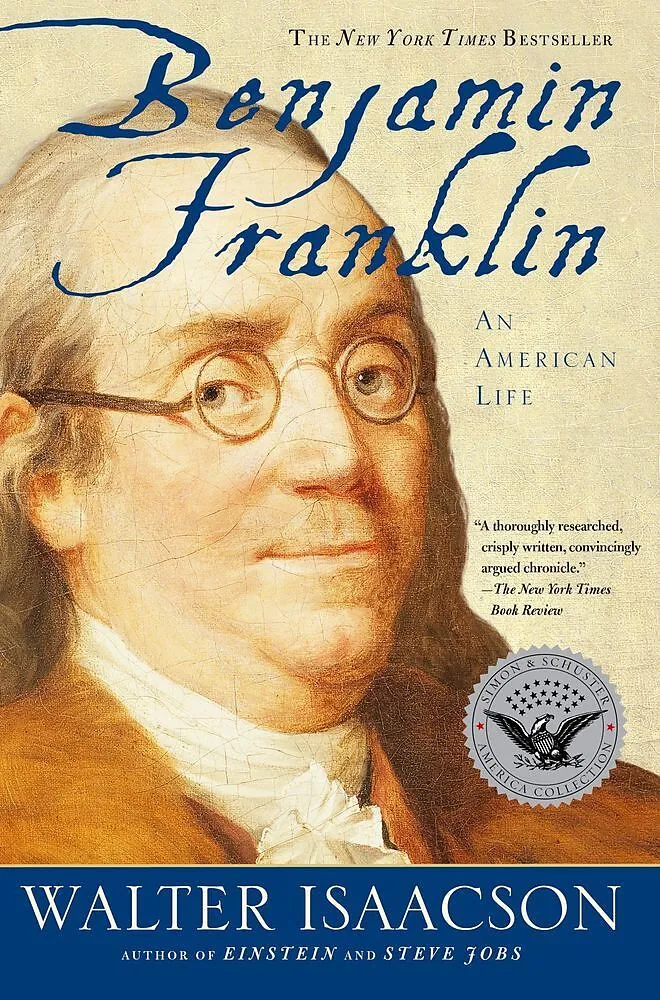
Benjamin Franklin
Beschreibung
Zusatztext The New York Times Book Review A thoroughly researched! crisply written! convincingly argued chronicle. Informationen zum Autor Walter Isaacson is the bestselling author of biographies of Elon Musk, Jennifer Doudna, Leonardo da Vinci, Steve Jobs, Be...Format auswählen
- BroschiertCHF 28.40

Wird oft zusammen gekauft
Andere Kunden kauften auch
Beschreibung
Zusatztext The New York Times Book Review A thoroughly researched! crisply written! convincingly argued chronicle. Informationen zum Autor Walter Isaacson is the bestselling author of biographies of Elon Musk, Jennifer Doudna, Leonardo da Vinci, Steve Jobs, Benjamin Franklin, and Albert Einstein. He is a professor of history at Tulane and was CEO of the Aspen Institute, chair of CNN, and editor of Time . He was awarded the National Humanities Medal in 2023. Visit him at Isaacson.Tulane.edu. Klappentext In this authoritative and engrossing full-scale biography, Walter Isaacson, bestselling author of Einstein and Steve Jobs, shows how the most fascinating of America's founders helped define our national character.Benjamin Franklin is the founding father who winks at us, the one who seems made of flesh rather than marble. In a sweeping narrative that follows Franklin's life from Boston to Philadelphia to London and Paris and back, Walter Isaacson chronicles the adventures of the runaway apprentice who became, over the course of his eighty-four-year life, America's best writer, inventor, media baron, scientist, diplomat, and business strategist, as well as one of its most practical and ingenious political leaders. He explores the wit behind Poor Richard's Almanac and the wisdom behind the Declaration of Independence, the new nation's alliance with France, the treaty that ended the Revolution, and the compromises that created a near-perfect Constitution.In this colorful and intimate narrative, Isaacson provides the full sweep of Franklin's amazing life, showing how he helped to forge the American national identity and why he has a particular resonance in the twenty-first century. Leseprobe Chapter One: Benjamin Franklin and the Invention of America His arrival in Philadelphia is one of the most famous scenes in autobiographical literature: the bedraggled 17-year-old runaway, cheeky yet with a pretense of humility, straggling off the boat and buying three puffy rolls as he wanders up Market Street. But wait a minute. There's something more. Peel back a layer and we can see him as a 65-year-old wry observer, sitting in an English country house, writing this scene, pretending it's part of a letter to his son, an illegitimate son who has become a royal governor with aristocratic pretensions and needs to be reminded of his humble roots. A careful look at the manuscript peels back yet another layer. Inserted into the sentence about his pilgrim's progress up Market Street is a phrase, written in the margin, in which he notes that he passed by the house of his future wife, Deborah Read, and that "she, standing at the door, saw me and thought I made, as I certainly did, a most awkward ridiculous appearance." So here we have, in a brief paragraph, the multilayered character known so fondly to his author as Benjamin Franklin: as a young man, then seen through the eyes of his older self, and then through the memories later recounted by his wife. It's all topped off with the old man's deft little affirmation -- "as I certainly did" -- in which his self-deprecation barely cloaks the pride he felt regarding his remarkable rise in the world. Benjamin Franklin is the founding father who winks at us. George Washington's colleagues found it hard to imagine touching the austere general on the shoulder, and we would find it even more so today. Jefferson and Adams are just as intimidating. But Ben Franklin, that ambitious urban entrepreneur, seems made of flesh rather than of marble, addressable by nickname, and he turns to us from history's stage with eyes that twinkle from behind those newfangled spectacles. He speaks to us, through his letters and hoaxes and autobiography, not with orotund rhetoric but with a chattiness and clever irony that is very contemporary, sometimes unnervingly so. We see his reflection in our own time. He was, during his e...
The New York Times Book Review A thoroughly researched, crisply written, convincingly argued chronicle.
Autorentext
Walter Isaacson is the bestselling author of biographies of Elon Musk, Jennifer Doudna, Leonardo da Vinci, Steve Jobs, Benjamin Franklin, and Albert Einstein. He is a professor of history at Tulane and was CEO of the Aspen Institute, chair of CNN, and editor of Time. He was awarded the National Humanities Medal in 2023. Visit him at Isaacson.Tulane.edu.
Klappentext
During his 84-year life Benjamin Franklin was America's best scientist, inventor, publisher, business strategist, diplomat, and writer. He was also one of its most practical political thinkers. America's first great publicist, he carefully crafted his own persona, portrayed it in public and polished it for posterity. In this riveting new biography Walter Isaacson provides readers with a full portrait of Franklin's public and private life - his loyal but neglected wife, his bastard son with whom he broke over going to war with England, his endless replacement families and his many amorous, but probably unconsummated, liaisons. But this is not just a biography of Benjamin Franklin but rather a fascinating look at American and European political history at that time. Isaacson examines the run up to the Revolutionary War, the intimate relations between Britain, France and the colonies and the decisive events that led to America's independence. Just as David McCullough brought life to the historic figure of John Adams, Isaacson portrays Franklin in the flesh, showing readers how this radical man helped define America's national character and personality.
Zusammenfassung
Rescuing Franklin from the cliché of the genial codger, the bestselling author of KISSINGER celebrates the most advanced and earthy of the founding fathers in a riveting biography that brings Benjamin Franklin to life.
Leseprobe
Chapter One: Benjamin Franklin and the Invention of America
His arrival in Philadelphia is one of the most famous scenes in autobiographical literature: the bedraggled 17-year-old runaway, cheeky yet with a pretense of humility, straggling off the boat and buying three puffy rolls as he wanders up Market Street. But wait a minute. There's something more. Peel back a layer and we can see him as a 65-year-old wry observer, sitting in an English country house, writing this scene, pretending it's part of a letter to his son, an illegitimate son who has become a royal governor with aristocratic pretensions and needs to be reminded of his humble roots.
A careful look at the manuscript peels back yet another layer. Inserted into the sentence about his pilgrim's progress up Market Street is a phrase, written in the margin, in which he notes that he passed by the house of his future wife, Deborah Read, and that "she, standing at the door, saw me and thought I made, as I certainly did, a most awkward ridiculous appearance." So here we have, in a brief paragraph, the multilayered character known so fondly to his author as Benjamin Franklin: as a young man, then seen through the eyes of his older self, and then through the memories later recounted by his wife. It's all topped off with the old man's deft little affirmation -- "as I certainly did" -- in which his self-deprecation barely cloaks the pride he felt regarding his remarkable rise in the world.
Benjamin Franklin is the founding father who winks at us. George Washington's colleagues found it hard to imagine touching the austere general on the shoulder, and we would find it even more so today. Jefferson and Adams are just as intimidating. But Ben Franklin, that ambitious urban entrepreneur, seems made of flesh rather than of marble, addressable by nickname, and he turns to us from history's stage with eyes that twinkle from behind those newfangled spectacles. He speaks to us, through his letters and hoaxes and autobiography, not with orotund rhetoric but with a chattiness and clever irony that is very contemporary, somet…