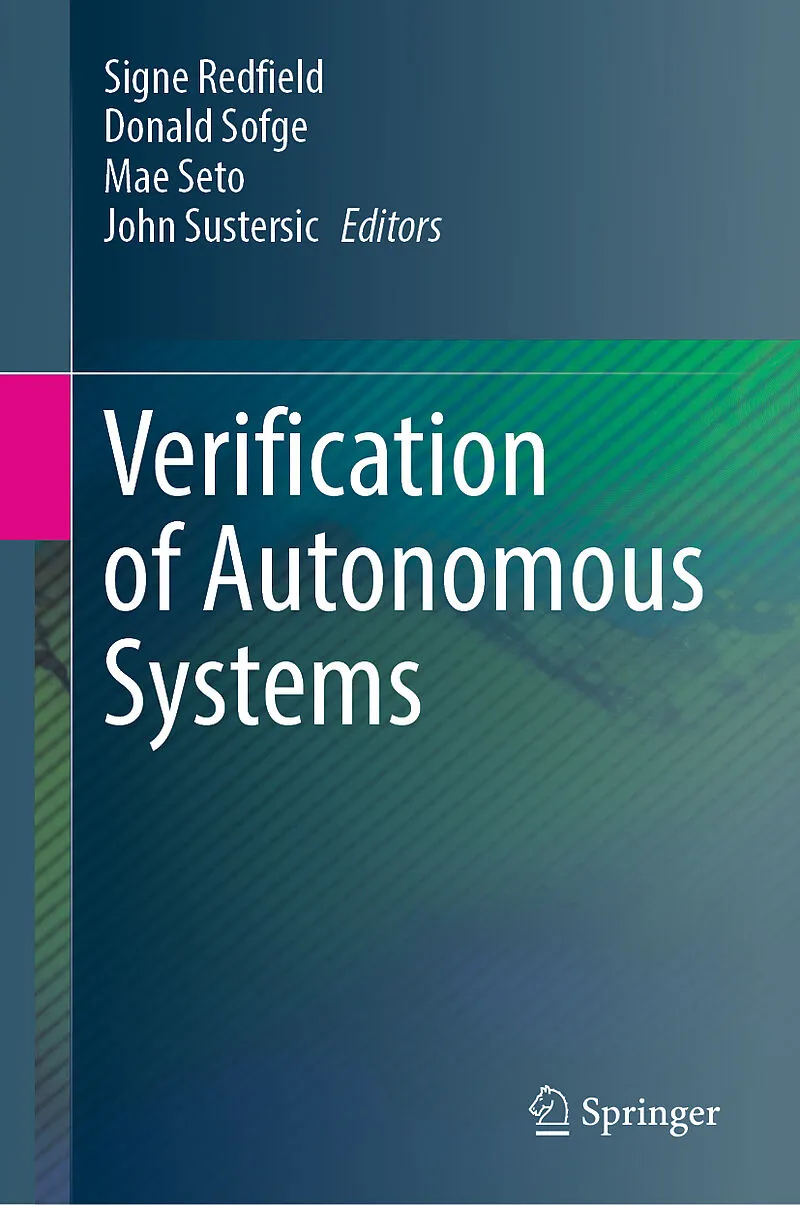
Verification of Autonomous Systems
Beschreibung
This book is a comprehensive guide to current practical and theoretical understanding of verification of autonomous systems, helping users find the tools and techniques they need to address this challenging problem. Autonomous systems are transitioning out of...Format auswählen
- Fester EinbandCHF 132.15
- E-Book (pdf)CHF 142.30

Wird oft zusammen gekauft
Andere Kunden kauften auch
Beschreibung
This book is a comprehensive **** guide to current practical and theoretical **** understanding of verification of autonomous systems, helping users find the tools and techniques they need to address this challenging problem. Autonomous systems are transitioning out of the lab and into the commercial and industrial space in ever increasing numbers. Verification provides the assurance case necessary for deployment of autonomous systems, but we lack guidance, certifications, and standards to help a business determine whether their autonomous system is safe, secure, or reliable. A community has formed to develop tools, techniques, and processes to solve this problem, but the existing literature largely focuses on autonomy design tools and techniques rather than on tools and techniques that can be used to verify an existing autonomy design. This book fills that gap.
It directly connects specific challenges faced by verification agents and autonomy developers with the research and topics most relevant to their concerns:
- Specific challenges faced by stakeholders and researchers are cross-referenced to chapters addressing the relevant tools and techniques.
- Individual aspects of the verification process like requirements and specification development, model tests, and integration tests are mapped into technical challenges related to modeling, testing, abstraction and verification tools.
- Each chapter is tied to both the stakeholder challenges and the technical challenges it addresses.
Verification processes, industrial needs, and issues with verification of learning systems are addressed across all domains, encompassing platforms from aircraft and spacecraft to marine systems and ground vehicles operating in industrial, military, commercial and household applications. Broad in scope, this reference ties advances in formal analysis, hardware testing, verification process modifications, and design and evaluation tools to the needs of verification researchers and professionals.
Encompasses the processes, tools, and fundamental understanding of system and behavior design, operation, and evaluation Deliberately crafted to appeal to a diverse audience of R&D professionals, operators, and test agents Clearly articulated editorial analysis identifying challenges across platform domains, user needs, and technical topics
Autorentext
Signe Redfield is the Director of the Laboratory for Autonomous Systems Research at the Naval Research Laboratory (NRL). She has served as Co-Chair for the IEEE Technical Committees for Verification of Autonomous Systems (TC-VAS) and Performance Evaluation and Benchmarking of Robotic and Automation Systems (TC-PEBRAS). She co-authored the first IEEE RAS standard, 1872-2015, and served as Secretary for standard 1872.1-2024, “Robot Task Representation”. She was detailed to the Joint Artificial Intelligence Center (JAIC) as the acting lead of their Test and Assessment group in 2019, and returned to the Naval Research Laboratory (NRL) Space Technology Division’s Robotics and Machine Learning Section where she developed assurance cases and supported the development of verification and testing tools for autonomous systems. She designed the Payload Mission Manager software component for DARPA’s Robotic Servicing of Geosynchronous Satellites (RSGS) program, which integrates the payload fault management system with operator generated automated, supervised, and fully autonomous behavior scripts. She served as the NRL RSGS Algorithms lead from 2014-2017 and the de facto Fault Management lead from 2015-2019. Before her arrival at NRL in 2014, she spent three years in London as the ONR Global Associate Director for Autonomy and Unmanned Systems. Prior to her term at ONR Global, Dr. Redfield worked at the Naval Surface Warfare Center, Panama City Division in Florida where she worked on heterogeneous teams of autonomous maritime vehicles and led the development of a new architecture, enabling the simulation and testing of a variety of arbitration mechanisms to control teams of vehicles.
Klappentext
This book is a comprehensive ****guide to current practical and theoretical ****understanding of verification of autonomous systems, helping users find the tools and techniques they need to address this challenging problem. Autonomous systems are transitioning out of the lab and into the commercial and industrial space in ever increasing numbers. Verification provides the assurance case necessary for deployment of autonomous systems, but we lack guidance, certifications, and standards to help a business determine whether their autonomous system is safe, secure, or reliable. A community has formed to develop tools, techniques, and processes to solve this problem, but the existing literature largely focuses on autonomy design tools and techniques rather than on tools and techniques that can be used to verify an existing autonomy design. This book fills that gap.
It directly connects specific challenges faced by verification agents and autonomy developers with the research and topics most relevant to their concerns:
- Specific challenges faced by stakeholders and researchers are cross-referenced to chapters addressing the relevant tools and techniques.
- Individual aspects of the verification process like requirements and specification development, model tests, and integration tests are mapped into technical challenges related to modeling, testing, abstraction and verification tools.
- Each chapter is tied to both the stakeholder challenges and the technical challenges it addresses.
Verification processes, industrial needs, and issues with verification of learning systems are addressed across all domains, encompassing platforms from aircraft and spacecraft to marine systems and ground vehicles operating in industrial, military, commercial and household applications. Broad in scope, this reference ties advances in formal analysis, hardware testing, verification process modifications, and design and evaluation tools to the needs of verification researchers and professionals.
Zusammenfassung
This book is a comprehensive **** guide to current practical and theoretical **** understanding of verification of autonomous systems, helping users find the tools and techniques they need to address this challenging problem. Autonomous systems are transitioning out of the lab and into the commercial and industrial space in ever increasing numbers. Verification provides the assurance case necessary for deployment of autonomous systems, but we lack guidance, certifications, and standards to help a business determine whether their autonomous system is safe, secure, or reliable. A community has formed to develop tools, techniques, and processes to solve this problem, but the existing literature largely focuses on autonomy design tools and techniques rather than on tools and techniques that can be used to verify an existing autonomy design. This book fills that gap.
It directly connects specific challenges faced by verification agents and autonomy developers with the research and topics most relevant to their concerns:
- Specific challenges faced by stakeholders and researchers are cross-referenced to chapters addressing the relevant tools and techniques.
- Individual aspects of the verification process like requirements and specification development, model tests, and integration tests are mapped into technical challenges related to modeling, testing, abstraction and verification tools.
- Each chapter is tied to both the stakeholder challenges and the technical challenges it addresses. Verification processes, industrial needs, and issues with verification of learning systems are addressed across all domains, encompassing platforms from aircraft and spacecraft to marine systems and ground vehicles operating …