Beschreibung
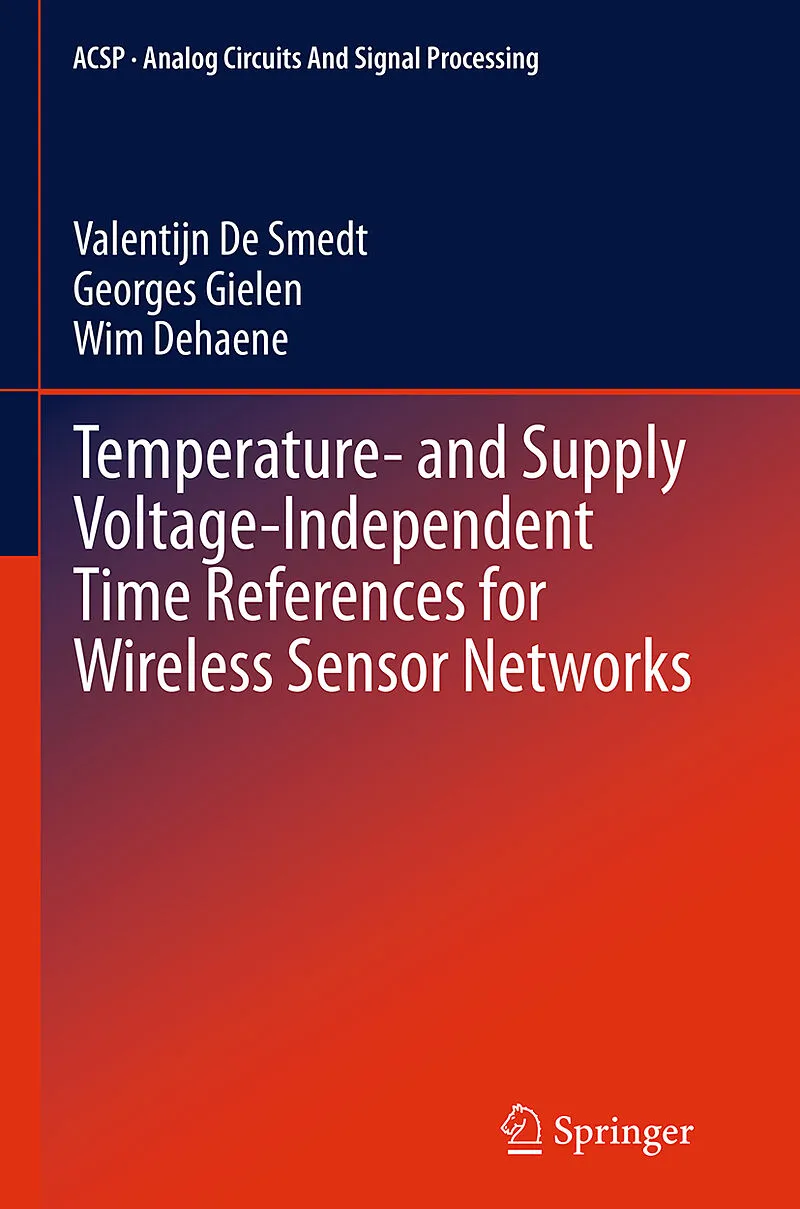
This book investigates the possible circuit solutions to overcome the temperature and supply voltage-sensitivity of fully-integrated time references for ultra-low-power communication in wireless sensor networks. The authors provide an elaborate theoretical in...This book investigates the possible circuit solutions to overcome the temperature and supply voltage-sensitivity of fully-integrated time references for ultra-low-power communication in wireless sensor networks. The authors provide an elaborate theoretical introduction and literature study to enable full understanding of the design challenges and shortcomings of current oscillator implementations. Furthermore, a closer look to the short-term as well as the long-term frequency stability of integrated oscillators is taken. Next, a design strategy is developed and applied to 5 different oscillator topologies and 1 sensor interface. All 6 implementations are subject to an elaborate study of frequency stability, phase noise and power consumption. In the final chapter all blocks are compared to the state of the art.
To provide a comprehensive overview of timing issues and solutions in wireless sensor networks To gain understanding of all underlying mechanisms by starting from the oscillator basics To provide and demonstrate a design strategy by describing the development of 6 state of the art process-, temperature- and supply voltage- independent building blocks and discussing the design trade-offs To demonstrate the reliability and functionality of the developed building blocks by integrating them in a complete, autonomous, flexible wireless tag To be a reference work for beginners as well as more experienced oscillator and ultra-low-power circuit design engineers Includes supplementary material: sn.pub/extras
Autorentext
Arijit Karmakar received a B.E. degree in Instrumentation and Electronics from Jadavpur University, Kolkata, India in 2013. He earned his M.Tech. degree in Electrical Engineering from Indian Institute of Technology (IIT) Bombay, Mumbai, India, in 2015, with a specialization in Electronics Systems. From 2015 to 2017, he worked as a Senior Systems Engineer at Cypress Semiconductor in Bangalore, India, where he acquired experience developing capacitive sensors using programmable System-on-a-Chip (SoC) Technology for Internet-of-Things (IoT) applications. From 2017 to 2023 he was working as a research assistant at the ADVISE Research Group of the Katholieke Universiteit (KU) Leuven towards a PhD degree as a part of RADSAGA ITN program on the topic of "Integrated Time-based Signal Processing Circuits for Harsh Radiation Environments", which he received in April 2023. His research interest includes radiation-hardened mixed-signal integrated circuits, TDCs and RF clock interfaces for ADPLLapplications, and integrated CMOS sensor front-end circuits. He joined IDLab (Internet technology and Data Science Lab), Ghent University, in collaboration with IMEC in September 2022 and is presently working on developing high-speed interfaces for optical-electronic co-design. Valentijn De Smedt received the M.Sc. degree in electrical engineering from the Katholieke Universiteit Leuven in 2007. The subject of his Master thesis was the design of an accurate integrated frequency reference. From 2007 to 2014 he was working as a research assistant at the MICAS laboratories of the Katholieke Universiteit Leuven towards a PhD degree on the design of ultra-low-power time-based building blocks for wireless sensor networks, which he received in April 2014. Between February 2014 and July 2017, he was employed at MinDCet as a Senior Design Engineer. At MinDCet he was responsible for the IP development of ultra-high voltage (1 kV) high-power integrated power converters and motor drivers. Apart from this, he was responsible for the further development of the MaDMix and MaDCap inductor and capacitor measurement system. In 2017 he became professor and head of the ADVISE research group. The focus of his research is on radiation-tolerant control systems for power and sensing applications. Currently, he is appointed as associate professor at the KU Leuven Dept. of Electrical Engineering (ESAT). He was vice-chair technical activities of the IEEE student branch of Leuven between 2009 and 2013, and chaired the IEEE Student Branch and GOLD congress 2010 (SBC2010). Between 2011 and 2015, he was IEEE Benelux GOLD (Young Professionals) chair and co-chair of the IEEE SSCS Benelux chapter. Since 2015 he is Membership Development Officer in the IEEE Benelux ExCom, since January 2020 he is treasurer of the IEEE Benelux section. In November 2017 he founded the IEEE Benelux NPSS chapter, which he currently chairs. Paul Leroux is Full Professor in the field of radiation hardened chip design within the Advanced Integrated Sensing Lab (ADVISE) of KU Leuven, Geel Campus. Prof. Leroux received the M.Sc. degree and Ph.D. degree in electronic engineering from the KU Leuven, Belgium, in 1999 and 2004, respectively. From 1999 to 2004, he was a Teaching and Research Assistant within the MICAS research group of the KU Leuven Department of Electrical Engineering (ESAT). In 2009 he became professor at the KU Leuven Dept. of Electrical Engineering (ESAT), where he headed the Electrical Engineering (ESAT) Technology Cluster from November 2011 to July 2016. Since August 2016 he is Campus Chair of the KU Leuven Geel Campus. His current research activities within the ADVISE research group focus on radiation hardened IC design for nuclear fusion, space and high-energy physics applications, circuits for optical communication and instrumentation. His group is part of the CERN CMS collaboration where Prof. Leroux is acting as KU Leuven team leader. Paul Leroux has (co)authored 4 books and ov
Inhalt
Introduction.- Part I Theoretical background on Oscillators and Time References.- Oscillators and Time References.- Jitter and Phase Noise in Oscillators.- Long-term Oscillator Stability.- Part II Oscillator Designs for Temperature and Voltage Independence.- Design of two Wien Bridge Oscillators.- The Pulsed Oscillator Topology.- Injection-Locked Oscillators.- Oscillator-Based Sensor Interfaces.- Part III Wireless Sensor Nodes.- Design of a Low-power Wireless RFID tag.- Conclusion.