Beschreibung
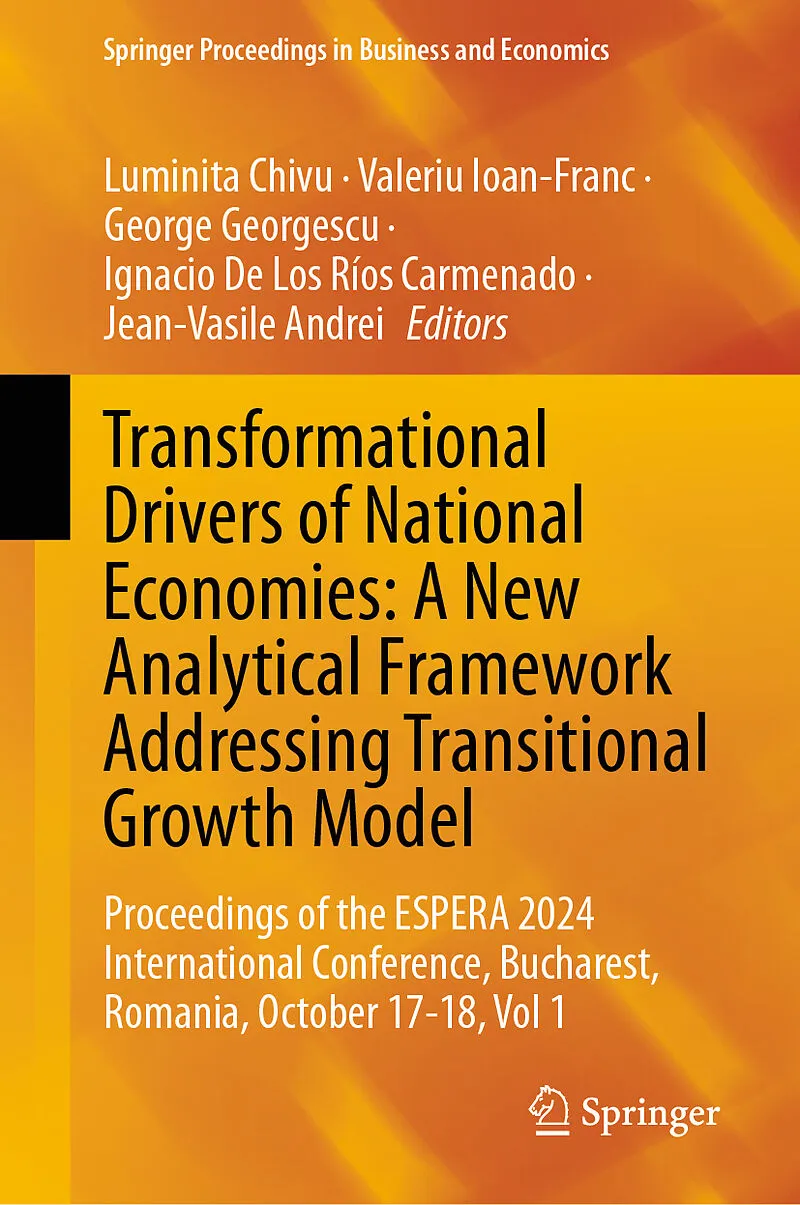
This conference proceedings volume examines key issues in international economics and the geopolitical landscape, assessing medium- and short-term developments and the structural reforms they demand. Featuring selected contributions presented at the 2024 Econ...
This conference proceedings volume examines key issues in international economics and the geopolitical landscape, assessing medium- and short-term developments and the structural reforms they demand. Featuring selected contributions presented at the 2024 Economic Scientific Research - Theoretical, Empirical and Practical Approaches (ESPERA) International Conference, this book analyzes the transformational forces reshaping national economies and evaluates policy tools suited to diverse regional contexts. Addressing both theoretical and applied dimensions of global economic change, this book explores themes such as cross-country implications, shifting industrial policies linked to renewable manufacturing, educational performance, public-debt pressures, fiscal-market tail risks, and the need for stronger multilateral coordination, among others. Bringing together quantitative and qualitative research, this volume is beneficial to researchers, scholars, academics, students, professionals, and decision-makers interested in the developments in the new world economy.
Analyses the current global economic shifts in response to geopolitical challenges Offers a cross-country perspective on policy reform and the forces shaping national economies Features topics such as renewable manufacturing, educational performance, fiscal sustainability, and green transition
Autorentext
Luminita Chivu is Managing Director and Senior Researcher at the National Institute for Economic Research Costin C. Kiritescu (INCE), Romanian Academy, Bucharest, Romania. Her research focuses on economics of agriculture, rural development, labor market, economic growth, European integration, economic restructuring, industrial relations and working conditions.
Valeriu Ioan-Franc is Deputy Director and Senior Researcher at the National Institute of Economic Research Costin C. Kiritescu (INCE), Romanian Academy, Bucharest, Romania. He is also Executive Director of the Romanian Center for Compared and Consensual Economy, Director of the Economic Information and Documentation Center, and President of the Pierre Werner Center of Studies and Documentation Romania-Luxembourg. He has published numerous scientific papers in marketing.
George Georgescu is Deputy Director and Senior Researcher at the National Institute of Economic Research Costin C. Kiritescu (INCE), Romanian Academy, Bucharest, Romania. His also the Head of the Centre for Economic Information and Documentation Romania and Editor-in-chief of NIER publications. He has an extensive experience in various areas of economic research, including macroeconomic and financial balances, labor market, industrial restructuring, FDI, internationalization of companies).
Ignacio De Los Ríos Carmenado is Full Professor for Engineering Projects at the School of Agricultural, Food and Biosystems Engineering and Director of GESPLAN Research Group at the Universidad Politécnica de Madrid, Spain. His research focuses on project management, urban/rural development, teaching methods, and behavioral competences.
Jean-Vasile Andrei is Full Professor at Petroleum-Gas University of Ploiesti, Department of Business Administration, scientific coordinator of the Center for Renewable Energies and Energy Efficiency within the National Institute for Economic Research "Costin C. Kiritescu", Romanian Academy and Ph.D. mentor in economics at Bucharest University of Economic Studies, Romania. He is co-founder and scientific coordinator of the Research Network on Resources Economics and Bioeconomy (RebResNet).
Inhalt
Ch 1 Measuring Mutual Causality in Macroeconomy.- Ch 2 Economics: An Applied Science?.- Ch 3 For a Holistic Approach to the Economy.- Ch 4 Dashboard for Monitoring Romania's Real Economic and Social Convergence with other Member States and the EU Average.- Ch 5 Demographic Challenges and Economic Implications for Romania's Counties by 2040: A Regional Analysis Using ESDA and Multivariate Spatial Clustering.- Ch 6 Demographic and Occupational Trends in the Romanian Labour Market in the Third Millenium.- Ch 7 Structural Changes and Correlations between Income Components of Romania's Gross Domestic Product during the Period 2000-2019.- Ch 8 Artificial Intelligence and Inequality. The Role of Ginis Coefficient and Perelmans Model in the Assessment of the Economic Trends.- Ch 9 Exploring the Connection Between Central Bank Policy and Income Inequality.- Ch 10 The Impact of Redistributive Fiscal Policies on Inequality.- Ch 11 Monetary Policy and Education: Determinants of Economic Inequality in Romania.- Ch 12 Digital Banking Transformation in Romania: Pathway Toward Financial Inclusion and Education.- Ch 13 State Aid Policy and Its Role in Romania's Post-Pandemic Recovery.- Ch 14 A Quantitative and Statistical Analysis of the Significance of Natural Resources in a Nation's Economy.- Ch 15 Resilience: Resources and Strategies of SMEs in a New Theoretical and Practical Framework.- Ch 16 Post-Covid-19 Regional Resilience and the Green Economy.- Ch 17 Sustainability Certifications in SMEs.- Ch 18 The Green Economy in Romania.- Ch 19 A Comparative Profiling of the EU-27.- Ch 20 New Concepts and Trends of Eco-Innovation for Circular Economy.- Ch 21 Contribution Benefits of Implementing Artificial Intelligence in Circular Economy Activities.- Ch 22 Adjustments of Romania's Manufacturing Industry to Recent Economic Shocks in the Context of the Transition to a Green Economy.- Ch 23 Clean Energy Developments and Perspectives in Romania.- Ch 24 The Impact of Environmental Management Practices on Perceived Firm Performance.- Ch 25 Controversies and Evolution of Oil and Gas Royalty Calculation.- Ch 26 Roads or Railways: The Dilemma of the Strategy for the Development of Sustainable Transport Infrastructure in Romania.- Ch 27 Conclusions and Follow-Ups.