Beschreibung
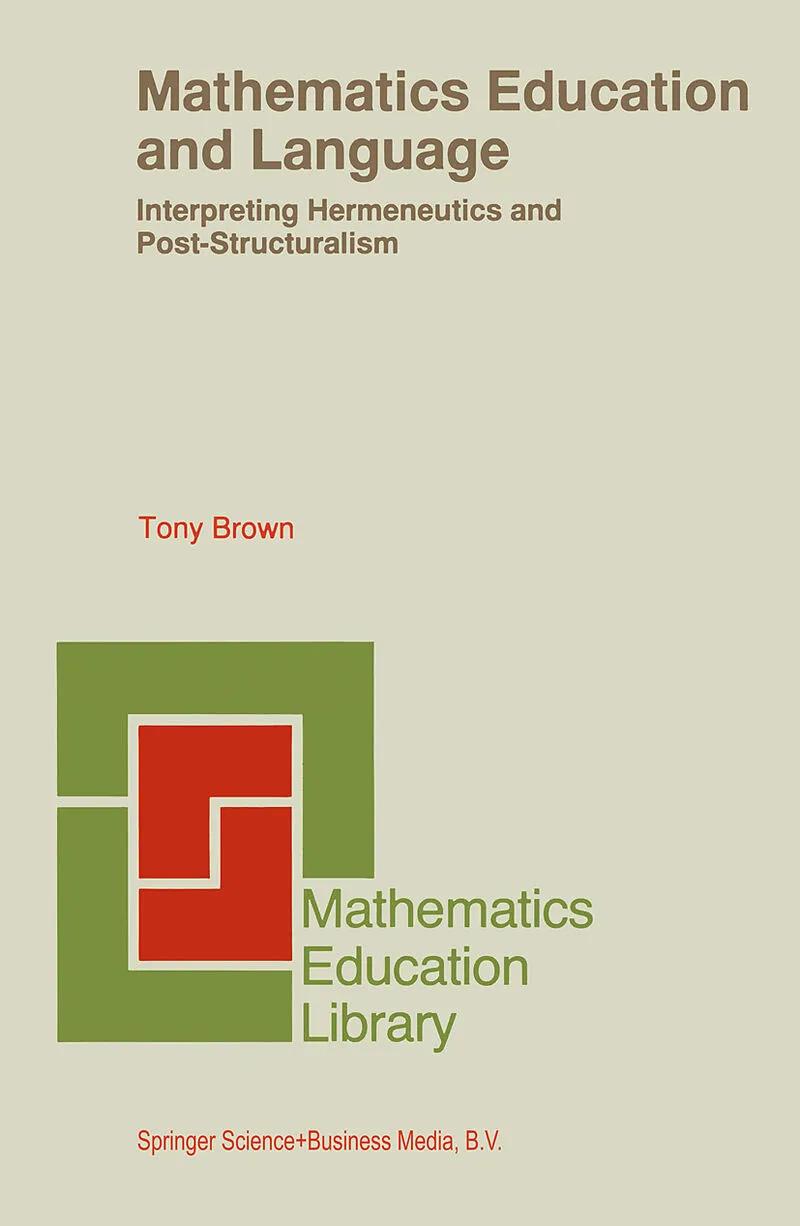
` Contemporary thinking on philosophy and the social sciences has been dominated by analyses that emphasise the importance of language in understanding societies and individuals functioning within them; important developments which have been under-utilised by ...` Contemporary thinking on philosophy and the social sciences has been dominated by analyses that emphasise the importance of language in understanding societies and individuals functioning within them; important developments which have been under-utilised by researchers in mathematics education. This book reaches out to contemporary work in these broader fields; drawing on original sources in key areas such as Gadamer and Ricoeur's development of hermeneutics, Habermas' work in critical social theory, Schutz's social phenomenology, Saussure's linguistics and the post-structuralist analysis of Derrida, Foucault and Barthes. Through examining the writings of these major thinkers it is shown how language is necessarily instrumental in developing mathematical understanding; but a language that is in a permanent state of becoming, resisting stable connections to the ideas it locates. The analysis offered extends from children doing mathematics to teachers inspecting and developing their own professional practices. '
Autorentext
Tony Brown Tony is Professor of Mathematics Education at Manchester Metropolitan University. Originally from London, Tony trained in Canterbury and Exeter before returning to London where he taught mathematics for three years at Holland Park School. This was followed by three years as a mathematics teacher educator for Volunteer Service Overseas in Dominica in the Caribbean. In 1987, he completed his PhD at Southampton University. His doctoral research focused on language usage in mathematics classrooms, especially where the fluent use of English could not be assumed. After a spell as mathematics coordinator in a middle school in the Isle of Wight, Tony moved to Manchester Metropolitan University. Tony has headed the doctoral programme in education and participated in a range of other courses; he became a professor in 2000. Projects have included: Economic and Social Research Council-funded studies examining teacher education; piloting a distance-teaching programme enabling British volunteers based in Africa to research their own teaching practice within a programme of professional development; a General Medical Council-funded project on how senior doctors learn; and leading a team of emergency medicine doctors carrying out professionally focused research. Tony also spent two years on leave from Manchester at the University of Waikato where he became the first Professor of Mathematics Education in New Zealand. There he led a project funded by the New Zealand Council for Educational Research on Pasifika teachers working in New Zealand Schools. Tony has published two other books in Springer s Mathematics Education Library series. Mathematics Education and Language, first published in 1997, outlines his interest in mathematics in schools. A revised second edition appeared in 2001. Mathematics Education and Subjectivity (forthcoming) explores mathematical learning from the perspective of contemporary social theory. Meanwhile, Tony has also co-authored, with Liz Jones, Action Research and Postmodernism, which explores how teachers might carry out practitioner research within higher degrees. Regulative Discourses in Education: A Lacanian Perspective, co-authored with Dennis Atkinson and Janice England, offers an analysis of teacher practices through psychoanalytic theory. The Psychology of Mathematics Education, which he edited, introduces psychoanalytic theory as an alternative to more cognitive understandings of psychology. Tony has also written extensively in journals such as Educational Studies in Mathematics, For the Learning of Mathematics and the British Educational Research Journal.
Inhalt
Short Review of Recent Research.- Experiencing Mathematics.- Hermeneutics and Mathematics Education.- The Production of Mathematical Meaning: A Post-Structuralist Perspective.- Sharing Mathematical Perspectives.- The Classroom Environment.- Some Lessons.- The Phenomenology of the Mathematics Classroom.- The Teacher's Perspective.- Teacher-Student Interactions.- Developing Teacher Practice.- Conclusion.- Conclusion.