
IHR WARENKORB IST AKTUELL LEER.
Haben Sie noch nichts passendes gefunden? Stöbern Sie durch unser komplettes Sortiment.
Oder melden Sie sich an bzw. registrieren Sie sich.
- Kostenlose Lieferung
- Kauf auf Rechnung
- Ex Libris Tiefpreis
- Filiallieferung und 650+ Abholorte
- Rabatt-Bons als Club-Mitglied
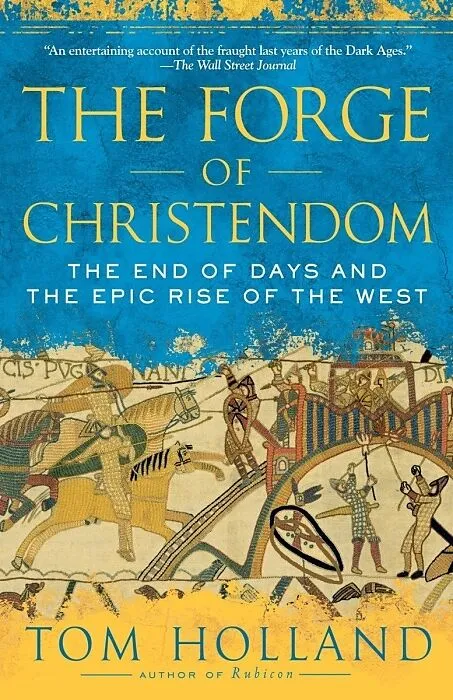
The Forge of Christendom
Beschreibung
Zusatztext 51814184 Informationen zum Autor Tom Holland Klappentext A grand narrative history of the re-emergence of Europe following the collapse of the Roman Empire. At the approach of the first millennium, the Christians of Europe did not seem likely candid...Format auswählen
- Kartonierter EinbandCHF 22.70
Wird oft zusammen gekauft
Andere Kunden kauften auch
Beschreibung
Zusatztext 51814184 Informationen zum Autor Tom Holland Klappentext A grand narrative history of the re-emergence of Europe following the collapse of the Roman Empire. At the approach of the first millennium, the Christians of Europe did not seem likely candidates for future greatness. Weak, fractured, and hemmed in by hostile nations, they saw no future beyond the widely anticipated Second Coming of Christ. But when the world did not end, the peoples of Western Europe suddenly found themselves with no choice but to begin the heroic task of building a Jerusalem on earth. In The Forge of Christendom , Tom Holland masterfully describes this remarkable new age, a time of caliphs and Viking sea kings, the spread of castles and the invention of knighthood. It was one of the most significant departure points in history: the emergence of Western Europe as a distinctive and expansionist power.1 The Return of the King The Whore of Babylon "All these will I give you," said Satan, showing Jesus the kingdoms of the world, "if you will fall down and worship me."1 But Jesus, scorning empire, refused the temptation. And Satan, confounded, retired in great confusion; and angels came and ministered to the Son of Man. Or so, at any rate, his followers reported. The kingdoms shown to Jesus already had a single master: Caesar. Monarch of a city which had devoured the whole earth, and trampled it down, and broken it to pieces, "exceedingly terrible,"2 he swayed the fate of millions from his palace upon the hill of the Palatine in Rome. Jesus had been born, and lived, as merely one of his myriad subjects. The rule proclaimed by the "Anointed One," the "Christ," however, was not of this world. Emperors and their legions had no power to seize it. The Kingdom of Heaven was promised instead to the merciful, the meek, the poor. "Blessed are the peacemakers, for they shall be called sons of God."3 And Jesus -- even facing death -- practised what he had preached. When guards were sent to arrest him, his chief disciple, Peter, "the rock" upon whom it had been prophesied that the Church itself would be built, sought to defend his master; but Jesus, healing the man wounded in the ensuing scuffle, ordered Peter to put up his weapon. "For all who take the sword," he warned, "will perish by the sword."4 Dragged before a Roman governor, Jesus raised no voice of complaint as he was condemned to death as an enemy of Caesar. Roman soldiers guarded him as he hauled his cross through the streets of Jerusalem and out on to the execution ground, Golgotha, the Place of the Skull. Roman nails were hammered through his hands and feet. The point of a Roman spear was jabbed into his side. In the years and decades that followed, Christ's disciples, insisting to the world that their master had risen from His tomb in defiance of Satan and all the bonds of death, not surprisingly regarded the empire of the Caesars as a monstrosity. Peter, who chose to preach the gospel in the very maw of the beast, named Rome "Babylon";5 and it was there that he, like his master, ultimately suffered death by crucifixion. Other Christians arrested in the capital were dressed in animal skins and torn to pieces by dogs, or else set on fire to serve the imperial gardens as torches. Some sixty years after Christ had departed from the sight of His disciples, a revelation of His return was granted to a disciple named John, a vision of the end of days, in which Rome appeared as a whore "drunk with the blood of the saints and the blood of the martyrs," mounted upon a scarlet beast, and adorned with purple and gold -- "and on her forehead was written a name of mystery: 'Babylon the great, mother of harlots and of earth's abominations.'"6 Great though she was, however, the doom of the whore was certain. Rome would fall, and deadly portents afflict mankind, and Satan, "the dragon, that ancient serpent,"7 escape his prison, until...
A Best Book of the Year: The Guardian, The Daily Telegraph, The Daily Mail, The Independent, The Evening Standard, The Spectator
“An entertaining account of the fraught last years of the Dark Ages.”
—The Wall Street Journal
“An enjoyable and exuberantly argued book. . . . Holland combines sound scholarly credentials with a gift for storytelling on a magisterial scale. . . . In a tightly woven and sometimes witty narrative, [Holland demonstrates] the subtle interplay of genuine religious sentiment and cynical power politics.”
—The Economist
“A sweeping and hugely enlightening study of Western history.”
—Providence Journal
“Prodigious. . . . A marvelous, enthralling read, [it] gives a lively sense of these turbulent centuries that were so crucial in the making of Western civilization. . . . Narrative history in the grand manner, written with the panache and confidence we associate with the great historians of the 18th and 19th centuries.”
—Daily Telegraph (London)
“A superb, fascinating and erudite medieval banquet of slaughter, sanctity and sex, filled with emperors, whores and monks.”
—Simon Sebag-Montefiore, The Evening Standard (London)
“Fresh from his triumphs in Rome and Persia, Tom Holland turns his brilliant narrative spotlight on the so-called ‘dark ages’ that followed the Western Empire’s decline. Global in reach, this book sweeps thrillingly over the troubled centuries that saw the triumph of Byzantium, the ascent of Islam—and the lingering disaster of the Crusades. . . . Unlike other blockbuster histories, this one takes as much care with beliefs as with the battles they provoked. We all live in the feverish aftermath of these events, which makes Holland’s galloping guidance all the more timely.”
—The Independent (London)
“A fast and lively lesson in that period which school so often misses out. . . . Another blockbuster.”
—The Sunday Times (London)
“A tremendously good read, which will no doubt gain more accolades and many more readers.”
—The Sunday Telegraph (London)
“As a stirring, vivid and formidably learned analysis of the events surrounding the Millennium, this will hardly be equalled. Extraordinary insights and lapidary phrases abound.”
—The Independent on Sunday (London)
“It is perfectly right for Holland to claim a great deal for the 11th century, of which his book is a splendid, highly coloured canvas.”
—The Guardian (London)
“Nobody believes in the Dark Ages any more, but Holland’s brightness and clarity makes this account of the year 1000 exceptionally pleasing.”
—The Scotsman
“This was the era when dragons were still thought to stalk the Earth; when daredevil noblemen would cover their bodies in honey and allow it to be licked off by ravening bears. . . . Mightily readable—far more than the stories of Greeks and Romans, this is your history.”
—Mail on Sunday (London)
“Remarkable. . . . Both a vastly entertaining read, with grandiloquent Gibbon-like sweep, as well as deeply intelligent: it constitutes a major contribution to some of the most crucial issues of our time.”
—John Cornwell, The Tablet
“An exhilarating sweep across European history either side of the year 1000; riveting.”
—The Spectator
“In the year 1000, Western Europe was no more than a primitive and fearful region in the shadow of Byzantium and Islam. Yet as Tom Holland demonstrates in this fascinating history it was also the crucible for the creation of the Europe we know today. From the age of Canute and William the Conqueror, Pope Gregory VII and the Vikings this vivid and bloodthirsty histor…