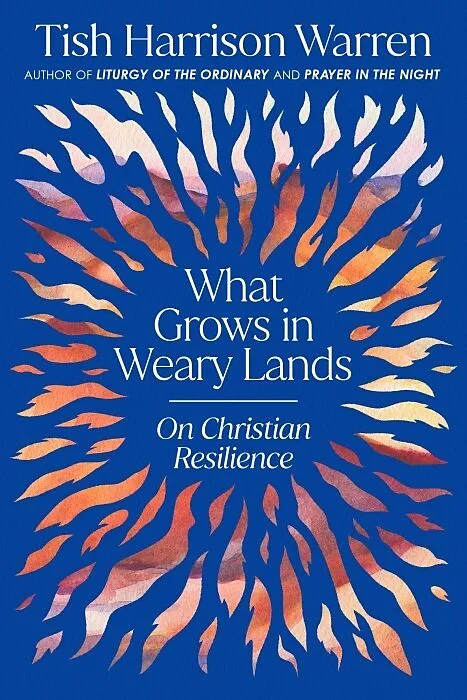
What Grows in Weary Lands
Beschreibung
How do we cultivate faith that endures? From the award-winning author and former Early Christians often grappled with a reality we rarely talk about in contemporary life: that God seems to abandon the soul at times, leaving us feeling as if we are alone and le...Format auswählen
- Fester EinbandCHF 27.60
Wird oft zusammen gekauft
Andere Kunden kauften auch
Beschreibung
How do we cultivate faith that endures? From the award-winning author and former Early Christians often grappled with a reality we rarely talk about in contemporary life: that God seems to abandon the soul at times, leaving us feeling as if we are alone and left to our own resources. These are;times of futility, when work and relationships feel hard, when prayer feels unsatisfying,;and we question if our efforts are amounting to anything. For centuries, Tish Harrison Warren notes, times of “aridity” were seen as necessary--prerequisites for growth and maturity. Yet in our culture fixated on speed and optimization, we risk losing this deeper sense of the human journey and the resilience that comes with it. Writing for a moment when two-thirds of Americans are dissatisfied with their work and a sense of languishing is widespread,;Warren draws from her own season of exhaustion and also from;the rich well of Christian tradition--particularly;the earliest Christian monks--to discover the habits and mindsets that anchor us through doubt, difficulty, and spiritual dryness. She offers hope to those who feel like life is overwhelming, taxing, or disorienting.; <What Grows in Weary Lands< speaks to anyone longing for a life of depth in a distracted age. Warren helps us see that nothing is wasted--that, even in desert seasons, something good is growing, rooted in grace and reaching toward glory.
Autorentext
Tish Harrison Warren is the author of Liturgy of the Ordinary, which was named Christianity Today’s Book of the Year, and Prayer in the Night, which received both Christianity Today’s Book of the Year and the ECPA Christian Book of the Year honors. Her work has appeared in The New York Times, Christianity Today, Comment Magazine, The Point Magazine, and other outlets. She serves as the C. S. Lewis Theological Writer-in-Residence for the Anglican Episcopal House of Studies at Baylor University’s George W. Truett Theological Seminary. She is a senior fellow with the Trinity Forum and an assisting priest at Immanuel Anglican Church. She lives in Austin, Texas, with her husband and their three children.
Klappentext
How do we cultivate faith that endures? From award-winning author and former New York Times writer Tish Harrison Warren comes a fresh vision for navigating burnout and weariness through ancient Christian practices—guiding us toward lives of resilience, renewal, and flourishing.
“Warren is one of our best living spiritual writers. . . . It would be impossible to overstate how warmly I recommend this book to all.”—John Mark Comer, New York Times bestselling author of Practicing the Way and The Ruthless Elimination of Hurry
Early Christians often grappled with a reality we rarely talk about in contemporary life: that God seems to abandon the soul at times, leaving us feeling as if we are alone and left to our own resources. These are times of futility, when work and relationships feel hard, when prayer feels unsatisfying, and we question whether our efforts are amounting to anything.
For centuries, Warren notes, times of “aridity” were seen as necessary prerequisites for growth and maturity. Yet in our culture fixated on speed and optimization, we risk losing this deeper sense of the human journey and the resilience that comes with it.
Writing for a moment when two-thirds of Americans are dissatisfied with their work, and a sense of languishing is widespread, Warren draws from both her own season of exhaustion and the rich well of Christian tradition—particularly that of the earliest Christian monks—to discover the habits and mindsets that anchor us in times of doubt, difficulty, and spiritual dryness. She offers hope to those who feel like life is overwhelming, taxing, and disorienting.
What Grows in Weary Lands speaks to anyone longing for a life of depth in a distracted age. Warren helps us see that nothing is wasted—that even in desert seasons something good is growing, rooted in grace and reaching toward glory.
Leseprobe
1
Discovery in the Desert
lost and found in a weary land
I.
Though we experience this differently, all of us hit points in our lives where we’re out of steam, where we can’t get traction, where we feel lifeless or tired, disoriented and unsure of ourselves. Things seem hard, maybe harder than we think they should be.
Paul wrote to the early church in Galatia urging them to “not become weary in doing good, for at the proper time we will reap a harvest if we do not give up.” But he would not have needed to issue this reminder if the course of life—even a life of faith—did not often make us weary. If the Christian life were meant to feel like a perpetual rock concert or an ecstatic mystical journey, if it was not difficult to pray or believe or obey God, the apostle would not have had to encourage us to keep going, to not give up. Instead, he implies that doing good—that staying true to the commitments of our lives—costs us something.
In the past few years, I found myself in something akin to a spiritual drought or a desert, yearning for rain, for renewal. I did not know how to name what I was experiencing. It was not a time of tragedy or deepest suffering, but neither was I flourishing. To call it a midlife crisis feels too dismissive and cliché. There was no plastic surgery or Botox. I didn’t run off with some charming stranger I’d met in a hot yoga class or “find myself” in some exotic locale. This was a quiet crisis, as inarticulable as it was unignorable. And it touched nearly every realm of my life.
I had written for The New York Times every week for two years. I’d published tens of thousands of words about the value of faith in public discourse and private life. And I had believed them, every word. But my actual faith—my connection to God in a typical day—felt wavering. God began to seem less like a kind, present friend and more like a corpse on a table that we, like medical examiners, analyzed and debated in the comment sections of my articles. Less like a being of overwhelming beauty, the Maker of heaven and earth, and more of a sociological artifact used to track American voting blocs.
Prayer grew halting and frustrating. I would sit to pray, but it felt as though the line had gone dead. I did not feel a sense of God’s nearness. I didn’t feel much of anything at all. And I’d begin to think, Is anyone there? Am I fooling myself? Is this a waste of my time?
At work, I met deadlines. I got positive feedback. But I had lost much of the initial joy I’d had when I first became a writer. Once words flowed from me, feeling electric, urgent, and at times ecstatic. Now my mind meandered and froze. I’d write a sentence and delete it. I’d stare at the empty page. Then came a heaviness in my limbs, a sighing in the soul. Sometimes I’d get up from my desk, lower myself onto the floor, and weakly moan, thinking about how my once beloved work now felt like pushing a boulder up a hill—punishing and pointless. Like Sisyphus, if he were under deadline. I’d stare at the ceiling and wonder, Am I just being lazy? Am I a fraud? Is it time to give up?
It seemed I was always worrying over something or other. The online critics, whose voices echoed in my head like some kind of demon parrot who only knew insults. Or the headlines that blared on my news feed. Or the feuding state of the American church. Or my slowing metabolism and sudden appearance of gray hair, which my youngest daughter had kindly begun referring to as my “tinsel.”
I wasn’t sure anymore who I was, where I was in life, or how to keep goin…