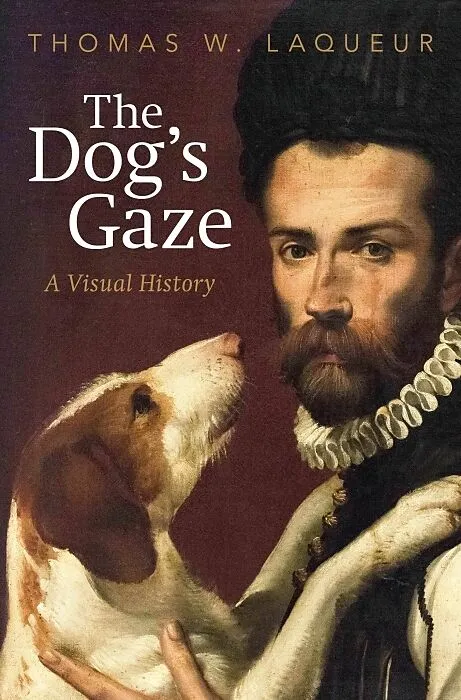

The Dog's Gaze
Beschreibung
From award-winning cultural historian, an enlightening and unique meditation on the presence of dogs in art, from the Paleolithic era to the present, and what our intertwined human-canine relationship reveals about human nature Long before the phrase ‘ma...Format auswählen
- Fester EinbandCHF 48.40

Wird oft zusammen gekauft
Andere Kunden kauften auch
Beschreibung
From award-winning cultural historian, an enlightening and unique meditation on the presence of dogs in art, from the Paleolithic era to the present, and what our intertwined human-canine relationship reveals about human nature Long before the phrase ‘man’s best friend’ became common parlance, dogs were already standing beside us in art as in life. In Dogs have been ubiquitous in the worldmaking of visual artists as far back as the Paleolithic age. Looking across the western tradition, from Giotto to Goya and Rubens to Rego, Laqueur shows what their presence – as hunting partners, beloved friends and even conduits to the afterlife – reveals about our own ways of seeing and how we want to be remembered. Far from being mere motifs, dogs are an integral and intentional element of the images in which they appear: they provide narrative coherence; they look out and bear witness, often on the artist’s behalf; they illuminate our understanding of morality and melancholy and some, like us, become celebrities. Indeed, as Laqueur reveals, dogs in art are our social doppelgängers, our companions in looking and being. Richly illustrated and lovingly written, "A splendid blend of histories: natural, cultural, and artistic . . . A delight for dog-loving art connoisseurs, and vice versa." --Kirkus (starred review) From award-winning cultural historian, an enlightening and unique meditation on the presence of dogs in art, from the Paleolithic era to the present, and what our intertwined human-canine relationship reveals about human nature** Long before the phrase man's best friend became common parlance, dogs were already standing beside us in art as in life. In The Dog's Gaze, the historian Thomas W. Laqueur invites us to explore why they feature more than any other animal in the ways in which we picture ourselves and our stories. Dogs have been ubiquitous in the worldmaking of visual artists as far back as the Paleolithic age. Looking across the Western tradition, from Giotto to Goya and Rubens to Rego, Laqueur shows what their presence--as hunting partners, beloved friends, and even conduits to the afterlife--reveals about our own ways of seeing and how we want to be remembered. Far from being mere motifs, dogs are an integral and intentional element of the images in which they appear: They provide narrative coherence; they look out and bear witness, often on the artist's behalf; they illuminate our understanding of morality and melancholy and some, like us, become celebrities. Indeed, as Laqueur reveals, dogs in art are our social doppelgängers, our companions in looking and being. Richly illustrated and lovingly written, The Dog's Gaze is a unique visual history that examines the remarkable social bond between two species, shedding new light on the human condition through the eyes of our canine companions.
Leseprobe
I did not come to this book from a lifelong love of dogs. My first pet, acquired in my late twenties, was a cat named Lydgate, after Tertius Lyd-gate, the doctor-reformer in George Eliot’s Middlemarch. In my teens and all through graduate school I was passionate about horses. Dogs entered my life late. Or at least as I remember them because there is a picture of me when I was three or four taken by my father in Kuzguncuk on the Bosporus straits with a dog in whose dinner I seem interested. He labelled it, ‘Thomas und Job beim Hundefressen’ (‘Thomas and Job as the dog feeds’) [2]. We are both looking intensely at his bowl. My parents were in Turkey as refugees from Nazi Germany.
My family had dogs when I was growing up but my relationship to them was shallow and vicarious. They were my mother’s, and I remember her through them. I don’t know what dogs meant to her; what childhood memories she had of them. She grew up in a large house with land around it in Holzminden an der Weser, a small town in the north-west of Germany, the daughter of a Jewish grain and animal merchant. I suspect her family had dogs but have no evidence for this.
I know that very soon after we arrived in Bluefield, West Virginia, from Istanbul in 1950, my mother acquired a dog – a boxer. She named her Heidi, the first of a succession of boxers with that name. I have a stuffed boxer, whose leg was broken and splinted at some point, that I retrieved from my mother’s house after she died. I don’t remember how it originally came into my life or how it was injured, and I don’t remember it ever meaning much to me. I keep it now because she kept it.
After the Heidis came a succession of cocker spaniels: Sapphos, a name suggested by my best friend from college – and ever after – a Greek who was visiting over the Christmas break. In the last decades of my mother’s life came Airedales, two of them in succession both named Druze – Serbian for ‘comrade’. My mother did not speak Serbian. Tante Elli gave my mother the first of this line and he came with the name; she had escaped the Nazis by going to Yugoslavia and had Airedales after she got to America. Dogs as gifts between rulers, friends, lovers, and family, as if they carried with them a declaration of intimacy, will appear often in this book [3–5].
My mother in her eighties made heroic efforts to care for Druze II; she broke her hip carrying a twenty-pound bag of kibble on slippery ice but recovered from that. When he died, she lost interest in living; the dog’s death seemed to signal that it was her time to die too.
Before starting to write this book I had never noticed the dog in a photograph of my father, mother, and little brother on the porch of our house that I must have taken when I was eleven or twelve. (In fact, I never noticed the dogs in so many of my early family pictures.) In 6, Heidi I is coming into our world, that is, entering the frame of the picture as dogs do in a great deal of the art in this book. Maybe my mother had called her, although I don’t remember her calling her dogs very often. I do remember her sending them away. ‘Go to your place’ in heavily German-accented English sent generations of Heidis, Sapphos and Druzes obediently to their beds.
My father had little interest in my mother’s dogs or dogs in general. I did not know his father, my paternal grandfather Walther Laqueur, who died in 1927. But I know he had a dog who was important enough to him to have commissioned a professional photographer to take a formal portrait of the two of them in the early 1920s on the steps of a large brownstone at 106 Hochallee in Hamburg [7]. My grandmother took the photograph with her when she narrowly escaped Germany in December 1939, aged almost seventy. My father learned that she been ordered to report to the Gestapo and managed very late in the day to persuade her to secure a Turkish visa and transit to Istanbul where he and my mother lived. (Her eldest daughter, my Tante Toni, who had emigrated to Holland and was subsequently murdered at Sobibor, had been urging her to come to Amsterdam.) The dual portrait of her husband and his dog sat in a silver frame on my grandmother’s desk in West Virginia from 1950 until five years before she died at age 100 in 1973. It is now, in the same silver frame, on my desk.
My grandfather Walther and his dog are poised in mid-action. The dog is coatless; his master fashionably bundled up against the cold – there is snow on the steps – and ready for a walk. I can imagine my grandfather as the narrator in Thomas Mann’s ‘Herr und Hund’ (A Man and His Dog), the longest of his short stories and clearly an autobiographical account of his life with a pointer-mix named Bashan. I do not know the name of Walther’s dog. I think the two of them are heading out rather than coming back from a walk. The lead is in my…