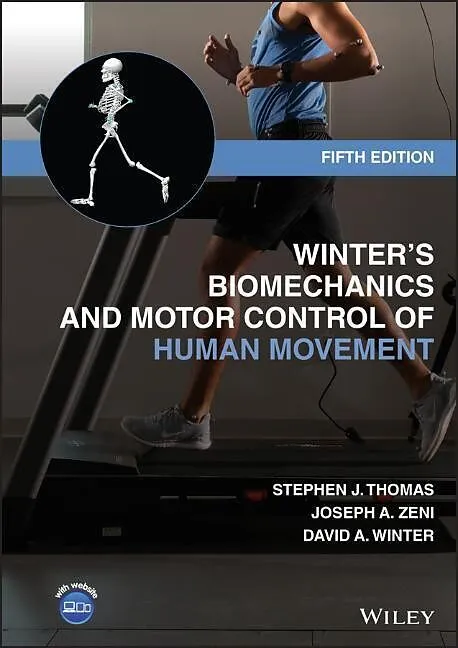
Winter's Biomechanics and Motor Control of Human Movement
Beschreibung
An In-Depth Resource for Understanding the Foundational Concepts and Clinical Applications in the Field of Biomechanics Winter's Biomechanics and Motor Control of Human Movement is highly suitable as a textbook for today's biomechanics students who m...Format auswählen
- Fester EinbandCHF 165.20
Wird oft zusammen gekauft
Andere Kunden kauften auch
Beschreibung
An In-Depth Resource for Understanding the Foundational Concepts and Clinical Applications in the Field of Biomechanics
Winter's Biomechanics and Motor Control of Human Movement is highly suitable as a textbook for today's biomechanics students who may come from many diverse academic programs and professional sectors. The work covers foundational theoretical and mathematical concepts in biomechanics, as well as up-to-date data collection, interpretation, and storage techniques. It also highlights the contemporary clinical applications of biomechanical research. New case studies related to cerebral palsy, patellar femoral pain syndrome, knee osteoarthritis, and ulnar collateral ligament reconstruction are also included.
The work appeals to a broad audience within the field of biomechanics, an interdisciplinary field with applications in mechanical engineering, medicine, physical therapy, sports and exercise, and product development. Authors at leading universities guide the reader through the latest advancements in the field while also imparting critical foundational knowledge to allow for subject matter mastery and more precise practical application. Concepts covered in the book include:
- Biomechanical signal processing, anthropometry, kinematics and kinetics, muscle mechanics, and kinesiological electromyography
- Forward simulations and muscle-actuated simulations, static and dynamic balance, and the role of the central nervous system in biomechanics
- Movement sequencing and the kinetic chain concept, electromagnetic systems, inertial sensors, clinical measures of kinematics, and the advantages and disadvantages of different types of force plates
- Markerset design and event detection for gait and athletic motions like jumping, landing, and pitching
- Guidance on setting up a motion lab and access to online Excel spreadsheets with kinematic and kinetic marker data
By providing a combination of theoretical and practical knowledge, Winter's Biomechanics and Motor Control of Human Movement will appeal to biomedical engineers working in the field of biomechanics and allied professionals in the medical, rehabilitation, and sports industries. Its comprehensive overall insight into the field of biomechanics also makes the work a highly useful resource for students and teachers of biomechanics at all levels of experience and expertise.
Autorentext
Stephen J. Thomas is Associate Professor and Chair of the Exercise Science Department at Thomas Jefferson University. His research focuses on biomechanic adaptations to stress, particularly in the shoulder and elbow. He is a consultant for the Philadelphia Phillies at the Penn Throwing Clinic and is a Past President of the American Society of Shoulder and Elbow Therapists.
Joseph A. Zeni is an Associate Professor at Rutgers University, where he teaches graduate level courses and conducts research within the Rutgers Motion Analysis Laboratory. His current work is focused on using biomechanical feedback to restore normal movement patterns after knee replacement surgery. He has published over 50 peer-reviewed articles in the field of clinical biomechanics.
David A. Winter (1930-2012) was a Distinguished Professor Emeritus at the University of Waterloo and a Founding Member of the Canadian Society of Biomechanics. The pioneer of many important methods and concepts in the study of human movement and balance, he received the Muybridge Medal of the International Society of Biomechanics and the Lifetime Achievement Award of the Gait and Clinical Movement Analysis Society.
Inhalt
List of Contributors xv
Preface xvii
Acknowledgments xix
About the Companion Website xxi
1 Biomechanics as an Interdiscipline 1
Stephen J. Thomas Joseph A. Zeni and David A. Winters
1.0 Introduction 1
1.0.1 Importance of Human Movement Analysis 1
1.0.2 The Interprofessional Team 2
1.1 Measurement Description Analysis and Assessment 2
1.1.1 Measurement Description and Monitoring 3
1.1.2 Analysis 4
1.1.3 Assessment and Interpretation 5
1.2 Biomechanics and its Relationship with Physiology and Anatomy 6
1.3 References 7
2 Signal Processing 8
Joseph A. Zeni Stephen J. Thomas and David A. Winters
2.0 Introduction 8
2.1 Auto- and Cross-Correlation Analyses 8
2.1.1 Similarity to the Pearson Correlation 9
2.1.2 Formulae for Auto- and Cross-Correlation Coefficients 10
2.1.3 Four Properties of the Autocorrelation Function 11
2.1.4 Three Properties of the Cross-Correlation Function 14
2.1.5 Importance in Removing the Mean Bias from the Signal 15
2.1.6 Digital Implementation of Auto- and Cross-Correlation Functions 15
2.1.7 Application of Autocorrelations 16
2.1.8 Applications of Cross-Correlations 17
2.2 Frequency Analysis 19
2.2.1 Introduction - Time Domain vs. Frequency Domain 19
2.2.2 Discrete Fourier (Harmonic) Analysis 19
2.2.3 Fast Fourier Transform (FFT) 21
2.2.4 Applications of Spectrum Analyses 22
2.3 Ensemble Averaging of Repetitive Waveforms 29
2.3.1 Examples of Ensemble-Averaged Profiles 31
2.3.2 Normalization of Time Bases to 100% 31
2.3.3 Measure of Average Variability about the Mean Waveform 32
2.4 References 32
3 Kinematics 34
Amy L. Lenz
3.0 Historical Development and Complexity of Problem 34
3.1 Kinematic Conventions 35
3.1.1 Absolute Spatial Reference System 35
3.1.2 Total Description of a Body Segment in Space 36
3.2 Direct Measurement Techniques 36
3.2.1 Goniometers 36
3.2.2 Accelerometers 38
3.2.3 Inertial Sensors 39
3.2.4 Special Joint Angle Measuring Systems 40
3.2.5 Electromagnetic Systems 41
3.3 Imaging Measurement Techniques 42
3.3.1 Review of Basic Lens Optics 42
3.3.2 f-Stop Setting and Field of Focus 43
3.3.3 Television Imaging Camera Historical Development 43
3.3.4 Optical Motion Capture 44
3.3.5 Optoelectric Techniques 47
3.3.6 Biplane Fluoroscopy 48
3.3.7 Markerless Systems 51
3.3.8 Summary of Various Kinematic Systems 51
3.4 Clinical Measures of Kinematics 52
3.4.1 2-D Kinematic Apps/Sensors 52
3.4.2 Sensor-Based Systems 52
3.5 Processing of Raw Kinematic Data 52
3.5.1 Nature of Unprocessed Image Data 52
3.5.2 Signal Versus Noise in Kinematic Data 53
3.5.3 Problems of Calculating Velocities and Accelerations 54
3.5.4 Smoothing and Curve Fitting of Data 54
3.5.5 Comparison of Some Smoothing Techniques 60
3.6 Calculation of Other Kinematic Variables 62
3.6.1 Limb-Segment Angles 62
3.6.2 Joint Angles 63
3.6.3 Velocities - Linear and Angular 63
3.6.4 Accelerations - Linear and Angular 63
3.7 Problems Based on Kinematic Data 64
3.8 References 65
4 Anthropometry 67
Joseph A. Zeni Stephen J. Thomas and David A. Winters
4.0 Scope of Anthropometry in Movement Biomechanics 67
4.0.1 Segment Dimensions 67
4.1 Density Mass and Inertial Properties 68
4.1.1 Whole-Body Density 68
4.1.2 Segment Densities 69
4.1.3 Segment Mass and Center of Mass 69
4.1.4 Center of Mass of a Multisegment System 72
4.1.5 Mass Moment of Inertia and Radius of Gyration 73
4.1.6 Parallel Axis Theorem 74
4.1.7 Use of Anthropometric Tables and Kinematic Data 75
4.2 Direct Experimental Measures 78
4.2.1 Location of the Anatomical Center of Mass of the Body 79
4.2.2 Calculation of the Mass of a Distal Segment 79
4.2.3 Moment of Inertia of a Distal Segment 80
4.2.4 Joint Axes of Rotation 81
4.3 Muscle Anthropometry 82
4.3.1 Cross-Sectional Area of Muscles 82
4.3.2 Change in Muscle Length During Movement 83
4.3.3 Force per Unit Cross-Sectional Area (Stress) 84
4.3.4 Mechanical Advantage of Muscle 84
4.3.5 Multijoint Muscles 85
4.4 Problems Based on Anthropometric Data 86
4.5 References 87
5 Kinetics: Forces and Moments of Force 89
Stephen J. Thomas Joseph A. Zeni and David A. Winters
5.0 Biomechanical Models 89
5.0.1 Link-Segment Model Development 89…