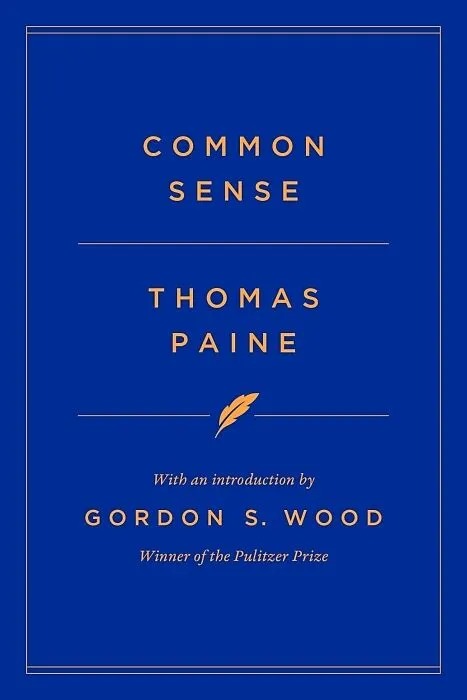
Common Sense
Beschreibung
In 1776, America was a hotbed of enlightenment and revolution. Thomas Paine not only spurred his fellow Americans to action but soon came to symbolize the spirit of the Revolution. His elegantly persuasive pieces spoke to the hearts and minds of those fighting...Format auswählen
- Fester EinbandCHF 21.10

Wird oft zusammen gekauft
Andere Kunden kauften auch
Beschreibung
In 1776, America was a hotbed of enlightenment and revolution. Thomas Paine not only spurred his fellow Americans to action but soon came to symbolize the spirit of the Revolution. His elegantly persuasive pieces spoke to the hearts and minds of those fighting for freedom. He was later outlawed in Britain, jailed in France, and finally labeled an atheist upon his return to America. "No writer has exceeded Paine in ease and familiarity of style; in perspicuity of expression, happiness of elucidation, and in simple unassuming language."--Thomas Jefferson
Autorentext
Thomas Paine was born in Norfolk, England, on January 29, 1737. He received a basic education in history, mathematics, and science, but left school at age 13 to apprentice in his father's corsetmaking shop. In 1757, he spent time at sea aboard the privateer ship King of Prussia, and later found employment as a journeyman staymaker in London. All the while, Paine continued to study on his own, influenced by the work of two leading figures of the Enlightenment, Isaac Newton and John Locke. He began writing political pamphlets, and at the urging of Benjamin Franklin, emigrated to Philadelphia in 1774 to work as an editor for The Pennsylvania Magazine. In 1776, he published Common Sense, which called for America's political freedom from England. The pamphlet sold more than 150,000 copies in three months. Paine next published The American Crisis during the Revolutionary War, inspiring George Washington to read it to his troops at Valley Forge. By the end of the Revolution, however, Paine's influence had run its course, and he fell out of political favor. He returned to Europe, where he published his treatise Rights of Man, which led to his arrest on charges of high treason. Disillusioned with life abroad, he returned to the U.S. to find himself vilifed as an agitator and atheist. He died in obscurity in New York City in 1809.
Klappentext
The incendiary political pamphlet that helped launch the American Revolution, introduced by Pulitzer Prize–winning historian Gordon S. Wood
The revolutionary fervor that sparked the American Revolution in 1776 had been a long time coming. Since the early 1760s, hundreds of pamphlets had been published on both sides of the Atlantic debating the limits of Great Britain’s authority over its North American colonies. Yet most of these were written by educated gentlemen for educated readers like themselves.
Common Sense by Thomas Paine, published on January 10, 1776, was entirely different. It was like a bomb thrown into the midst of a sedate debate—exploding with a force that stunned and alarmed the gentry elites. Paine sought readers everywhere, especially in the tavern- and artisan-centered worlds of the cities. Even more important than the work’s accessibility was the fact that Paine wrote with a rage and a moral fury that few before him had ever expressed. He tapped into a deep anger shared by many common, middling people in these years—shopkeepers, traders, petty merchants—people weary of being scorned and held in contempt by a monarchical, aristocratic, hierarchical world.
Common Sense became the most influential pamphlet in the entire Revolutionary era, going through twenty-five editions in 1776 alone and selling 150,000 copies. Introduced here by Pulitzer Prize–winning historian Gordon S. Wood, this is the singular, electrifying work that galvanized a nation—and a people—who were ready for independence.
Leseprobe
Introduction
Perhaps the sentiments contained in the following pages, are not yet sufficiently fashionable to procure them general favor; a long habit of not thinking a thing wrong, gives it a superficial appearance of being right, and raises at first a formidable outcry in defence of custom. But the tumult soon subsides. Time makes more converts than reason.
As a long and violent abuse of power, is generally the Means of calling the right of it in question (and in Matters too which might never have been thought of, had not the Sufferers been aggravated into the inquiry) and as the King of England hath undertaken in his own Right, to support the Parliament in what he calls Theirs, and as the good people of this country are grievously oppressed by the combination, they have an undoubted privilege to inquire into the pretensions of both, and equally to reject the usurpation of either.
In the following sheets, the author hath studiously avoided every thing which is personal among ourselves. Compliments as well as censure to individuals make no part thereof. The wise, and the worthy, need not the triumph of a pamphlet; and those whose sentiments are injudicious, or unfriendly, will cease of themselves unless too much pains are bestowed upon their conversion.
The cause of America is in a great measure the cause of all mankind. Many circumstances hath, and will arise, which are not local, but universal, and through which the principles of all Lovers of Mankind are affected, and in the Event of which, their Affections are interested. The laying a Country desolate with Fire and Sword, declaring War against the natural rights of all Mankind, and extirpating the Defenders thereof from the Face of the Earth, is the Concern of every Man to whom Nature hath given the Power of feeling; of which Class, regardless of Party Censure, is the
author.
P. S. The Publication of this new Edition hath been delayed, with a View of taking notice (had it been necessary) of any Attempt to refute the Doctrine of Independance: As no Answer hath yet appeared, it is now presumed that none will, the Time needful for getting such a Performance ready for the Public being considerably past.
Who the Author of this Production is, is wholly unnecessary to the Public, as the Object for Attention is the Doctrine itself, not the Man. Yet it may not be unnecessary to say, That he is unconnected with any Party, and under no sort of Influence public or private, but the influence of reason and principle.
Philadelphia, February 14, 1776
Of the origin and design of government in general. With concise remarks on the English constitution.
Some writers have so confounded society with government, as to leave little or no distinction between them; whereas they are not only different, but have different origins. Society is produced by our wants, and government by our wickedness; the former promotes our happiness positively by uniting our affections, the latter negatively by restraining our vices. The one encourages intercourse, the other creates distinctions. The first is a patron, the last a punisher.
Society in every state is a blessing, but government even in its best state is but a necessary evil; in its worst state an intolerable one; for when we suffer, or are exposed to the same miseries by a government, which we might expect in a country without government, our calamity is heightened by reflecting that we furnish the means by which we suffer. Government, like dress, is the badge of lost innocence;1 the palaces of kings are built on the ruins of the bowers of paradise. For were the impulses of conscience clear, uniform, and irresistably obeyed, man would need no other lawgiver; but that not being the case, he finds it necessary to surrender up a part of his property to furnish means for the protection of the rest; and this he is induced to do by the same prudence which in every other case advises him out of two evils to choose the least. Wherefore, security being the true design and end of government, it unanswerably follows that whatever form thereof appears most likely to ensure it to us, with the least expence and greatest benefit, is preferable to all others.
In order to gain a clear and just idea of the design and end of government, let us suppose a small number of persons settled in some sequestered…