Beschreibung
The authors explore various Unmanned Aerial Vehicle (UAV)-assisted massive Multiple-Input and Multiple-Output (MIMO) relaying systems designed for 5G-and-Beyond wireless networks. This book also addresses scenarios where a direct connection between a base sta...
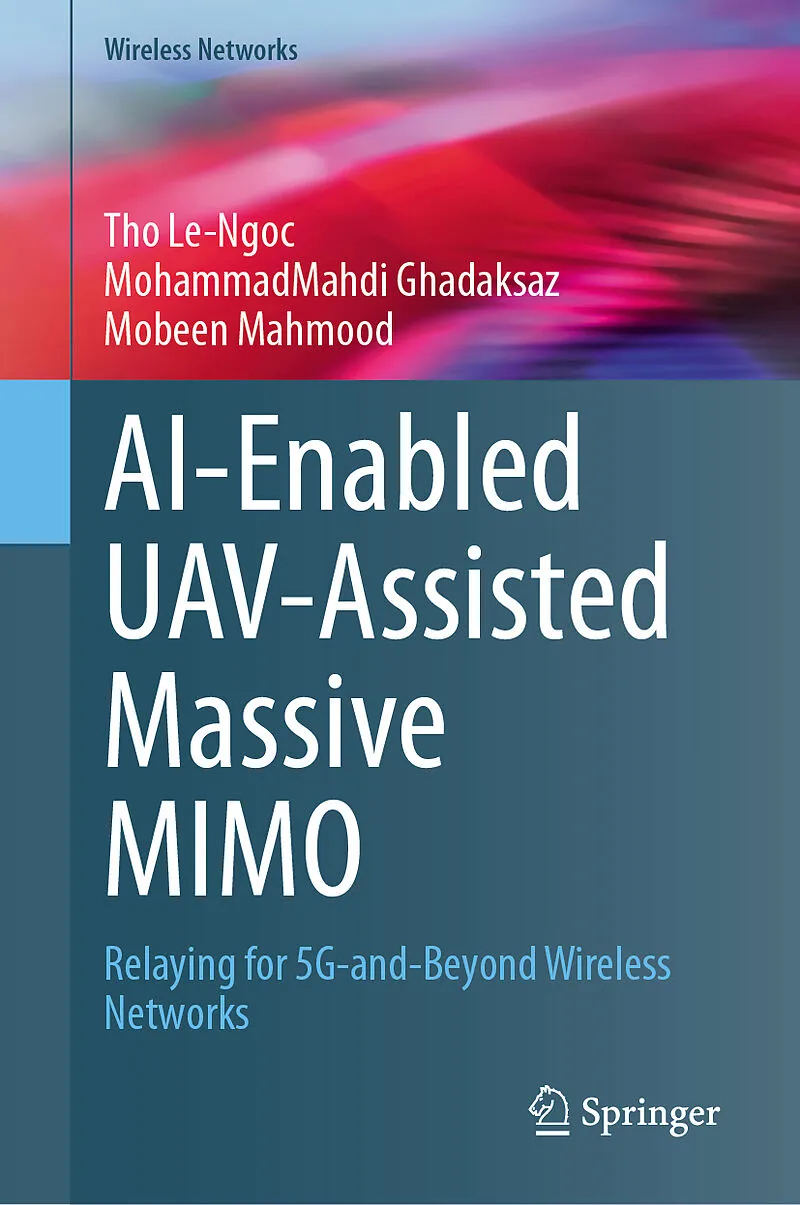
The authors explore various Unmanned Aerial Vehicle (UAV)-assisted massive Multiple-Input and Multiple-Output (MIMO) relaying systems designed for 5G-and-Beyond wireless networks. This book also addresses scenarios where a direct connection between a base station and users is blocked, and a UAV acts as a relay to ensure seamless connectivity. The goal is to maximize the total achievable rate by solving key optimization problems in UAV placement, power allocation, and beamforming design. To tackle these challenges, the authors present novel artificial intelligence (AI)-driven solutions that achieve near-optimal performance in complex environments.
The first part introduces particle swarm optimization (PSO), a nature-inspired algorithm, for both single-user and multi-user massive MIMO settings, extending to multiple-UAV relay configurations. Our results demonstrate that PSO-based approaches can effectively enhance network capacity and coverage. The second part focuses on reducing computational complexity, while maintaining high performance. The authors develop deep learning (DL)-based approaches, from supervised learning for UAV placement and power allocation to deep reinforcement learning for trajectory optimization in dynamic conditions. Numerical evaluations confirm that these DL-based methods achieve reduced runtime without sacrificing achievable rates.
This book targets **** researchers, advanced-level students and engineers interested in the challenges and practical solutions for UAV-assisted MIMO communications in wireless networks. Professionals working in wireless communications focused on this topic will also want to purchase this book.
Integration of hybrid beamforming techniques for UAV relay scenarios Clear simulations with extensive designs and tests Evaluation of diverse algorithms with analysis of pros and cons
Autorentext
Tho Le-Ngoc obtained his B.Eng. (with Distinction) in Electrical Engineering in 1976, his M.Eng. in 1978 from McGill University, Montreal, and his Ph.D. in Digital Communications in 1983 from the University of Ottawa, Canada. During 1977–1982, he was with Spar Aerospace Limited and involved in the development and design of satellite communications systems. During 1982–1985, he was an engineering manager of the Radio Group in the Department of Development Engineering of SRTelecom Inc., where he developed the new point-to-multipoint DA-TDMA/TDM Subscriber Radio System SR500. During 1985–2000, he was a professor at the Department of Electrical and Computer Engineering of Concordia University. Since 2000, he has been with the Department of Electrical and Computer Engineering of McGill University. His research interest is in the area of broadband digital communications. He is a fellow of the Institute of Electrical and Electronics Engineers (IEEE), the Engineering Institute of Canada (EIC), the Canadian Academy of Engineering (CAE), and the Royal Society of Canada (RSC). He is the recipient of the 2004 Canadian Award in Telecommunications Research and the recipient of the IEEE Canada Fessenden Award 2005. He holds a Canada Research Chair (Tier I) on Broadband Access Communications. Yuanzhe Gong received the B.Eng. (Hons.) and Ph.D. degrees in Electrical and Computer Engineering from McGill University, Montreal, QC, Canada, in 2020 and 2025, respectively. Since 2018, he has served as a teaching assistant in the Department of Electrical and Computer Engineering at McGill and as a research associate with the Broadband Communication Research Laboratory. He was the recipient of the McGill Engineering Doctoral Award (MEDA), the Graduate Research Enhancement and Travel Award (GREAT Award), the McGill Graduate Excellence Fellowship, the Dean’s Honour List, and the McGill Faculty of Engineering Scholarship. His research interests include wireless communications, antenna design, metamaterial-based large-scale array structures, massive MIMO, near-field communications, intelligent beamforming optimization algorithms, and full-duplex systems. Mobeen Mahmood received his B.Sc. (Hons.) in Electrical Engineering from the University of Engineering and Technology (UET), Taxila, Pakistan in 2013; M.Sc. (Hons.) Electrical Engineering from the American University of Sharjah (AUS), Sharjah, UAE in 2019; and Ph.D. in Electrical Engineering from McGill University, Montreal, QC, Canada in 2024. From 2014 to 2017, he was with China Mobile Pakistan (CMPak), Islamabad, Pakistan. He is the recipient of AUS teaching assistantship, AUS research assistantship, Fonds de Recherche du Québec-Nature and Technologies (FRQNT), IEEE VTS Student Travel Award, IEEE Canada Vehicular Technologies Grant, McGill Graduate Research Enhancement and Travel Award (GREAT Award), McGill Graduate Excellence Fellowship, McGill Engineering Class of 1936 Fellowship, and J.W.McConnell Memorial Fellowship as part of McGill Engineering Doctoral Award (MEDA). His main research interests include massive MIMO, hybrid beamforming, UAV communications, AI-enable wireless networks, and full-duplex communications.
Inhalt
Chapter 1. Introduction.- Chapter 2. UAVs in the Next Generation Wireless Networks: Background & Literature Review.- Part I. PSO-based Algorithmic Solutions for UAV-Assisted mMIMO Communications .- Chapter 3. Joint HBF and UAV Deployment in Dual-Hop SU-mMIMO Systems.- Chapter 4. PSO-Based UAV-Assisted DF Relaying in Terrestrial MU-mMIMO System.- Chapter 5. Multiple UAV-Assisted Cooperative DF Relaying for Enhanced Coverage and Capacity.- Part II. Low-Complexity DL-Based Solutions for Real-time UAV-Assisted MU-mMIMO Communications. - Chapter 6. Joint UAV Location and PA Optimization: A Deep SL (DSL) Approach.- Chapter 7. UAV Deployment Based on Deep RL (DRL) in Dynamic Communication Networks.- Chapter 8. A Codebook-Based DRL Approach for UAV Deployment & Trajectory Design.- Chapter 9. Conclusions & Future Works.