Beschreibung
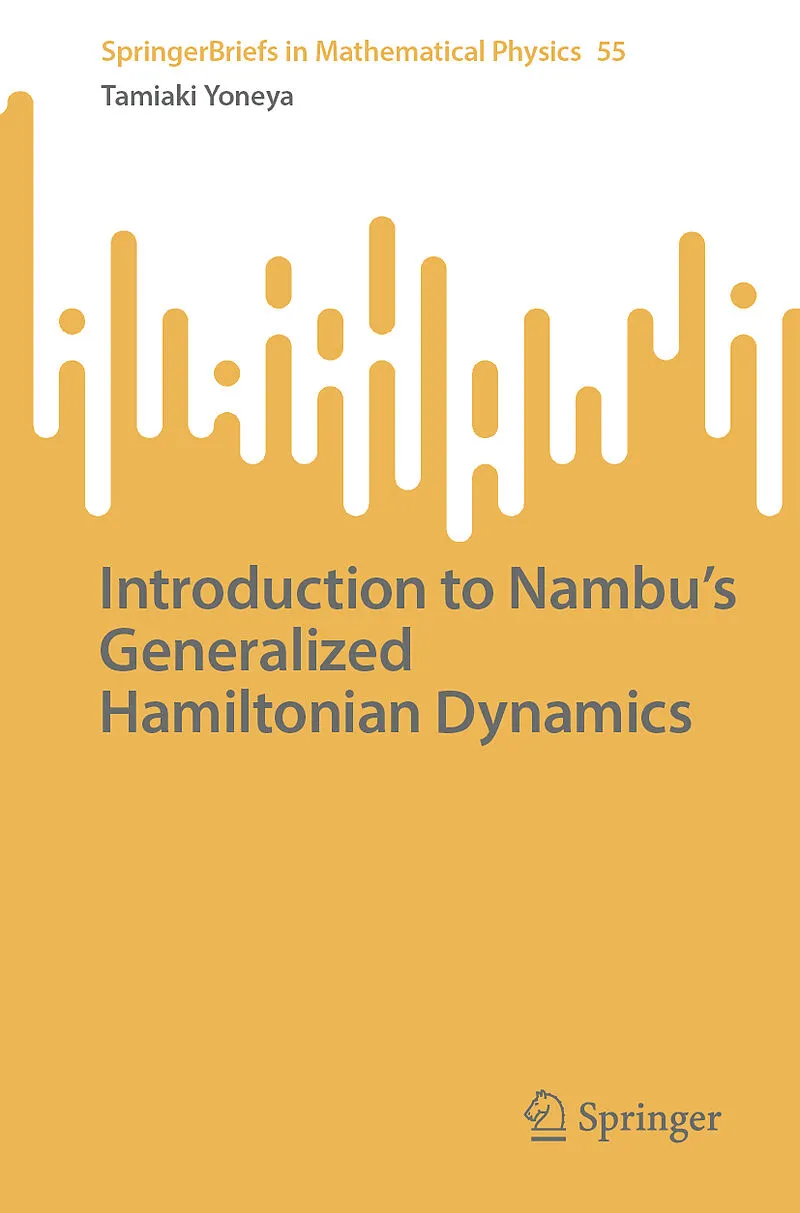
This book introduces Nambu's generalized Hamiltonian dynamics. In 1973, Nambu proposed extending classical Hamiltonian mechanics by replacing the canonical doublet ( p , q ) with a three-dimensional phase space defined by a canonical triplet ( x , y , z ). Th...This book introduces Nambu's generalized Hamiltonian dynamics. In 1973, Nambu proposed extending classical Hamiltonian mechanics by replacing the canonical doublet ( p , q ) with a three-dimensional phase space defined by a canonical triplet ( x , y , z ). The equations of motion are formulated using a triple bracketa generalization of the Poisson bracketwith two 'Hamiltonians' treated on an equal footing. This framework can further be extended to an n -tuple of phase-space coordinates, an n -bracket, and equations of motion involving n 1 Hamiltonians in an n -dimensional phase space. Nambu's original motivation was to generalize the Liouville theorem, which states that the volume of an ensemble in phase space is preserved under dynamical flowsa principle fundamental to statistical mechanics. He sought to construct systems with analogous properties for arbitrary-dimensional phase spaces, including odd dimensions. Although his proposal attracted little attention for more than a decade, subsequent developments revealed its relevance in diverse areas of theoretical and mathematical physics, notably in string/M-theory and fluid mechanics. This book introduces the reader to classical Nambu dynamics by explaining its principal aspects from an elementary viewpoint and developing it further from a coherent and unified standpoint. It is intended for readers with a reasonable understanding of classical analytical mechanics and working knowledge of basic physics and standard mathematical methods in theoretical physics.
Reaches readers across diverse disciplines with clear explanations and broad applicability Provides students and researchers with essential insights into the current status of Nambu dynamics Offers the first comprehensive book dedicated exclusively to this specialized subject
Autorentext
Tamiaki Yoneya is Professor Emerotus of The Universitu of Tokyo.
Klappentext
This book introduces Nambu’s generalized Hamiltonian dynamics. In 1973, Nambu proposed extending classical Hamiltonian mechanics by replacing the canonical doublet (p,q) with a three-dimensional phase space defined by a canonical triplet (x,y,z). The equations of motion are formulated using a triple bracket—a generalization of the Poisson bracket—with two 'Hamiltonians' treated on an equal footing. This framework can further be extended to an n-tuple of phase-space coordinates, an n-bracket, and equations of motion involving n−1 Hamiltonians in an n-dimensional phase space. Nambu’s original motivation was to generalize the Liouville theorem, which states that the volume of an ensemble in phase space is preserved under dynamical flows—a principle fundamental to statistical mechanics. He sought to construct systems with analogous properties for arbitrary-dimensional phase spaces, including odd dimensions. Although his proposal attracted little attention for more than a decade, subsequent developments revealed its relevance in diverse areas of theoretical and mathematical physics, notably in string/M-theory and fluid mechanics. This book introduces the reader to classical Nambu dynamics by explaining its principal aspects from an elementary viewpoint and developing it further from a coherent and unified standpoint. It is intended for readers with a reasonable understanding of classical analytical mechanics and working knowledge of basic physics and standard mathematical methods in theoretical physics.
Inhalt
Introduction: Historical Overview and Basic Concepts.- The Construction of Generalized Canonical Structure for Nambu Dynamics.- The Extension of Variational Principle and HamiltonJacobi Theory to Nambu Dynamics.- Bibliographical Remarks.