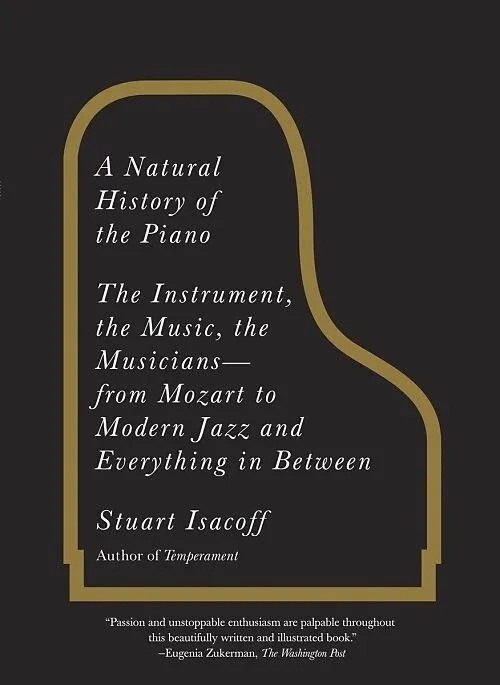
A Natural History of the Piano
Beschreibung
Zusatztext 41786008 Informationen zum Autor Stuart Isacoff is a pianist, composer, and critic; he was the founding editor of Piano Today magazine. A winner of the ASCAP Deems Taylor Award for excellence in writing about music, he is a regular contributor to Th...Format auswählen
- Kartonierter EinbandCHF 21.90

Wird oft zusammen gekauft
Andere Kunden kauften auch
Beschreibung
Zusatztext 41786008 Informationen zum Autor Stuart Isacoff is a pianist, composer, and critic; he was the founding editor of Piano Today magazine. A winner of the ASCAP Deems Taylor Award for excellence in writing about music, he is a regular contributor to The Wall Street Journal and other publications. Isacoff gives lectures and performances at numerous venues, which have included the Chamber Music Society of Lincoln Center and the Metropolitan Museum of Art. He currently teaches at the SUNY at Purchase. Klappentext A fascinating celebration of the piano, including tales of its masters from Mozart and Beethoven to Oscar Peterson and Jerry Lee Lewis, told with the expertise of composer and author of Temperament, Stuart Isacoff. This history takes us back to the piano's humble genesis as a simple keyboard, and shows how everyone from Ferdinando de' Medici to Herbie Hancock affected its evolution of sound and influence in popular music. Presenting the instrument that has been at the core of musical development over the centuries in all its beauty and complexity, this explores the piano's capabilities and the range of emotional expression it conveys in different artists' hands. A Natural History of the Piano is fast-paced and intriguing, with beautiful illustrations and photos, a must-read for music lovers and pianists of every level. Chapter 1 A Gathering of Traditions Even as his body began to fail, for Oscar Peterson (1925-2007) the piano remained a lifeline. The instrument had long been a trusted companion-sparking early dreams, conferring a place in the history books, and easing his way in a world of racial strife. Now, at eighty- one, he looked worn out. Arriving at the stage of New York's Birdland in a wheelchair, after debilitating strokes had weakened his legs and slowed his left hand, he struggled to move his heavy frame onto the piano bench. Yet, as soon as the keyboard was within reach, even before his torso had completed its fall into a seated position, he thrust out his right arm and grabbed a handful of notes; at that signal, the bass player, drummer, and guitarist launched into their first number. And suddenly there was that sound. He still had it-a musical personality as large as life, steeped in tradition yet recognizably, unmistakably all its own. For decades, Peterson's technical command and musical instincts had instilled in others the kind of awe and fear he expressed about his idol, the late Art Tatum. He once compared that older piano master to a lion: an animal that scares you to death, though you can't resist getting close enough to hear it roar. (Classical firebrands Sergei Rachmaninoff and Vladimir Horowitz went to hear Tatum perform and came away with the same sense of intimidation.) And that made his comeback all the more difficult. The Peterson style was always characterized by rapid, graceful, blues- tinged melody lines unfurled in long, weaving phrases with the inexorable logic of an epic narrative; and, equally important, a visceral sense of rhythm, transmitted with fire and snap. Those qualities for which he was renowned-effortless fluidity and clockwork precision-were not merely aspects of his playing; they were the very foundation on which his artistic expression rested. And pulling them off required the highest level of athletic prowess. At times that evening in 2006, in one of the few scheduled performances on what would turn out to be his farewell tour to the world, flashes of the old brilliance emerged, unscathed by illness and time. Yet the strain was also clear. No matter: playing was for him as necessary as eating and breathing. "That's my therapy," he said after the set, nodding in the direction of the piano as a small smile inched across his half-frozen visage. But in the memorable moments during his set, the large, gl...
**Praise for Stuart Isacoff's A Natural History of the Piano:
**“Isacoff’s heartfelt history of the piano will make you want to Stop! Read! and then go Listen! . . . Like listening to a fascinating raconteur who informs and entertains and really knows his stuff . . . Passion and unstoppable enthusiasm are palpable throughout this beautifully written and illustrated book.”
—Eugenia Zukerman, The Washington Post
“A generous, welcoming book, full of oddities and insights. . . . A history written by a pianist and historian with a lively touch and a reach that spans octaves of science, culture and politics.”
—The Dallas Morning News
“Anybody who cares about the piano—past, present and future—will find this book irresistible reading.”
—Tim Page
“Wonderful. . . . The perfect gift book . . . **So layered with anecdote that it reads like a novel or a good biography.”
—*Hudson Valley News
“Isacoff follows the piano into the honkytonk, the drawing room, the middle-class home and the jazz club, tracking the evolution of the physical instrument itself as well as the composers and performers who made the piano an emblem of cultural variety and a laboratory for musical form.”
—The Wall Street Journal
“That rarest of treats: a substantial book about music that’s actually easy to read. . . . As a primer on the piano and music history . . . it executes the job with distinction.”
—The Plain Dealer
“A big slice of heaven for piano lovers.”
—Booklist
“An exhaustive and entertaining cultural history of the piano . . . ‘Sparkling discourse’ is his aim, and he succeeds . . . An enjoyable read.”
—The Star-Ledger
“Fascinating. . . . A rare journey of discovery and delight. . . . Every detail is conveyed with a vivid sense of ‘you are there,’ and on every page we sense Mr. Isacoff’s enthusiasm and lifelong dedication to the art of the piano. . . . This is no obvious retelling of the piano’s development. . . . It contains a wealth of information, lavish illustrations, thought-provoking comments, and, most of all, it is a pleasure to read.”
—Clavier Companion
“Deft . . . In A Natural History of the Piano, Isacoff proves as fleet-fingered as any virtuoso.”
—The Chronicle of Higher Education
*
“It’s almost like listening to the music as you read Isacoff’s relaxed, compelling prose.”
—Huffington Post
“[A] historical tribute to the piano.”
—NPR
“A lively, virtually all-inclusive survey of all things pianistic . . . Isacoff’s ability to convey his formidable erudition in the most engaging terms, coupled with his infectious enthusiasm for music of all kinds, make this a charming and highly readable potpourri. Informative fun for every variety of music lover.”
—Kirkus Reviews
“Engrossing . . . Witty . . . Pianists at all levels, music history buffs, and academics will appreciate Isacoff’s insights and clever way with words; this is an enjoyable and informative book.”
—Library Journal
“An encyclopedic and argumentative overview of all things piano. . . . Readers will be impressed . . . by the depth and diversity of Isacoff’s research and references.”
—Publishers Weekly
“Entertaining . . . Crammed with great anecdotes and mini-essays.”
—The Seattle Times
“Informative, comprehensive, and conversational . . . Refreshing . . . A deft rendering.”
—Choice
“Never before have I learned and enjoyed so much about the instrument and its most distinctive practitioners—transcending so many categories of music. Whether the subject is jazz or classical music, …