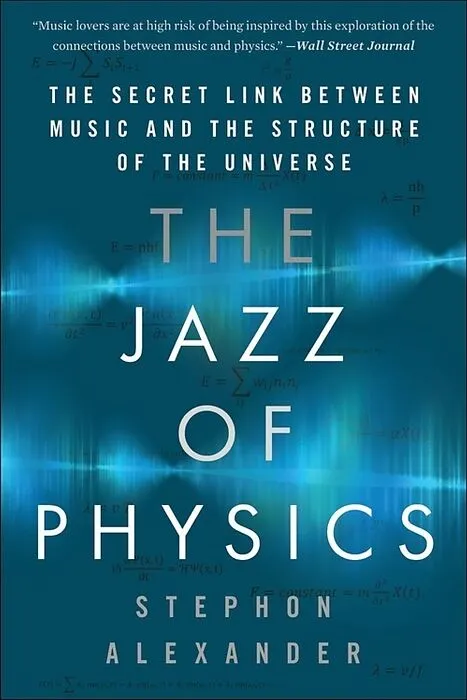
The Jazz of Physics
Beschreibung
Informationen zum Autor Stephon Alexander is a professor of theoretical physics, the director for the Brown Theoretical Physics Center, and an established jazz musician. He is the author of Fear of a Black Universe, and his work has been featured by the New Yo...Format auswählen
- Kartonierter EinbandCHF 22.25

Wird oft zusammen gekauft
Andere Kunden kauften auch
Beschreibung
Informationen zum Autor Stephon Alexander is a professor of theoretical physics, the director for the Brown Theoretical Physics Center, and an established jazz musician. He is the author of Fear of a Black Universe, and his work has been featured by the New York Times, the Wall Street Journal, and many other outlets.? He lives in Rhode Island. Klappentext A spectacular musical and scientific journey from the Bronx to the cosmic horizon that reveals the astonishing links between jazz, science, Einstein, and Coltrane I'll forever be grateful to musician/physicist Stephon Alexander He'll help you see how our awe-inspiring universe is on a never-ending, cosmological riff. ?Felix Contreras, NPR More than fifty years ago, John Coltrane drew the twelve musical notes in a circle and connected them by straight lines, forming a five-pointed star. Inspired by Einstein, Coltrane put physics and geometry at the core of his music. Physicist and jazz musician Stephon Alexander follows suit, using jazz to answer physics' most vexing questions about the past and future of the universe. Following the great minds that first drew the links between music and physics a list including Pythagoras, Kepler, Newton, Einstein, and Rakim The Jazz of Physics reveals that the ancient poetic idea of the Music of the Spheres, taken seriously, clarifies confounding issues in physics. The Jazz of Physics will fascinate and inspire anyone interested in the mysteries of our universe, music, and life itself. Zusammenfassung A spectacular musical and scientific journey from the Bronx to the cosmic horizon that reveals the astonishing links between jazz, science, Einstein, and Coltrane More than fifty years ago, John Coltrane drew the twelve musical notes in a circle and connected them by straight lines, forming a five-pointed star. Inspired by Einstein, Coltrane put physics and geometry at the core of his music. Physicist and jazz musician Stephon Alexander follows suit, using jazz to answer physics' most vexing questions about the past and future of the universe. Following the great minds that first drew the links between music and physics-a list including Pythagoras, Kepler, Newton, Einstein, and Rakim The Jazz of Physics reveals that the ancient poetic idea of the "Music of the Spheres," taken seriously, clarifies confounding issues in physics. The Jazz of Physics will fascinate and inspire anyone interested in the mysteries of our universe, music, and life itself....
Autorentext
Stephon Alexander is a professor of theoretical physics, the director for the Brown Theoretical Physics Center, and an established jazz musician. He is the author of Fear of a Black Universe, and his work has been featured by the New York Times, the Wall Street Journal, and many other outlets. He lives in Rhode Island.
Klappentext
**A spectacular musical and scientific journey from the Bronx to the cosmic horizon that reveals the astonishing links between jazz, science, Einstein, and Coltrane
“I’ll forever be grateful to musician/physicist Stephon Alexander… He’ll help you see how our awe-inspiring universe is on a never-ending, cosmological riff.”
―Felix Contreras, **NPR
More than fifty years ago, John Coltrane drew the twelve musical notes in a circle and connected them by straight lines, forming a five-pointed star. Inspired by Einstein, Coltrane put physics and geometry at the core of his music.
Physicist and jazz musician Stephon Alexander follows suit, using jazz to answer physics’ most vexing questions about the past and future of the universe. Following the great minds that first drew the links between music and physics – a list including Pythagoras, Kepler, Newton, Einstein, and Rakim – The Jazz of Physics reveals that the ancient poetic idea of the Music of the Spheres, taken seriously, clarifies confounding issues in physics.
The Jazz of Physics will fascinate and inspire anyone interested in the mysteries of our universe, music, and life itself.