Beschreibung
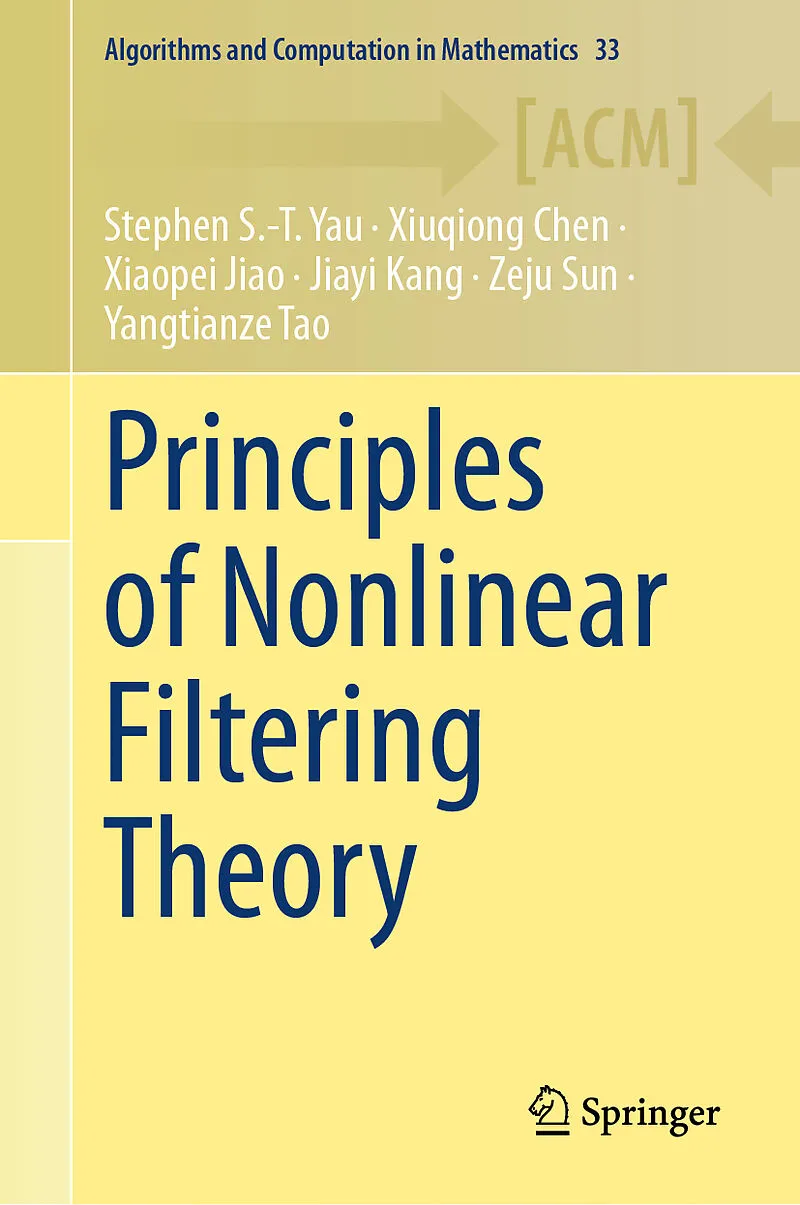
This text presents a comprehensive and unified treatment of nonlinear filtering theory, with a strong emphasis on its mathematical underpinnings. It is tailored to meet the needs of a diverse readership, including mathematically inclined engineers and scienti...
This text presents a comprehensive and unified treatment of nonlinear filtering theory, with a strong emphasis on its mathematical underpinnings. It is tailored to meet the needs of a diverse readership, including mathematically inclined engineers and scientists at both graduate and post-graduate levels. What sets this book apart from other treatments of the topic is twofold. Firstly, it offers a complete treatment of filtering theory, providing readers with a thorough understanding of the subject. Secondly, it introduces updated methodologies and applications that are crucial in today's landscape. These include finite-dimensional filters, the Yau-Yau algorithm, direct methods, and the integration of deep learning with filtering problems. The book will be an invaluable resource for researchers and practitioners for years to come.
With a rich historical backdrop dating back to Gauss and Wiener, the exposition delves into the fundamental principles underpinning the estimation of stochastic processes amidst noisy observationsa critical tool in various applied domains such as aircraft navigation, solar mapping, and orbit determination, to name just a few. Substantive exercises and examples given in each chapter provide the reader with opportunities to appreciate applications and ample ways to test their understanding of the topics covered. An especially nice feature for those studying the subject independent of a traditional course setting is the inclusion of solutions to exercises at the end of the book.
The book is structured into three cohesive parts, each designed to build the reader's understanding of nonlinear filtering theory. In the first part, foundational concepts from probability theory, stochastic processes, stochastic differential equations, and optimization are introduced, providing readers with the necessary mathematical background. The second part delves into theoretical aspects of filtering theory, covering topics such as the stochastic partial differential equation governing the posterior density function of the state, and the estimation algebra theory of systems with finite-dimensional filters. Moving forward, the third part of the book explores numerical algorithms for solving filtering problems, including the Yau-Yau algorithm, direct methods, classical filtering algorithms like the particle filter, and the intersection of filtering theory with deep learning.
Holistic approach offers detailed mathematical backgrounds of filtering problems and practical numerical algorithms Includes a complete treatment of finite dimensional filters using estimation algebra Goes beyond traditional approaches by introducing deep learning and its connection with filtering problems
Autorentext
Stephen Shing-Toung Yau (Life Fellow, IEEE) received the Ph.D. degree in mathematics from the State University of New York, Stony Brook, NY, USA, in 1976. He was a Member of the Institute of Advanced Study, Princeton, NJ, USA, from 1976 to 1977 and 1981 to 1982. He was a Benjamin Pierce Assistant Professor with Harvard University, Cambridge, MA, USA, from 1977 to 1980. He then joined the Department of Mathematics, Statistics and Computer Science (MSCS), University of Illinois at Chicago (UIC), Chicago, IL, USA, and served for more than 30 years. From 2005 to 2011, he was a Joint Professor with the Department of Electrical and Computer Engineering, MSCS, UIC. After his retirement in 2012, he joined Tsinghua University, Beijing, China, where he is currently a Full Time Professor with the Department of Mathematical Sciences. His research interests include nonlinear filtering, bioinformatics, complex algebraic geometry, Cauchy-Riemann geometry, and singularities theory.,Dr.Yau has been the Managing Editor and Founder of Journal of Algebraic Geometry since 1991 and the Editor-in-Chief and Founder of Communications in Information and Systems since 2000. He was the General Chairman of the 1995 IEEE International Conference on Control and Information. He received the Sloan Fellowship in 1980, the Guggenheim Fellowship in 2000, and the American Mathematical Society Fellow Award in 2013. In 2005, he was entitled the UIC Distinguished Professor. Xin Zhao received the B.Sc. and M.S. degrees in electronic engineering from the Beijing Institute of Technology, Beijing, China, in 2016 and 2019, respectively, where he is currently pursuing the Ph.D. degree with the School of Electronic and Information. From 2019 to 2021, he was a Research Assistant at the State Key Laboratory of Internet of Things for Smart City, University of Macau, Macau, China. His research interests include signal processing, hybrid beamforming, nonlinear precoding, RIS-aided communication, and convex optimization. Kun Tian received a bachelor's degree in mathematics and applied mathematics from the Department of Mathematical Sciences, Tsinghua University from August 2008 to July 8. He then later returned to the Department of Mathematical Sciences and went on to receive his Ph. D. degree in Statistics from August 2012 to July 7. In July of 2017, he worked as a Postdoctoral Fellow for Mathematician Chengtong Yau at Tsinghua University. From August 2019 to present, he currently works at the School of Mathematics, Chinese Minmin University as a lecturer. Hongyu Yu is at the Department of Mathematical Sciences, Tsinghua University, Beijing, People's Republic of China.
Inhalt
Preface.- I. Preliminary knowledge.- 1. Probability theory.- 2. Stochastic processes.- 3. Stochastic differential equations.- 4. Optimization.- II. Filtering theory.- 5. The filtering equations.- 6. Estimation algebra.- III. Numerical algorithms.- 7. Yau-Yau algorithm.- 8. Direct methods.- 9. Classical filtering methods.- 10. Estimation algorithms based on deep learning.