
IHR WARENKORB IST AKTUELL LEER.
Haben Sie noch nichts passendes gefunden? Stöbern Sie durch unser komplettes Sortiment.
Oder melden Sie sich an bzw. registrieren Sie sich.
- Kostenlose Lieferung
- Kauf auf Rechnung
- Ex Libris Tiefpreis
- Filiallieferung und 650+ Abholorte
- Rabatt-Bons als Club-Mitglied
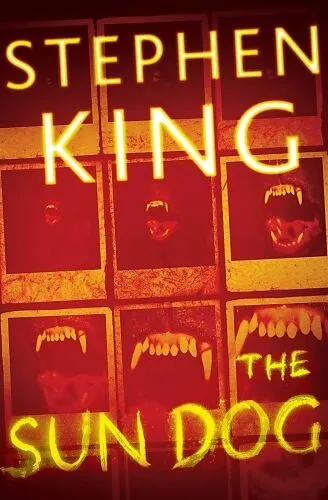
The Sun Dog
Beschreibung
Autorentext Stephen King is the author of more than sixty books, all of them worldwide bestsellers. His recent work includes Never Flinch, the short story collection You Like It Darker (a New York Times Book Review top ten horror book of 2024), Holly (a New Yo...Format auswählen
- Kartonierter EinbandCHF 19.20

Wird oft zusammen gekauft
Andere Kunden kauften auch
Beschreibung
Autorentext
Stephen King is the author of more than sixty books, all of them worldwide bestsellers. His recent work includes Never Flinch, the short story collection You Like It Darker (a New York Times Book Review top ten horror book of 2024), Holly (a New York Times Notable Book of 2023), Fairy Tale, Billy Summers, If It Bleeds, The Institute, Elevation, The Outsider, Sleeping Beauties (cowritten with his son Owen King), and the Bill Hodges trilogy: End of Watch, Finders Keepers, and Mr. Mercedes (an Edgar Award winner for Best Novel and a television series streaming on Peacock). His novel 11/22/63 was named a top ten book of 2011 by The New York Times Book Review and won the Los Angeles Times Book Prize for Mystery/Thriller. His epic works The Dark Tower, It, Pet Sematary, Doctor Sleep, and Firestarter are the basis for major motion pictures, with It now the highest-grossing horror film of all time. He is the recipient of the 2020 Audio Publishers Association Lifetime Achievement Award, the 2018 PEN America Literary Service Award, the 2014 National Medal of Arts, and the 2003 National Book Foundation Medal for Distinguished Contribution to American Letters. He lives in Bangor, Maine, with his wife, novelist Tabitha King.
Klappentext
#1 New York Times bestselling author Stephen King's terrifying novella "The Sun Dog," published in his 1990 collection Four Past Midnight, now available as a standalone edition featuring a stunning vintage cover design!
Kevin Delevan wants only one thing for his fifteenth birthday: a Polaroid Sun 660.
There’s something wrong with his gift, though. No matter where Kevin aims the camera, it produces a photograph of an enormous, vicious dog. In each successive picture, the menacing creature draws nearer to the flat surface of the Polaroid film as if it intends to break through.
When old Pop Merrill, Castle Rock’s sharpest trader, gets wind of this phenomenon, he devises a way to profit from it. But the Sun Dog, a beast that shouldn’t exist at all, turns out to be a very dangerous investment.
Zusammenfassung
#1 New York Times bestselling author Stephen King’s novella The Sun Dog, published in his award-winning 1990 story collection Four Past Midnight, now available for the first time as a standalone publication.
The dog is loose again. It is not sleeping. It is not lazy. It’s coming for you.
Kevin Delavan wants only one thing for his fifteenth birthday: a Polaroid Sun 660. There’s something wrong with his gift, though. No matter where Kevin Delevan aims the camera, it produces a photograph of an enormous, vicious dog. In each successive picture, the menacing creature draws nearer to the flat surface of the Polaroid film as if it intends to break through. When old Pop Merrill, the town’s sharpest trader, gets wind of this phenomenon, he envisions a way to profit from it. But the Sun Dog, a beast that shouldn’t exist at all, turns out to be a very dangerous investment.
Leseprobe
The Sun Dog
CHAPTER ONE
September 15th was Kevin’s birthday, and he got exactly what he wanted: a Sun.
The Kevin in question was Kevin Delevan, the birthday was his fifteenth, and the Sun was a Sun 660, a Polaroid camera which does everything for the novice photographer except make bologna sandwiches.
There were other gifts, of course; his sister, Meg, gave him a pair of mittens she had knitted herself, there was ten dollars from his grandmother in Des Moines, and his Aunt Hilda sent—as she always did—a string tie with a horrible clasp. She had sent the first of these when Kevin was three, which meant he already had twelve unused string ties with horrible clasps in a drawer of his bureau, to which this would be added—lucky thirteen. He had never worn any of them but was not allowed to throw them away. Aunt Hilda lived in Portland. She had never come to one of Kevin’s or Meg’s birthday parties, but she might decide to do just that one of these years. God knew she could; Portland was only fifty miles south of Castle Rock. And suppose she did come . . . and asked to see Kevin in one of his other ties (or Meg in one of her other scarves, for that matter)? With some relatives, an excuse might do. Aunt Hilda, however, was different. Aunt Hilda presented a certain golden possibility at a point where two essential facts about her crossed: she was Rich, and she was Old.
Someday, Kevin’s Mom was convinced, she might DO SOMETHING for Kevin and Meg. It was understood that the SOMETHING would probably come after Aunt Hilda finally kicked it, in the form of a clause in her will. In the meantime, it was thought wise to keep the horrible string ties and the equally horrible scarves. So this thirteenth string tie (on the clasp of which was a bird Kevin thought was a woodpecker) would join the others, and Kevin would write Aunt Hilda a thank-you note, not because his mother would insist on it and not because he thought or even cared that Aunt Hilda might DO SOMETHING for him and his kid sister someday, but because he was a generally thoughtful boy with good habits and no real vices.
He thanked his family for all his gifts (his mother and father had, of course, supplied a number of lesser ones, although the Polaroid was clearly the centerpiece, and they were delighted with his delight), not forgetting to give Meg a kiss (she giggled and pretended to rub it off but her own delight was equally clear) and to tell her he was sure the mittens would come in handy on the ski team this winter—but most of his attention was reserved for the Polaroid box, and the extra film packs which had come with it.
He was a good sport about the birthday cake and the ice cream, although it was clear he was itching to get at the camera and try it out. And as soon as he decently could, he did.
That was when the trouble started.
He read the instruction booklet as thoroughly as his eagerness to begin would allow, then loaded the camera while the family watched with anticipation and unacknowledged dread (for some reason, the gifts which seem the most wanted are the ones which so often don’t work). There was a little collective sigh—more puff than gust—when the camera obediently spat out the cardboard square on top of the film packet, just as the instruction booklet had promised it would.
There were two small dots, one red and one green, separated by a zig-zag lightning-bolt on the housing of the camera. When Kevin loaded the camera, the red light came on. It stayed on for a couple of seconds. The family watched in silent fascination as the Sun 660 sniffed for light. Then the red light went out and the green light began to blink rapidly.
“It’s ready,” Kevin said, in the same straining-to-be-off-hand-but-not-quite-making-it tone with which Neil Armstrong had reported his first step upon the surface of Luna. “Why don’t all you guys stand together?”
“I hate having my picture taken!” Meg cried, covering her face with the theatrical anxiety and pleasure which only sub-teenage girls and really bad actresses can manage.
“Come on, Meg,” Mr. Delevan said.
“Don’t be a goose, Meg,” Mrs. Delevan said.
Meg dropped her hands (and her objections), and the three of them stood at the end of the table with the diminished birthday cake in the foreground.
Kevin looked through the viewfinder. “Squeeze a little closer to Meg, Mom,” he said, motioning with his left hand. “You too, Dad.” This time he motioned with his right.
“You’re squishing me!” Meg said to her parents.
Kevin put his finger on the button which would fire the camera, then rememb…