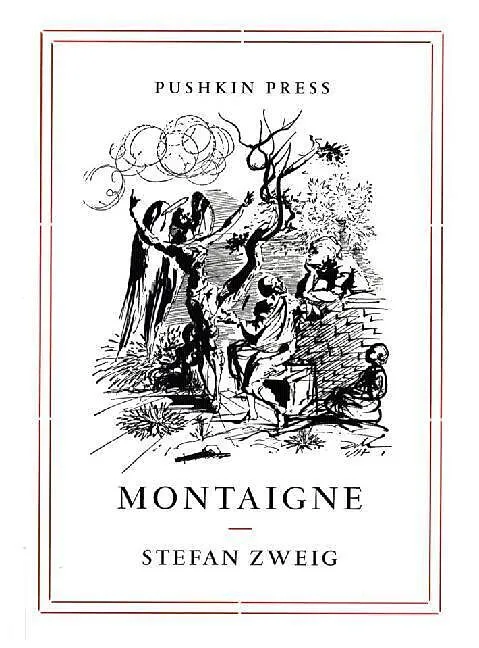
Montaigne
Beschreibung
'He who thinks freely for himself, honours all freedom on earth.'Stefan Zweig was already an emigre-driven from a Europe torn apart by brutality and totalitarianism-when he found, in a damp cellar, a copy of Michel de Montaigne's Essais. Montaigne would become...Format auswählen
- TaschenbuchCHF 19.20
Wird oft zusammen gekauft
Andere Kunden kauften auch
Beschreibung
'He who thinks freely for himself, honours all freedom on earth.'Stefan Zweig was already an emigre-driven from a Europe torn apart by brutality and totalitarianism-when he found, in a damp cellar, a copy of Michel de Montaigne's Essais. Montaigne would become Zweig's last great occupation, helping him make sense of his own life and his obsessions-with personal freedom, with the sanctity of the individual. Through his writings on suicide, he would also, finally, lead Zweig to his death.With the intense psychological acuity and elegant prose so characteristic of Zweig's fiction, this account of Montaigne's life asks how we ought to think, and how to live. It is an intense and wonderful insight into both subject and biographer.
"Thanks to Stone's assiduous translation, Zweig's fascinating meditation on the writer in whom he saw himself mirrored appears now for the first time in English. Zweig weaves biographical elements into his study—Montaigne's study of Latin at age four, his retirement from his public duties as a French nobleman at age 38—but the book is more properly an introduction to an endlessly inquisitive thinker who never stopped searching for the truth... This captivating study portrays a writer whose life and work can be summed up by his constant posing of the question, 'How should I live?'" — Publishers Weekly
'Zweig's accumulated historical and cultural studies remain a body of achievement almost too impressive to take in' - Clive James
'[Pushkin Press's republication of Stefan Zweig's work] has been entirely successful. Zweigmania seems to break out with the publication of each book, with readers discovering his work by word-of-mouth and by accident' - Guardian
'[Zweig's] life and work tell of the perilous flimsiness of our world of security-a message that many insistently deny, but somehow need to hear' - John Gray, New Statesman
Vorwort
Zweig's highly personal last work, written during the Second World War-a biography of his hero, Michel de Montaigne, and a passionate argument for humanity in times of barbarity
Autorentext
Stefan Zweig was born in 1881 in Vienna, into a wealthy Austrian-Jewish family. He studied in Berlin and Vienna and was first known as a poet and translator, then as a biographer. Between the wars, Zweig was an international bestseller with a string of hugely popular novellas including Letter from an Unknown Woman, Amok and Fear. In 1934, with the rise of Nazism, he left Austria, and lived in London, Bath and New York-a period during which he produced his most celebrated works: his only novel, Beware of Pity, **and his memoir, The World of Yesterday. He eventually settled in Brazil, where in 1942 he and his wife were found dead in an apparent double suicide. Much of his work is available from Pushkin Press.
Will Stone, born 1966, is a poet, essayist and literary translator. His first poetry collection Glaciation (Salt, 2007), won the international Glen Dimplex Award for poetry in 2008. Shearsman Books has re-published his subsequent critically appraised collections. Will's poetry translations include To the Silenced - Selected Poems of Georg Trakl (Arc, 2005) Emile Verhaeren Poems (Arc, 2013), Georges Rodenbach Poems (Arc, 2017) and Friedrich Hölderlin's Life Poetry and Madness by Wilhelm Waiblinger (2018). Pushkin Press published his translation of Montaigne by Stefan Zweig in 2015, Messages from a Lost World - Europe on the Brink by Stefan Zweig in 2016 and The Art of the City - Rome, Florence, Venice by Georg Simmel in September 2018. Encounters and Destinies - A Farewell to Europe by Stefan Zweig and Surrender to Night - Collected Poems of Georg Trakl will be published in 2019. Will has contributed poems, translations, essays and reviews to a range of publications including The London Magazine, The Times Literary Supplement, The Spectator, Apollo Magazine, the RA Magazine, The White Review, Poetry Review and Agenda.
Klappentext
A brilliant and impassioned biography of one of the founding fathers of humanism, from one of its greatest defenders in the 20th century Written during the Second World War, Zweig's typically passionate and readable biography of Michel de Montaigne, is also a heartfelt argument for the importance of intellectual freedom, tolerance and humanism. Zweig draws strong parallels between Montaigne's age, when Europe was torn in two by conflict between Catholicism and Protestantism, and his own, in which the twin fanaticisms of Fascism and Communism were on the verge of destroying the pan-continental liberal culture he was born into, and loved dearly. Just as Montaigne sought to remain aloof from the factionalism of his day, so Zweig tried to the last to defend his freedom of thought, and argue for peace and compromise. One of the final works Zweig wrote before his suicide, this is both a brilliantly impassioned portrait of a great mind, and a moving plea for tolerance in a world ruled by cruelty.
Zusammenfassung
Zweig's highly personal biography of his hero, Michel de Montaigne and a passionate argument for humanity in times of barbarity.