Haben Sie noch nichts passendes gefunden? Stöbern Sie durch unser komplettes Sortiment.
Oder melden Sie sich an bzw. registrieren Sie sich.


Beschreibung
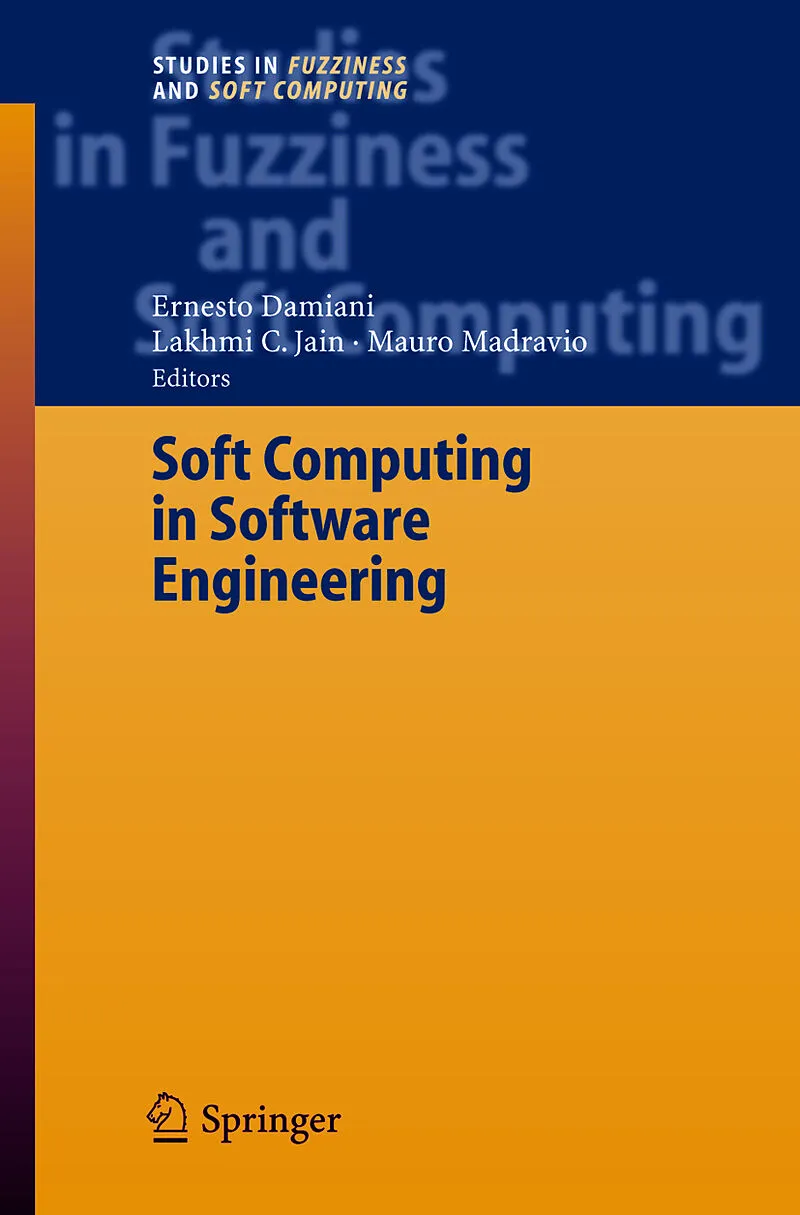
Soft computing is playing an increasing role in the study of complex systems in science and engineering. There is a large spectrum of successful applications of soft computing in very different applications domains such as aerospace, communication, consumer ap...Soft computing is playing an increasing role in the study of complex systems in science and engineering. There is a large spectrum of successful applications of soft computing in very different applications domains such as aerospace, communication, consumer appliances, electric power systems, process engineering, transportation, and manufacturing automation and robotics. It has taken a while to bring the early ideas of soft computing to an area and a discipline that seems to be more than appropriate for that. Here it is! This book studies SOFT computing in SOFTware engineering environment. The book is HARD in terms of its results. It covers a range of core topics from software engineering that are soft from its very nature: selection of components, software design, software reuse, software cost estimation and software processes. Soft computing differs from conventional (hard) computing in its ability to be tolerant of imprecision, uncertainty, partial truth, and approximation. The guiding principle of soft computing is: Exploit the tolerance for imprecision, uncertainty, partial truth, and approximation to achieve tractability, robustness and low solution cost. The role model for soft computing is the human mind. This seems to be a natural fit with software engineering, a human-based development activity based on sound engineering principles. A recent survey by researchers reveals that "Software Engineering research tends to be quite self-contained, not relying on other disciplines for its thinking".
Covering the state of the art of soft computing in software engineering Includes supplementary material: sn.pub/extras
Autorentext
Marco Anisetti is Full Professor in the Department of Computer Science at the Università degli Studi di Milano. His research interests are in the area of Computational Intelligence and its application to the design and evaluation of complex systems and services. Specifically, he has been investigating innovative solutions for security assurance and software/service certification for modern Edge and AI-assisted systems. In this area, he defined new schemes for continuous and incremental Cloud/Web service security certification based on the distributed assurance evaluation architecture that had percolated in his Moon Cloud spin-off. He is the winner of the 2010 GIRPR award for the best Ph.D. thesis and the 2009 Chester Sall Award from the IEEE Consumer Electronics Society. He is an editorial board member of IEEE Transactions on Cloud Computing, IEEE Transactions on Services Computing, and Future Generation Computer Systems (FGCS) at Elsevier. He has been a program committee member for several international conferences and workshops in the area of distributed systems, service-based architectures, and security. He contributed to a number of EU projects including FP7 ASSET4SOA and FP7 CUMULUS focused on certification of services and H2020 CONCORDIA investigating security assurance for modern systems.Claudio Agostino Ardagna is a Full Professor in the Department of Computer Science at the Università degli Studi di Milano, Italy, the Director of the CINI National Lab on Data Science, and co-founder of Moon Cloud srl. His research interests are in the areas of distributed systems security and assurance, cloud-edge and AI/ML certification, and data science. He is the winner of the ERCIM (European Research Consortium for Informatics and Mathematics) WG STM 2009 Award for the Best Ph.D. Thesis on Security and Trust Management. He has been an invited professor at the Université Jean Moulin Lyon 3 and a visiting researcher at Beijing University of Posts and Telecommunications, Khalifa University, and George Mason University. He is a member of the Steering Committee for IEEE Transactions on Cloud Computing, member of the editorial board of the IEEE Transactions on Cloud Computing and IEEE Transactions on Services Computing, and secretary of the IEEE Technical Committee on Services Computing. He has been Program Chair of several international conferences and workshops in the area of distributed systems and security and privacy. He co-authored with Professors Ernesto Damiani and Nabil El Ioini the book Open Source Systems Security Certification, published by Springer.Ernesto Damiani serves as the acting Dean of Computing and Mathematical Sciences and Director of the Center for Cyber Physical Systems (C2PS) at Khalifa University in the UAE. He is a full professor in the Department of Computer Science at the Università degli Studi di Milano, Italy, where he leads the SESAR research lab. His research interests include secure service-oriented architectures (SOA), certifiable robust Artificial intelligence and Data Analytics models, and cyber-physical systems security. Dr. Damiani has served as the Editor-in-Chief of the IEEE Transactions on Service-oriented Computing and as an Associate Editor of the IEEE Transactions on Fuzzy Systems. He is a senior member of the IEEE and served as Vice-Chair of the IEEE Technical Committee on Industrial Informatics. In 2008, Dr. Damiani was nominated as an ACM Distinguished Scientist and received the Chester Sall Award from the IEEE Industrial Electronics Society. Later, he received a doctorate honoris causa from Institut National des Sciences Appliquées (INSA) of Lyon, France, for his contributions to Big Data analysis platforms and architectures. In 2022, Ernesto was awarded the rank of Officer of the Order of the Star of Italy for his contributions to international scientific collaboration in AI. Nabil El Ioini is an Associate Professor within the School of Computer Scienc
Klappentext
This book illustrates the impact of soft computing techniques on software engineering research and practices dealing with a range of novel methods reshaping the software development process. Specifically, it is shown how Software Engineering tasks such as reuse-oriented classification (e.g. components' repositories), software diagnostic (e.g. bug detection and correction), effort prediction (e.g. project costs and time estimation), planning (e.g. project scheduling) and others can be appropriately handled by means of soft computing techniques. The book is a valuable reference for practitioners as well as an updated resource of ongoing interdisciplinary research in Soft Computing in Software Engineering.
Inhalt
1 Fuzzy Selection of Software Components and of Web services.- 2 A Training Approach to Develop Reusable Software Components by Combining Adaptation Algorithms.- 3 Fuzzy Case-Based Reasoning Models for Software Cost Estimation.- 4 Automating Software Development Process Using Fuzzy Logic.- 5 Many Maybes Mean (Mostly) the Same Thing.- 6 Soft Computing Based Effort Prediction Systems A Survey.- 7 High-Level Design of Composite Systems.- 8 RHSP: an Information Representation Model Based on Relationship.- 9 Neurofuzzy Analysis of Software Quality Data.- 10 Linguistic Resources and Fuzzy Algebra in Adaptive Hypermedia Systems.
Tief- preis
Tief- preis